

By downloading this file, you can listen to this newsletter on the go, or as an alternative to your screen reader. And it’s in my voice! 😊
Good day my good friend.
Similar to last week, events have overtaken me slightly. The post that I have been desperate to write for about 3 months now will be delayed again, as another itch needs to be scratched rather urgently.
Also, a public service announcement. This will be my last post for a few weeks, as I take some time off during the Easter holiday. Normal service will resume at the end of April.
📕 I have co-authored a book on Mobility-as-a-Service, which is a comprehensive guide on this important new transport service. It is available from the Institution of Engineering and Technology and now Amazon.
💼 I am also available for freelance transport planning consultancy, through my own company Mobility Lab. You can check out what I do here.
🔀 Against Everythingism
After many months of trying to get through my reading backlog, I discovered the amazing Speech Central app. An app that takes a report or article, converts into extremely robotic speech, and reads it to you. My reading backlog has been very much reduced as the app has chirped away while I have planted some pansies and put a rockery into the garden. One of those articles is an excellent article by Joe Hill on Policy Memes in 2025.
As is so often the case with anything with a hint of humour, there is truth to it. Especially when it came to Everythingism. To summarise this quickly, this is when – at the insistence of policy makers or systems thinkers – government programmes need to have integrated within them numerous policy goals as well as the original policy goal. Namely, it tries to achieve everything and show its value in doing so.
We experience this often in transport. The most notable example is the economy. For the economy, the economic benefits of schemes have to be meaningfully assessed, primarily through TAG. There is a long established field of practice surrounding understanding the economic impacts of transport policies and interventions, with an ever-increasing arsenal of economic values ranging from how much a road crash costs to the social value of projects.
In the last fifteen years, the number of frameworks devised as a means for transport to achieve wider goals has expanded and expanded. A good example is the Healthy Streets framework that underpins the Mayor’s Transport Strategy for London. Others include missions, which are especially popular currently in the UK, as well as outcomes frameworks which link programmes and policies to wider objectives.
Its time that we stopped all of this.
Stop with the frameworks. Stop with encouraging everyone to be systems thinkers, or focus on shared outcomes, or devising new ways to identify linkages between transport policy outcomes and achieving shared measures of wellbeing. Stop it. Now.
This is not to say that these outcomes are not important, nor that policy makers should not think about them. Or even look at ways by which they can be achieved. But they are a perfect example of what I refer to as “strategy language.” This language focuses on higher-level aims and objectives. It is the language of thinkers who establish theoretical links between policy outcomes in different areas, often in partnership with those who speak a similar language in those sectors. And, might I say, often based on tenuous causation links.
This is useful language in terms of setting transport goals in context. And it is important to do. We need to understand things like how achieving transport goals on carbon emissions will help to reduce the overall carbon footprint of the UK, as well as further second order benefits for which there is a strong causation link. If we reduce car use, for example, not only would it reduce carbon emissions, but it likely will result in a more active population over the course of their lives, reduce air pollution in urban areas, and have an economic benefit through reductions in congestion.
But what we often forget is that in order to achieve this, we need to actually deliver things on the ground. And “delivery language” is an entirely different thing. Transport planning is an industry born from civil engineering, an industry of doers. Speaking as a doer, one thing they understand above all else is this. Tell us something that needs to be done, with some specific outcomes, and we will do it, and do it well.
One of the under-appreciated arts is acting as a translator between these two languages. If you show a doer a logic map, chances are they will understand it. But they will understand it in the same way that someone who can read English at a basic level can understand War and Peace. They will get it, but its not a natural thing. They need translators to help them.
Simply adding more things for deliverers to think about usually does not help. If you say to people that their strategy should consider this area of policy making as well as their own objectives, at best you are confusing matters, and at worst you are providing a distraction. Acknowledging that these links between policy outcomes exists absolutely must happen, and understanding impact on other areas is important. But it must not be at the heart of what transport policy should actually do.
Transport policy should achieve transport outcomes foremost, and ideally in areas which also have a knock on benefit in other policy areas.
The way that I think of this is that its like ten pin bowling. The goal is to get a strike, and the bowler is only focussed on a single action: bowling. The person who has a strategy mindset will take the bowler to one side, and explain how hitting a certain pin in a certain location will result in that pin hitting this other in this way, which in turn will hit another in this way, and complexity theory indicates that in all probability there will be a strike. By the time the explanation ends, the bowler has forgotten what pin they are supposed to hit.
A doer will say “hit that pin there.” Easy, to the point, but doesn’t result in any degree of understanding of the consequences of the actions of the bowler.
Someone who translates will say “hit between the front and front right pin, that will cause a chain reaction which stands a good chance of knocking over all the pins.”
An over-abundance of strategy can lead to confused delivery. It leads to people who are best tasked with doing things to think about things that are not important, even if they are able and willing to understand the wider impact of what they do.
Transport planning does not need more strategy, or strategic thinking. It needs more doing. For that, we should stop thinking about how we can achieve everything, everywhere, all at once, and focus on the transport outcomes that matter. That will mean that instead of talking a big game, we might stand a chance of delivering a big game.
👩🎓 From academia
The clever clogs at our universities have published the following excellent research. Where you are unable to access the research, email the author – they may give you a copy of the research paper for free.
TL:DR – Yes. And it turns out that those people who work from home also order the weekly shop online more, order in more, and eat out less.
Noise impacts and social justice analysis of off-peak deliveries in the Greater Toronto Area
TL:DR – Daytime delivers cause more problems with noise pollution than off-peak deliveries.
TL:DR – A model is developed to identify the optimal charging strategy for a bus fleet in Windsor, Canada. Turns out you need a mix of strategies to charge optimally.
Railway diplomacy: China’s infrastructure investments and Africa’s global connectivity
TL:DR – This paper analyses the impacts of China’s Belt and Road initiative.
😊 Positive News
As we are about to head into the third “once in a lifetime” economic event in twenty years, I think we need this.
Some good news on the carbon emission side. UK carbon emissions in 2023 fell to their lowest level since 1879. This was mainly down to luck, as gas demand collapsed. But right now we’ll take whatever luck we can get. Transport emissions are lower than they were in 2005, but only just.
While Camden High Street will start its trial pedestrianisation with a big party, the idea is also expanding to elsewhere in London. With Deptford High Street also looking at becoming pedestrianised.
There is also going to be more trains between London and the North. As Lumo have confirmed that they will have more services towards Scotland and Manchester. While also looking to introduce new services to Carmarthen. All pending regulatory approval.
🖼 Graphic Design
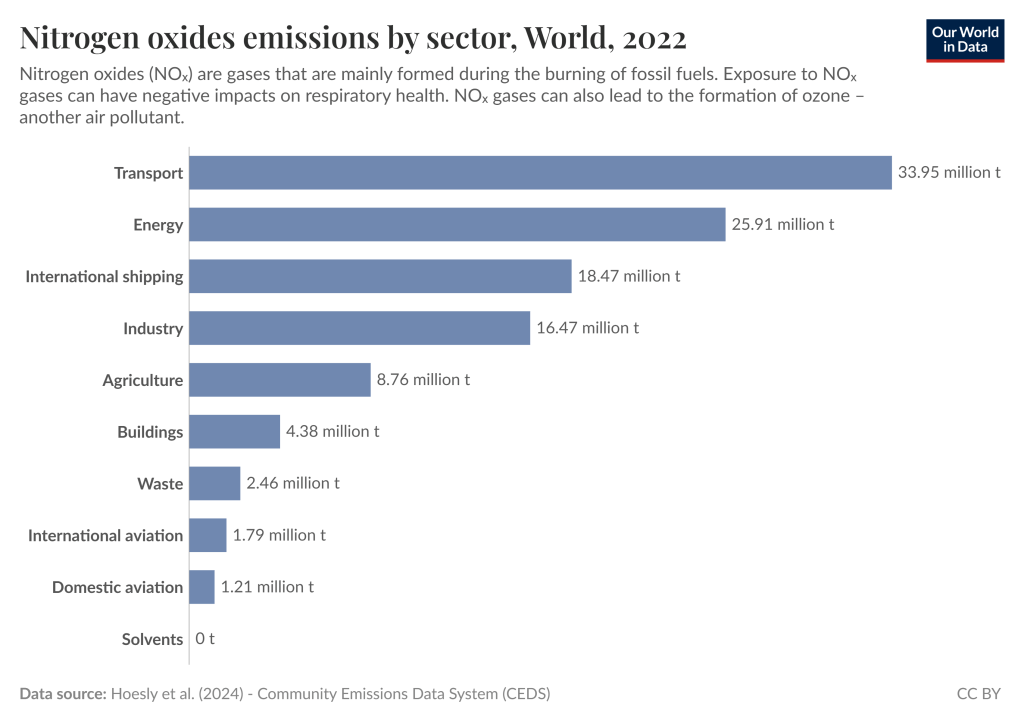
Nitrogen oxides emissions by sector, 2022 (Source: Our World In Data)
I will just leave the explainer of why tackling NOx emissions from transport is important to Our World In Data:
NOₓ has a particularly large impact on human health because it acts through all three mechanisms we looked at earlier. It can be acutely toxic, inflaming the lungs. It reacts with other gases to form particulate matter, and it also forms ozone. NOₓ, therefore, causes smog and the thick haze you often see in highly polluted cities…we don’t have exact estimates for how many deaths it contributes to. But, given that it’s a main source of ozone (which kills around half a million) and a substantial fraction of particulate matter (which kills several million), it’s reasonable to expect that NOₓ is linked to over a million deaths yearly.
📺 On the (You)Tube
In what is fast becoming my favourite YouTube channel, the guys on All the Gear try something that is, quite honestly, mad. They try and travel from Brighton to Eastbourne on vehicles costing less than $10. I am amazed they got through the part where they use their “vehicles” to traverse the Seven Sisters, at night, in near-zero visibility.
📚 Random things
These links are meant to make you think about the things that affect our world in transport, and not just think about transport itself. I hope that you enjoy them.
- What Donald Trump’s dramatic US trade war means for global climate action (The Conversation)
- Reining in Our Tech God-Emperors (Democracy)
- ‘Neighbours are more trusted than government’: When crisis hits, communities are saving themselves (Big Issue)
- The Value of Climate Prediction Markets (Interactive Brokers)
- The problem of organizing weak states; and why Africa needs a new model of Pan-Africanism (An Africanist Perspective)
📰 The bottom of the news
A Pennsylvania suburb got some squiggly lines on the road to improve road safety. Now the the residents want them removed. That barely does the story justice. Just read it.



 Mobility Matters
One response to “⏩ Everything, Everywhere, All At Once”
My dear James,
Aah, a pleasure to read this, as is so often the case when a Mobility Matters pensif lands in my inbox. Bring on The Rest is Mobility Podcast, I say, sell it to Gary Lineker and make your fortune.
Regards, Nic
Associate Director
DEFT153
LikeLike