
By downloading this file, you can listen to this newsletter on the go, or as an alternative to your screen reader. And it’s in my voice! 😊
Good day my good friend.
This week, I had planned to share with you my thoughts on the Integrated National Transport Strategy. But as the end of the call for ideas has been delayed until 20th February, I am instead talking about some research I have spent just over a year working on.
Without further ado…
📕 I have co-authored a book on Mobility-as-a-Service, which is a comprehensive guide on this important new transport service. It is available from the Institution of Engineering and Technology and now Amazon.
💼 I am also available for freelance transport planning consultancy, through my own company Mobility Lab. You can check out what I do here.
Bloomin’ Councillors
This is a little sneak peak at some findings from some research I have done to understand council decision making. The full report will be released soon.
Ask most transport professionals and campaigners what the main barrier to delivering sustainable transport is, you can be very certain what the most common answer will be: politicians. They lack the political will to make the tough choices necessary to create a sustainable future. Or the knowledge. Or they simply don’t care.
Whatever the reason is, most politicians who make decisions on transport schemes usually make the wrong ones, or make the right ones with conditions that effectively make the right choice meaningless. Notable examples being allowing cycle tracks to be interrupted by parking bays, or ensuring that bus priority schemes do not delay traffic.
If only politicians would make the right decisions. Or if only the electorate would elect the politicians WE want who are more likely to make the right decision. Simple, right?
In research I have undertaken, funded by the Foundation for Integrated Transport, I found this take to be somewhat simplistic. The research question was simple in its premise: what influences decision makers? I sought to find this out by literally asking them, and looking at the research into just this.
In some respects, what influences decision makers is remarkably simple, but it plays out in all kinds of strange ways. If you are a Cabinet Member for highways and transport, there are three things that influence your decision above all others:
- The public acceptability of the decision being made;
- The views of fellow members in their Cabinet, and;
- The advice of officers.
Each of these play out in ways that are often not visible to us professionals, but are important to understand.
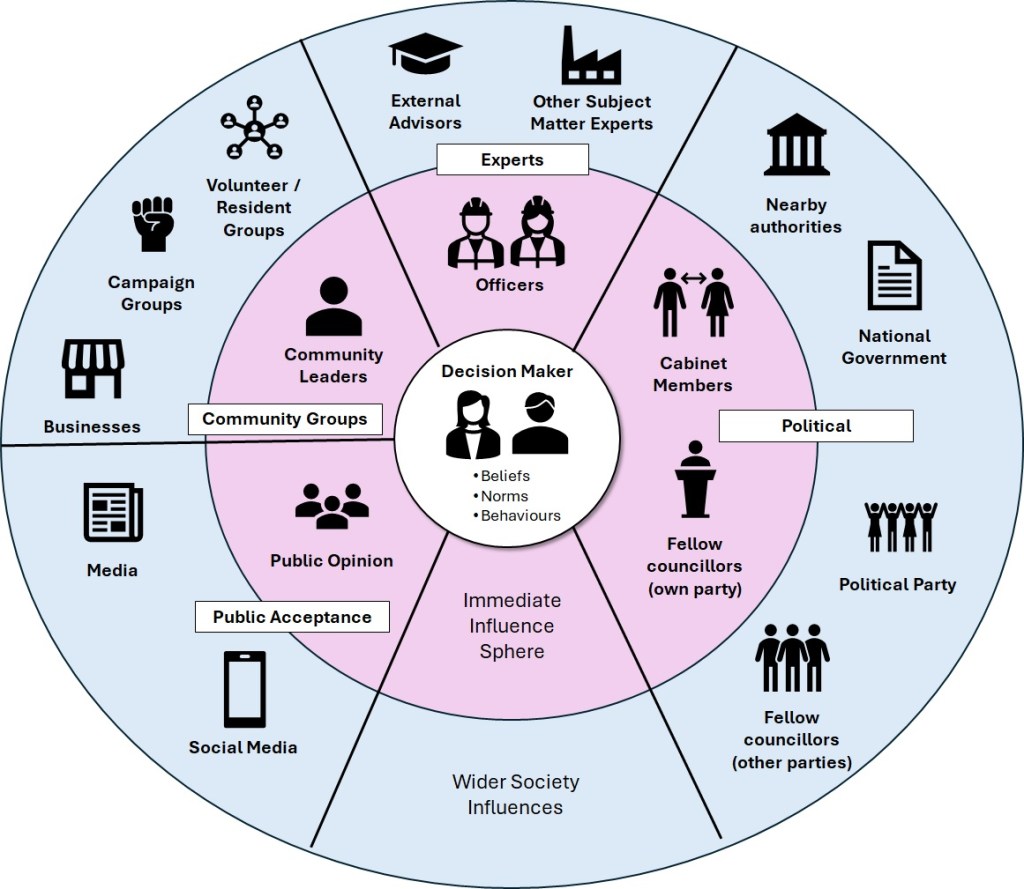
What influences the decisions of decision makers in local councils
For public acceptability, at times when people care most about an issue, they are more likely to cast their vote with that in mind. This is known as issue salience. For example, if you are thinking about Low Traffic Neighbourhoods as you are walking to the polling station, you are more likely to cast your vote based on what you think of them.
There are other factors that help translate a political issue into action at the polling station. Namely are the benefits of an initiative more widely distributed, and have problems been tackled when they have arisen.
A challenge for councillors is understanding these changes in salience and how they will play out over time. There is a wider context here, namely that social media, traditional media, and community leaders can help shape what is salient. One that is hard to draw conclusions from.
Such matters are often at the core of discussions between cabinet members. A strong feeling that came through from interviews held with councillors was that where there is a strong feeling of collective ownership of controversial decisions within the Cabinet, then such decisions become much more palatable.
In such instances, the constant question being asked is how such initiatives are achieving their goals for the Council – whether practical or political. Public acceptability comes into it, but what is more critical is how what is proposed achieves a vision, and people agree on the interpretation of that vision.
There are two necessary pre-conditions for this to happen. The first is that the Cabinet has sufficient time to discuss the issue at hand. A major, controversial decision suddenly foisted upon them will put them on the defensive. But if there is extensive discussion beforehand, and an understanding built over time as to how schemes can achieve a goal, this can be mitigated. Its not enough to insist that a cycling scheme will clearly achieve a climate goal of the Council. It needs to be commonly understood and accepted that this is the case, and that the controversy over any such scheme is a price worth paying.
The second necessary pre-condition is a positive and constructive relationship with officers. In the words of one councillor I interviewed, councillors cannot do anything without them. The relationship with officers is them advising on the practicality and legality of delivery, with cabinet members seeing their role as providing the strategic direction and check and challenge on the public acceptability and political aspects of schemes.
There are examples of officers who have actively worked against councillors to ‘force through’ their pet schemes. This is a case if winning the battle but losing the war. This sows distrust in a critical delivery relationship, meaning future, well-meaning schemes that are otherwise acceptable are likely to get blocked.
In a later post, I will go into what can be done to take action to maximise opportunities to deliver sustainable transport improvements. But I wanted to end this post with some reflections on how understanding this decision making context is important, and how it challenges many assumptions we have.
We often consider that getting ‘correct’ political decisions is simply a matter of electing the right politicians. There is some merit to that, as the attitude and approaches of councillors can matter a great deal. But a good councillor making good decisions can be very lonely. As critical is ensuring that they have allies in decision making positions, so that tough decisions are a collective responsibility.
We also tend to see political decision making through the prism of being a professional. I have seen countless guides explaining the technicalities of highway works to councillors, but that’s not useful – as we as professionals are paid to know that. What they need from us is some political nous, and understanding that what they need has to be useful in a political environment. In effect, we are giving them things that are useful to us, and not to them.
Finally, when we do engage politically, its often with people who we like. I’ve seen many campaigners showcase their relationships with, for example, Green Party councillors. Its great you are friends, but my experience tells me that you learn far more about what is likely to succeed from people who you disagree with. They pick holes in what you are doing in a way that a friend won’t see.
Over the course of the coming weeks, I will share more insight from this report. Hopefully, it will make you think again about the role of political decision makers in delivering sustainable transport improvements.
👩🎓 From academia
The clever clogs at our universities have published the following excellent research. Where you are unable to access the research, email the author – they may give you a copy of the research paper for free.
Public transport investments as generators of economic and social activity
TL:DR – Investing in public transport boosts both economic growth and social connections. But these benefits are not uniform, and there are sometimes unintended consequences such as gentrification.
Did the German aviation tax have a lasting effect on passenger numbers?
TL:DR – In the first two years, passenger numbers dropped by between 6% and 11%. After that, the effects of such a policy are hard to tell.
Slow traffic, fast food: The effects of time lost on food store choice
TL:DR – If you get stuck in traffic, you are more likely to go to McDonald’s than go to a grocery store. Which makes a lot of sense.
TL:DR – This paper recommends providing non-mobility incentives as part of Mobility as a Service packages.
😃 Positive News
Starting off with a non-transport news item that has transport implications, and is definitely positive. In 2024 Europe generated more electricity from solar panels than it did from coal. Which is extremely good news for the planet, and stands an outside chance of delaying true calamity enough that we might sort the rest out. Ok, that bit is somewhat hopeful.
Next is some fantastic news from the North East that I spectacularly failed to notice. The Northumberland Line between Newcastle and Ashington is now open, and provides a genuine alternative to those not wanting to fight the traffic into the centre of Newcastle. And yes, Geoff Marshall has a video on it. Of course he does.
While Alan Partridge has strong views on the pedestrianisation of Norwich City Centre, its East Anglian rival Ipswich is forging ahead with its own pedestrianisation plans. And the local papers seem positively enthused about the project.
Cars parked in cycle tracks is a bit of a pain, if I am honest with you. So the news that Derby City Council is taking this seriously is a good thing. They see to be taking the right approach, encouraging drivers to do the right first before slapping a £60 fine on their windscreen. Let’s see how it works.
I cannot really avoid the obvious thing of Elon Musk seemingly trying to emulate Henry Ford. And I’m not talking about owning a car company here. If you feel rather depressed about the state of the world – I entirely understand, and you have every right to feel that way. I found this article by Robert Evans, host of the excellent Behind the B******s Podcast, to be somewhat comforting and instructive in an extremely dark time.
🖼 Graphic Design
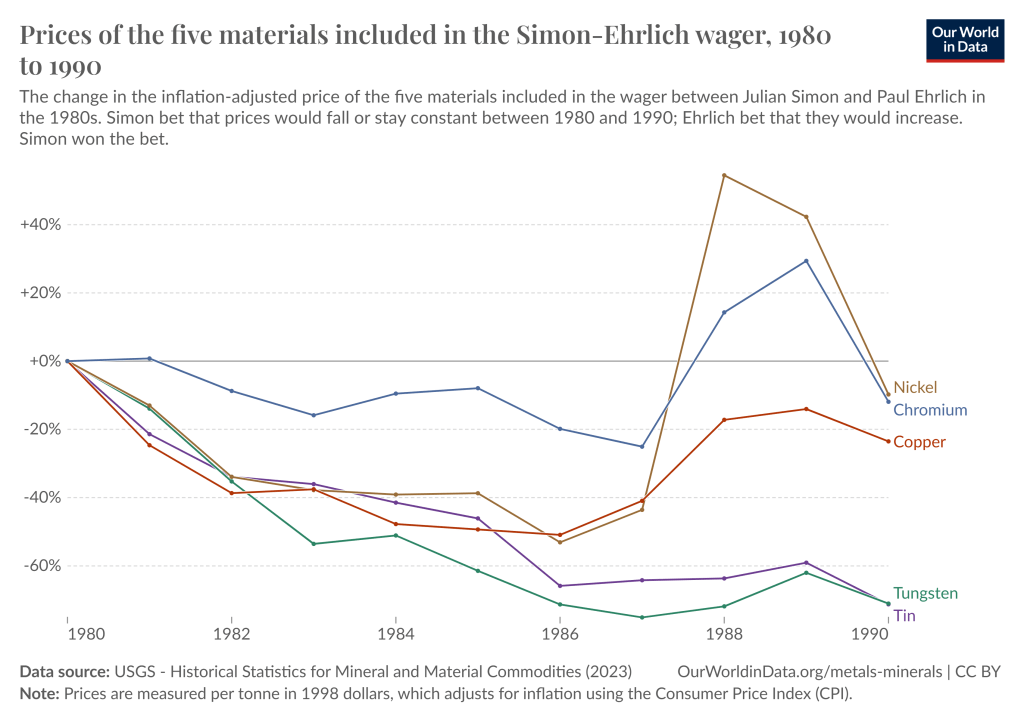
Who won the Simon-Ehlrich Wager? (Source: Our World In Data)
This doesn’t seem transport-related, but bear with me. In 1980, biologist Paul Ehlrich offered a bet. He predicted that as population growth would lead to societal collapse due to over-extraction, the price of Nickel, Chromium, Copper, Tungsten, and Tin would rapidly increase. The economist Paul Simon took him up on the bet, predicting that human innovation and ingenuity would result in a fall in prices. They would compare the prices in 1990 to see what the results were.
Taking this at face value, Simon won his bet, even if he got lucky with Nickel and Chromium. But this exercise shows two things to me. Firstly, long term bets of precision are risky things. Simon may have been right, but if the bet had finished in 1989 he would have lost on two minerals. Always question precision in such projections. Secondly, focussing on just a handful of indicators does not reflect wider movements in society. I am not sure you can say much about the vast complexity of society and economic systems from just these 5 minerals alone. So while the bet is noteworthy, and arguably fun, it may not be the best indicator of changes.
📺 On the (You)Tube
I’ve always thought of the Dutch as fighting a one-country war against the North Sea. So much so that over the years they have exported their expertise to fellow North Sea countries to do the same. But this excellent video by Practical Engineering called ‘Why are the Dutch so famous for waterworks?’ really goes into why they are so good at engineering. In short, its because they have to be.
📚 Random things
These links are meant to make you think about the things that affect our world in transport, and not just think about transport itself. I hope that you enjoy them.
- Earth’s magnetic north pole is on the move, and scientists just updated its position (CNN)
- After Forced Return-to-Office, Some Amazon Workers Find Not Enough Desks, No Parking (New York Post)
- Progressively Losing (Naked Capitalism)
- Fatbergs turned into perfume – inside Britain’s bizarre new industrial revolution (BBC)
- An oral history of Twin Peaks by its unforgettable stars: ‘I put my waitress uniform on and began bawling’ (The Guardian)
📰 The Bottom of the News
Potholes are a frustration across the UK. So it’s only natural that us Brits would add a dash of humour to the whole issue. So congratulations to the villagers of Pontfadog in Wales for coming up with the idea of renaming themselves Pothole Land.
🔚 And finally…
The Board of the Transport Planning Society in the UK is asking for people to become part of the Board. So if you are the kind of transport planner who actually wants to get things done, you should go to their website and find out more. The deadline for nominations is 5pm Thursday 30th January.
 Mobility Matters
One response to “🤝 How To Make Friends and Influence Councillors”
Hi James,
The audio is a great idea, just listening on my train back to Birmingham.
I assume you’re aware it’s a wave file, so quite a big download? 168mb…
Thanks,
John
LikeLike