

Good day my good friend.
Yet another busy week ahead. No time to dilly-dally. Really sorry for the short newsletters, but I am very much up against it. So getting anything out is a miracle, to be quite honest. Anyway, enough with the troubles in my life.
📕 I have co-authored a book on Mobility-as-a-Service, which is a comprehensive guide on this important new transport service. It is available from the Institution of Engineering and Technology and now Amazon.
💼 I am also available for freelance transport planning consultancy, through my own company Mobility Lab. You can check out what I do here.
🗻 Twin Peaks?
There has been some commentary on how things may or may not have changed since the pandemic (remember that?). Lots of talk about the long term implications of remote working, as well as shifting journey patterns over the course of a week. So, while I had a spare few minutes, I thought that I would take a look at how journey patterns have (or have not) shifted.
This will take me some time to crunch through every single possible data point and question that I want to answer. But I started with something simple – is there any indication that the highway peak hour has shifted?
To try and get an initial indication, I thought I would take a look at National Highway’s Webtris data. Focussing in the first instance on a single location – the M1 close to me. Specifically MIDAS sites M1/2710A (on the northbound carriageway) and M1/2707B (on the southbound carriageway).
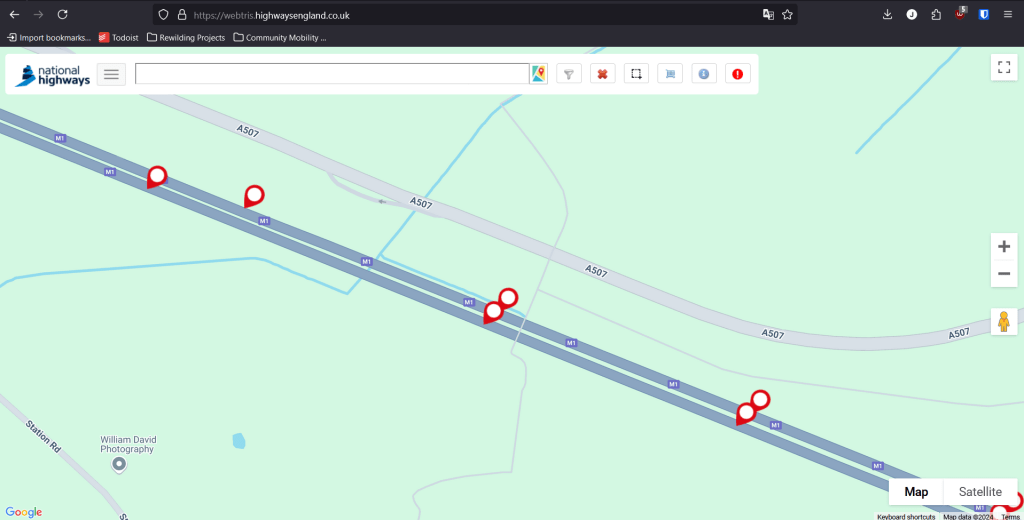
Location map from Webtris
I collected the data for October to October (12 months) for 2017/18, 2018/19 (pre-pandemic), 2022/23 and 2023/24 (post-pandemic, focussing on hourly counts over 7 days. Then simply averaged the counts for each hour from the data over the course of the year. Then visualised it.
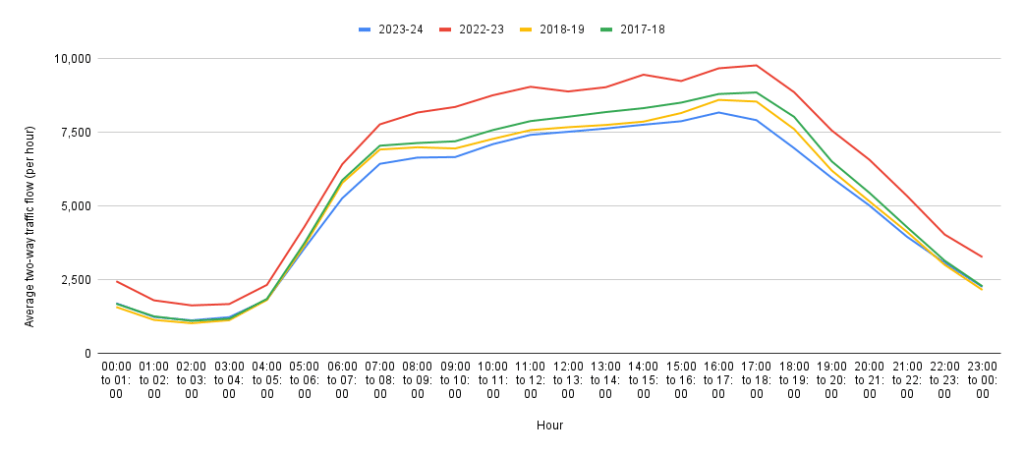
Average two-way daily traffic flows each hour on the M1 near Bedfordshire (Source of data: Webtris)
What can we tell from this? On the face of it, it seems that there has been no shift at all. The busiest time of the day is between 17:00 and 18:00, with traffic slowly building over the course of the day. As well as a notable dip in traffic in the early hours of the morning.
But otherwise, no notable shifts between pre-pandemic and post-pandemic. At least in terms of the daytime peak hours and the overall profile of the traffic flow across the day.
I have the feeling that this may be partly explained by the nature of the M1 in this location. This motorway is one of the major links between the North, Midlands, and the South East, including for onward travel to the channel ports for freight traffic. I also get the feeling that the weekend evening peak hours on Saturday and Sunday evenings might be affecting this data somewhat.
Despite this, the lack of change in the profile is notable. Over the coming months, I hope to explore this in much more detail with more sites across the network over the coming months. And hopefully with more modes of travel as well. It just goes to show that sometimes, a lack of change speaks volumes much more than things radically changing.
👩🎓 From academia
The clever clogs at our universities have published the following excellent research. Where you are unable to access the research, email the author – they may give you a copy of the research paper for free.
Evaluating low-emission-zone impacts on urban road transport system in large city
TL:DR – Good for the environment. Bad for the transport system.
TL:DR – Make it simple for those with visual impairments to cross, and they will like it.
Cyclists’ heterogeneous parking preferences and their implications for bicycle parking facilities
TL:DR – If cyclists have to walk far, they won’t use cycle parking.
China’s commuting-based metropolitan areas
TL:DR – China’s travel to work areas are small relative to the size of the country.
📺 On the (You) Tube
Well, we have had zero carbon shipping for thousands of years – its called sails. But some of these ideas could work.
🖼 Graphic Design
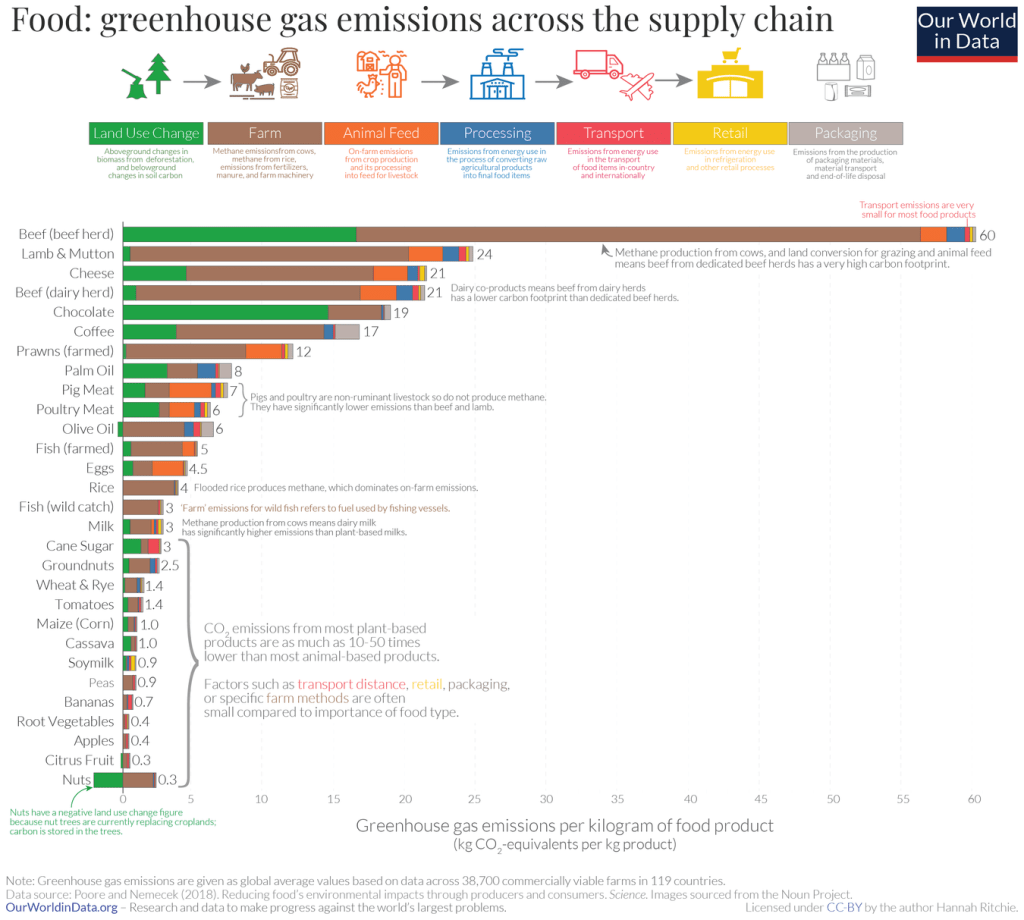
Greenhouse gas emissions across the supply chain (Source: Our World In Data)
Want to buy local food as a means of reducing your carbon emissions? Good. But most carbon emissions from food are at the farm. So the best thing you can do for carbon emissions is quit the meat.
📚 Random things
These links are meant to make you think about the things that affect our world in transport, and not just think about transport itself. I hope that you enjoy them.
- ‘Used like taxis’: Soaring private jet flights drive up climate-heating emissions (Grist)
- What History Says About Tariffs (Econlife)
- Going Back to the Source: A Personal Reflection on Capital, Volume 1 (Naked Capitalism)
- What Trump Can—and Probably Can’t—Do to Reverse U.S. Climate Policy (Scientific American)
- With Agriculture Facing a ‘Great Collision,’ More Farmers Seek to Nourish and Heal (Daily Yonder)
👍 Your feedback is essential
I want to make the newsletter better. To do this, I need your feedback. Just fill in the 3 question survey form to provide me with quick feedback, that I can put into action. Thank you so much.

 Mobility Matters