Good day my good friend.
No nonsense today or small talk, just straight in. Let’s go.
Mobility Camp is back, and the number one transport unconference is heading to York on Friday 20th September. Book your tickets now! 🎫
I have co-authored a book on Mobility-as-a-Service, which is a comprehensive guide on this important new transport service. It is available from the Institution of Engineering and Technology and now Amazon. 📕
✍ NPPF WTF
Much has been written on the proposed reforms to the National Planning Policy Framework, the ‘guiding mind’ for planning policy and decisions in England. The consultation is open until 24th September in case you wish to have your say on the changes being made. But with this document being arguably the most important non-transport policy document in the UK, I thought it worthwhile providing some kind of reflection on the key changes being made.
And here is my takeaway: its a charter for car-based development that will lock in unsustainable growth patterns. Here is why.
The key change being proposed is on paragraph 115 (paragraph 113 in the revised text). I have put in bold the key additional text in this paragraph.
Development should only be prevented or refused on highways grounds if there would be an unacceptable impact on highway safety, or the residual cumulative impacts on the road network would be severe, in all tested scenarios.
Currently, developments are tested for their highways impacts across a variety of transport scenarios. Ideally these should be the local transport plan scenarios, but these are often missing. Should the development grind the highway to a halt in even a single scenario, the highway authority can request highway improvements, sustainable transport interventions, and anything in between to mitigate the impact of the development.
That threshold just became much higher. Namely, as this is written, a development could ‘work’ in a single scenario and be deemed acceptable under the NPPF.
Elsewhere in the sustainable transport section, mention is made of a “vision-led” approach. When I read this, I cannot help but think of the words of Inigo Montoya in The Princess Bride, when he says “You keep saying that word. I do not think it means what you think it means.”
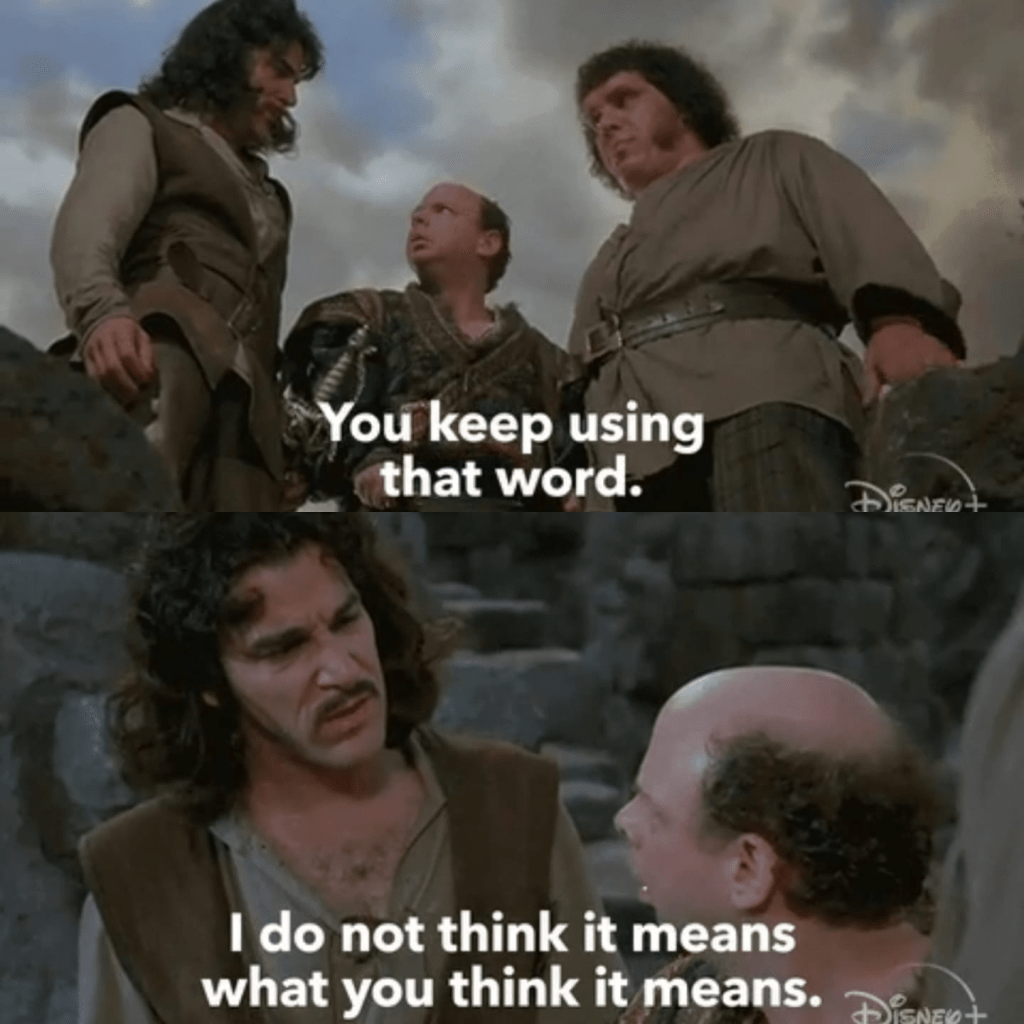
A vision-led approach in the NPPF (Source: r/s**ttymoviedetails)
Let’s be honest, it reads like a civil servant saw the words in TAG, and copied and pasted it into the NPPF twice in paragraph 112. What vision is being referred to? The Local Plan? The Local Transport Plan? The Development Brief? The developers? It means nothing without definition, and by extension just writing those words gives them no meaning. They may as well just be deleted.
The most significant change is the new idea of “grey belt land,” which is another idea without definition. A widely-understood definition is previously-developed land in the green belt, which is undermined by paragraph 144 which says (new text in bold):
When drawing up or reviewing Green Belt boundaries, the need to promote sustainable patterns of development should be taken into account. Strategic policy-making authorities should consider the consequences for sustainable development of channelling development towards urban areas inside the Green Belt boundary, towards towns and villages inset within the Green Belt or towards locations beyond the outer Green Belt boundary. Where it is necessary to release Green Belt land for development, plans should give first consideration to previously-developed land in sustainable locations, then consider grey belt land in sustainable locations which is not already previously-developed, and only then consider other sustainable Green Belt locations. They should also set out ways in which the impact of removing land from the Green Belt can be offset through compensatory improvements to the environmental quality and accessibility of remaining Green Belt land.
So, it’s not previously-developed land in green belt then? The official definition does not help that much:
Grey belt: For the purposes of plan-making and decision-making, ‘grey belt’ is defined as land in the green belt comprising Previously Developed Land and any other parcels and/or areas of Green Belt land that make a limited contribution to the five Green Belt purposes (as defined in para 140 of this Framework), but excluding those areas or assets of particular importance listed in footnote 7 of this Framework (other than land designated as Green Belt)
I mean, this is a developers charter if ever I have seen it, and it places a duty on local planning authorities to prove that land is not grey belt. This will be argued extensively at planning appeal and in court, I can see it.
What planning policy should be doing is accelerating the types of development that are deemed acceptable in policy terms, while making less sustainable development harder. You want to build houses close to a railway station with 50% affordable homes? Here is a local development order that short-cuts the planning system. You want to build thousands in the green belt next to a motorway junction with no new bus service? Sorry, that’s going to be very hard.
The changes to the NPPF do no such thing. It will likely make building in less sustainable locations much easier, as developers focus on bringing forward sites in grey belt areas, with a lower burden on transport provision being given. All in the name of building more homes.
There is no problem with building more homes being the aim of such changes. If you are at least up front about it, and do so in a way that does not create inertia in the system as definitions are argued over. This change in the planning system will likely make less desirable development more possible, and stop short of the fundamental reform the planning system needs if the right kinds of development need to be delivered and quickly.
All in all, a bit of a disappointment if I am honest. And I will let the government know accordingly as I respond. I urge you all to do the same.
👩🎓 From academia
The clever clogs at our universities have published the following excellent research. Where you are unable to access the research, email the author – they may give you a copy of the research paper for free.
TL:DR – Signs on the outside of AVs might make pedestrians and cyclists feel safer.
TL:DR – Situate dockless bike bays near metro stations.
How do multitaskers and screen addicts perceive travel elements?
TL:DR – Having your face in your phone makes the worst parts of travelling even worse.
TL:DR – People are willing to pay for better public transport, but are not as keen on paying for DRT.
✊ Awesome people doing awesome things
Baroness Tanni Grey-Thompson is a force for nature when it comes to campaigning for the rights of disabled persons to get around like the rest of us. Her experience with LNER was nothing short of appalling, and not for the first time. The Disability Discrimination Act is nearly 30 years old and we are still screwing up. The work of the Baroness is critical in ensuring that such issues see the light of day.
📺 On the (You)Tube
If you have been to any major city, you will probably have seen numerous pop-up street food outlets, serving their specialist brand of locally-sourced, hand made food with WICKED sauce served on a roof tile, or something. This Vox video goes into their rise.
🖼 Graphic Design
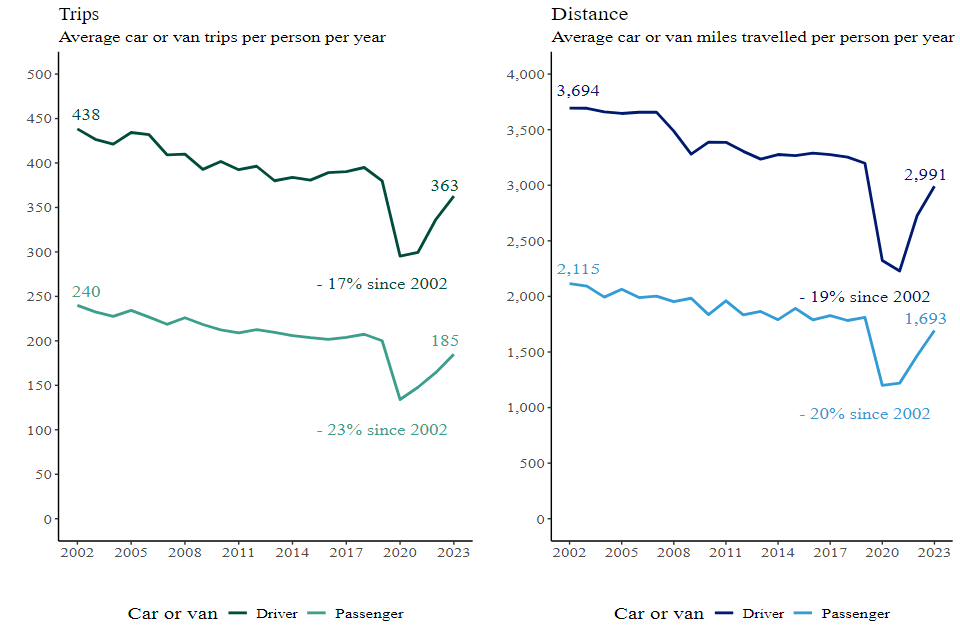
Trends in car trips and distance in the UK (Source: Department for Transport)
I will do a deeper dive into the National Travel Survey data for 2023 at some point. But I always find this stat interesting. We are driving less compared to 2002. Substantially less.
📚 Random Things
These links are meant to make you think about the things that affect our world in transport, and not just think about transport itself. I hope that you enjoy them.
- Why We Worry About Sand Demand (EconLife)
- Political parties in the transnational arena: reaching out to citizens abroad (The Loop)
- Why are the sailors who first braved the Atlantic so often ignored? (The Spectator)
- Grenfell Tower: the fire, the findings, who’s to blame and what happens next (The Guardian)
- The tragedy of progress in the developing world (New Statesman)
📰 The bottom of the news
There is a naked bike ride in Philadelphia in the USA. Not only that, its in its 15th year. They are mad.
👍 Your feedback is essential
I want to make the newsletter better. To do this, I need your feedback. Just fill in the 3 question survey form by clicking on the below button to provide me with quick feedback, that I can put into action. Thank you so much.