

Good day my good friend.
Some days writing is second nature. Other days it is a struggle. I have to admit to today being a struggle. There is a term for that I think. So the newsletter is likely to be much more to the point.
Mobility Camp is back, and the number one transport unconference is heading to York on Friday 20th September. Book your tickets now! 🎫
I have co-authored a book on Mobility-as-a-Service, which is a comprehensive guide on this important new transport service. It is available from the Institution of Engineering and Technology and now Amazon. 📕
👉 You’re Fired
If you are a regular subscriber to this newsletter, I will assume that you know of the potential benefits of introducing road pricing mechanisms covering many areas. This report by the House of Commons Transport Committee is a good primer on the subject if you want to get up to speed.
There are not shortage of ideas on how to implement such a scheme either. A recent opinion piece by Richard Sallnow has estimated that delivering one will take a minimum of 3.5 years (effectively a single parliament). Just Googling “how to deliver road pricing in the UK” brings up a whole load of suggestions on how to do it. There is no shortage of ideas, and analysis, that shows the merit of the idea.
Despite all of this, we are not past the stage of civil servants in the Treasury not being able to figure out how to do it, because to say it is a political hot potato is an understatement. The one time it got put to a vote in England (Greater Manchester) it was turned down, as it was in Edinburgh when it got put to a vote there.
A decision on road pricing – whether to take it forward meaningfully or to kick it out for good – does need making. Despite the obvious points around a lack of ring-fencing and not covering the external costs of roads, fuel duty does raise a substantial amount of revenue – £24 billion in 2023/24. To put that in perspective, in 2022/23 the UK spent £25 billion on railways.
That amount is likely to go down over the coming years, as electric vehicles become more widespread, and as overall consumption of fuel is likely to decrease. Not to mention abandoning the freeze in fuel duties being politically challenging on its own (that can partly explain why annual revenues from fuel duties has gone down from £27 billion per annum in 2010/11).
If I was a betting person on this, I would anticipate that any road pricing scheme would need to be approved either extremely early in a Parliament or extremely late in a Parliament. The former so that any scheme could be approved, rolled out, and bedded in with time for people to get used to it before the voters go to the polls. And the latter so that a government can ‘bind’ the next Parliament economically (yes, I know that no government can bind the next one, but when the nations balance sheet says it needs road pricing that is a hard thing to argue against).
I also think that road user charging will be rolled out in places where it has historically been strong. Namely, where the alternative is poor or a complete pain to use. Such as bridges where the next crossing over is a long drive away. I’m looking at you, Lower Thames Crossing.
And a final prediction on this, and this is something that for me is as certain as death and taxes, is that in 5 years time we will be still talking about road user charging. Because this is the ultimate transport zombie project. It is something that is needed, can be delivered in a reasonably fair and equitable manner, and people agree it needs to be done. But those who do it will likely lose their jobs. So, does anyone know anyone who quite likes being fired?
👩🎓 From academia
The clever clogs at our universities have published the following excellent research. Where you are unable to access the research, email the author – they may give you a copy of the research paper for free.
From ‘pop-up’ to permanent: Temporary urbanism as an emerging mode of strategic open-space planning
TL:DR – Temporary improvements are good, but permanent change is hard.
Measuring mobility resilience with network-based simulations of flow dynamics under extreme events
TL:DR – Disasters can screw with your transport system, and this work shows even ‘small’ disasters can have a cascade effect.
The spatial impacts of a massive rail disinvestment program: The Beeching Axe
TL:DR – Dr Beeching managed to reduce population growth.
The 15-minute city dilemma? Balancing local accessibility and gentrification in Gothenburg, Sweden
TL:DR – Making places accessible gentrifies them.
📺 On the (You)Tube
Who doesn’t love the fire brigade (sorry, American friends, this is a British newsletter on this)? Well, it turns out they are making our roads more dangerous. If this was in the UK, the guilty party would be bin lorries.
📻 On the Wireless
Monocle’s The Urbanist podcast is great for an occasional listen. Their most recent show covers how monarch’s have shaped the cities in which we live. As anyone who has ever lived in a place with or has had a monarchy, much of this will not be a shock to you, but it is still a very interesting listen.
🖼 Graphic Design
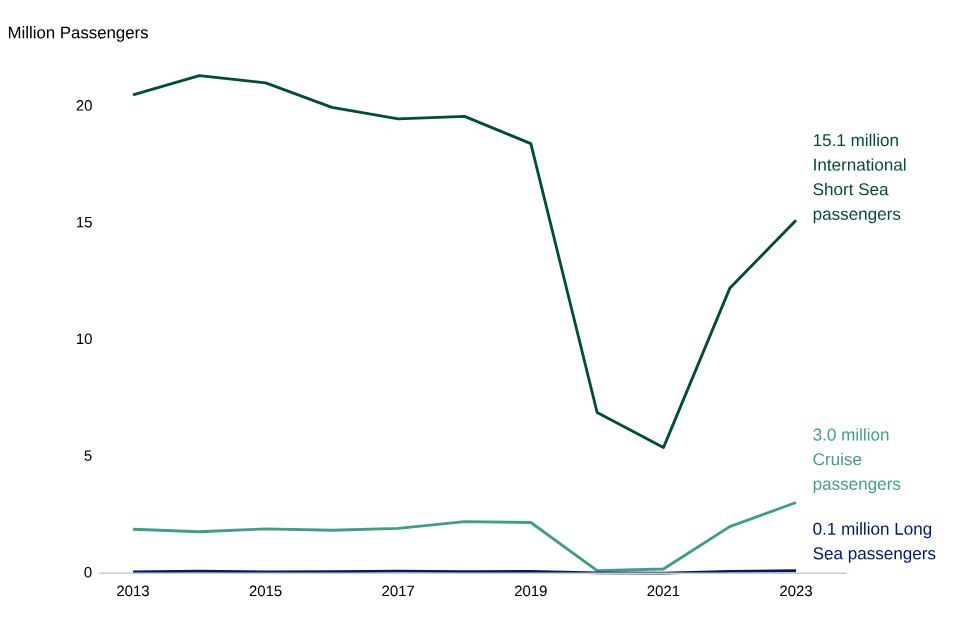
International sea passengers in the UK, 2013-2023 (Source: Department for Transport)
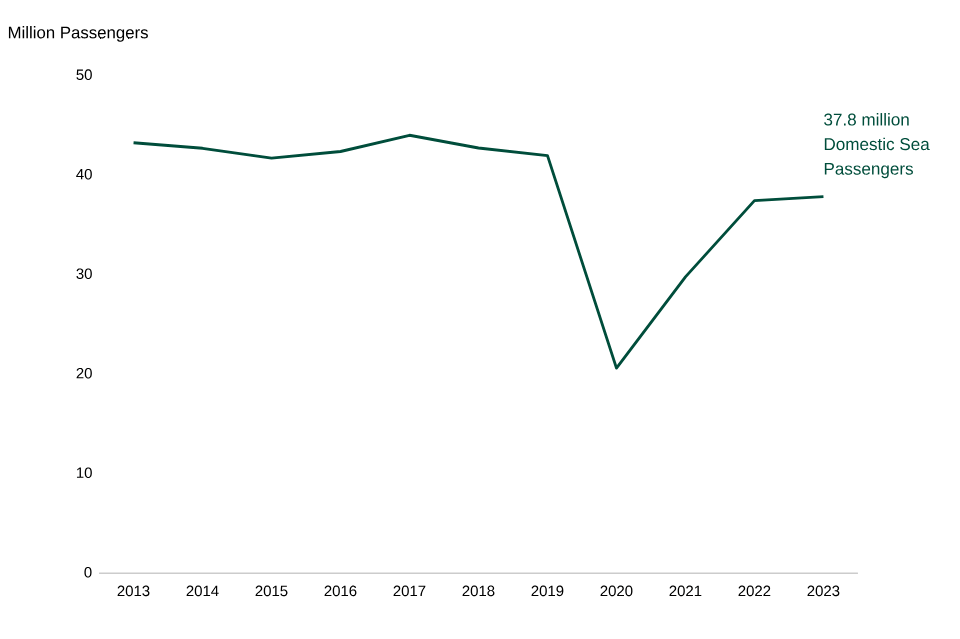
UK Domestic Sea Passengers, 2013-2023 (Source: Department for Transport)
Here is a fun fact for you. If you are catching a ferry and set off somewhere in the UK, chances are your destination is somewhere else in the UK. According to the Department for Transport’s sea passenger statistics, in 2023 there were 18.2 million international sea passengers, while there were 37.8 million domestic sea passengers.
📚 Random Things
These links are meant to make you think about the things that affect our world in transport, and not just think about transport itself. I hope that you enjoy them.
- A Googler’s guide to getting things done (The Verge)
- Zombie Wells: A $280 Billion Problem the U.S. Can’t Ignore (Naked Capitalism)
- Stonehenge’s enigmatic centre stone was hauled 800 kilometres from Scotland (Nature)
- The world will lose $4.7 trillion of revenue in the next decade to tax havens. How did we get here? (The Business Standard)
- Dad Jokes (3 Quarks Daily)
👍 Your feedback is essential
I want to make the newsletter better. To do this, I need your feedback. Just fill in the 3 question survey form by clicking on the below button to provide me with quick feedback, that I can put into action. Thank you so much.



 Mobility Matters
2 responses to “🪑 Musical Chairs”
Hi James, what caught my eye was your statement below: “TL:DR – Dr Beeching managed to reduce population growth.”
This is not true – the paper says that it “caused falls in population in affected areas relative to less affected areas,”, in other words, a redistribution of growth to those places that saw no cuts. It is important to be clear – people don’t reproduce less, or immigration figures don’t change, it is a national zero sum game. Of course this may not be so for eg employment or wealth, where overall connectivity across the country may affect its international competitiveness.
Tom
LikeLike
Duly accepted Tom!
LikeLike