

Good day my good friend.
After the fun and games of last week, it was a nice and quiet weekend in the Gleave household, with trips confined to dog-walking purposes only. Speaking of which, people who own dogs take more car trips than those who don’t, and they also tend to drive more carefully when their dog is in the car with them. I personally can verify both of these findings.
If you like this newsletter, please share it with someone else who you think will love it. The main way my audience grows is through your recommendations. I will love you forever if you do. 😍
🚗 The impossible job
Contrary to popular belief, it is not being the England manager which is the impossible job (which always reminds me of one of the best bits of British TV ever – it is truly “watch through your fingers” TV). It is being a transport planner, and I truly, truly believe this.
When talking about the state of the world to my dad on Friday, inevitably the state of traffic in my original home town of Barnstaple came up. In talking about how bad it was (a bit of insight, its always been bad in Barnstaple) and how it was down to too many new houses or pedestrian crossings being in the wrong position, I tried to give this observation to my dad:
Ultimately, we have to choose. On the one hand, we can build more and bigger roads. But its a false choice as it doesn’t really solve the problem of traffic at all, and people tend not to like new roads.
The other is that we prioritise people who walk, cycle, and use buses and trains. But doing that is unpopular and takes time to solve the problem of traffic. So we don’t do that either.
What we have right now is the result of our inability to make choices, or making them piecemeal, and leaving others to make the hard calls. A situation where traffic doesn’t get better, and everyone gets annoyed.
My dad said “Yeah, well…” in the way that is essentially him saying he can’t be bothered to argue, and we moved onto something else. But even what I said here is a simplification of things, and ignores a much bigger issue. Namely, that in order to tackle the issue of traffic, we also have to tackle the issues of car ownership.
What we know from the National Travel Survey is that having access to a car has a big impact both on how you travel, and how much you travel. If you live in a household without access to a car, you are far more likely to walk and use public transport, and the reverse is true for people living in households with access to a car. Especially for public transport, where on average people who have access to a car make 150 trips less every year by public transport compared to those who don’t own a car.

Number of trips per person per annum by different levels of access to a car in 2022 (Source: National Travel Survey)
When it comes to distance travelled, the difference could not be more stark. The main driver in a household with access to a car travels nearly three time further every year compared to a person in a household without a car. The only group which people in a household without a car are close to in terms of distance travelled every year are non-drivers in car owning households, with the latter travelling marginally further every year.
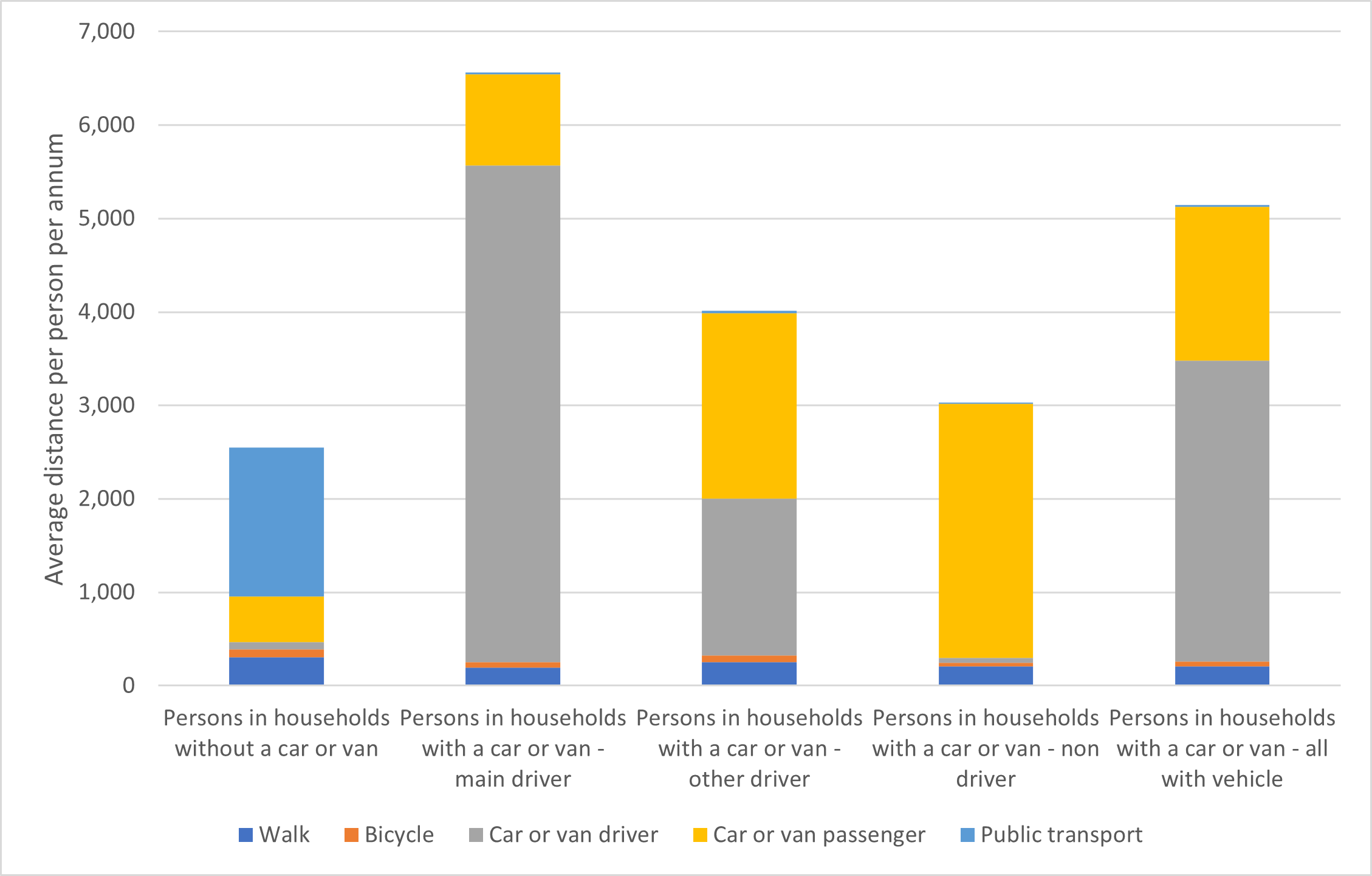
Average distance travelled per person per annum by different levels of access to a car, broken down by travel by specific modes in 2022 (Source: National Travel Survey)
To achieve a low carbon future, and to achieve significant behaviour change, this ownership link needs to be broken. It stands to reason: you own a car, you are going to use it unless you have little other choice but not to.
Ignoring the obvious political issues with discouraging car ownership – any politician saying that we should stop people owning cars is committing political suicide – discouraging car ownership is a really challenging problem. Car ownership is often associated with social status and how we wish others to see us. De-marketing the car has been suggested as a way of removing this symbolism, but even among younger generations who are for sustainable consumption, there is a desire to own a car and to drive one.
What we know from the evidence is that measures that discourage car use can, given time, slowly decrease car ownership. This is not just promoting walking, cycling, and public transport (but not car sharing). This is also measures to make using a car harder, like parking management. As well as complimentary land use policies and changing the built form.
All of this has been known for a long time, but there is complexity behind this. The evidence shows that such initiatives do work in reducing car ownership – slightly. What it does not show is why. Some research indicates that this is a result of changing travel patterns of those who live in affected neighbourhoods using before and after studies with the same study cohort. But this does not answer other questions that may demonstrate the power of the impact – for example have people’s attitudes to cars changed, and do people who use cars less move into the area over time?
Not to mention, by the way, that reducing car ownership can have unforeseen consequences. There is some evidence that for some car owning families, giving up a car entirely and maintaining consumption lifestyles can actually increase their overall carbon emissions despite reducing them by not owning a car.
It is because of such complexity why transport planners have an impossible job. The obvious solution to traffic (build more roads) doesn’t work, and the other solution (discourage car ownership and encourage sustainable travel) takes time to work, is politically hard, and can have unforeseen consequences. It is such complexity that we must take account of when making plans and strategies, no matter how certain we want the future to be.
What you can do: Understand this complexity. I have recommended systems thinking for years and numerous times in this blog. This is a great basic introduction, as is this article by the World Economic Forum. The uncertainty brought about by such complexity can be navigated through TAG’s excellent Uncertainty Toolkit.
👩🎓 From academia
The clever clogs at our universities have published the following excellent research. Where you are unable to access the research, email the author – they may give you a copy of the research paper for free.
TL:DR – Safety has big implications for walkability.
Comparing urban form influences on travel distance, car ownership, and mode choice
TL:DR – Living close to the city centre has a big transport impact on people.
The role of community-led social infrastructure in disadvantaged areas
TL:DR – Invest in social infrastructure and its good for the city.
Gender safety perspective in urban planning: The case of pedestrian mobility in Kanpur city
TL:DR – In Kanpur, accessibility and lighting at sidewalks, lack of lighting in underpasses, and and absence of street furniture at bus stops were identified gender safety issues.
✊ Awesome people doing awesome things
Residents in Keyworth, Nottinghamshire, were fed up with problems with their local bus service. Rather than complain on the local Facebook page, they got organised. They ran a survey on satisfaction with local services, lobbied their councillors and MP, met with the CEO of the bus company, and got them to commit to a 10 point plan to improve the services. And this is now being delivered.
📺 On the (You)Tube
This is what change looks like. This is a great short video showing Broadway in New York before and after significant changes to make it more pedestrian and bike friendly. Sometimes, you need to see things like these to remember that the fight is worth it.
📻 On the Wireless
A recent episode of The Urbanist Podcast asked whether the green revolution means that we are not loving the urban environment we have. I think that’s very simplistic, but that’s me.
📚 Random things
These links are meant to make you think about the things that affect our world in transport, and not just think about transport itself. I hope that you enjoy them.
- Boeing Officials Grapple With Crisis: ‘We Simply Must Be Better. Our Customers Deserve Better’ (Inc)
- The Promise and Pitfalls of Mega-Projects: Lessons From History (MIT Press Reader)
- The French farmers’ protests are more complex than they seem (Vox)
- Car-tech breakup fever is heating up (The Verge)
- Unveiling the geographical dimension of populist radical-right voting (The Loop)
📰 The bottom of the news
Cars falling off quays into the water is never a good thing. But in Olso, when a driver mistakenly hit the accelerator and plunged in, they could not have guessed how they would have been rescued. By a sauna boat with people “wearing only towels.” That must have been some sight.
👍 Your feedback is essential
I want to make the calls to actions better. To do this, I need your feedback. Just fill in the 3 question survey form by clicking on the below button to provide me with quick feedback, that I can put into action. Thank you so much.

 Mobility Matters