Good day my good friend.
Just this last evening (as I write this), I think my car managed to do its annual trip where it seems to justify its entire existence for the rest of the year. I won’t get into details, but it involved a mad dash to a hospital with a relative at 11pm, and staying there until 4am, well outside operational hours for all forms of public transport.
Whilst ideally an ambulance would have been a better choice, they are having a few issues with response times at the moment. Now, whenever I make the suggestion to ditch what is otherwise a money pit, I await this example to come up which justifies the car’s entire existence.
If you like this newsletter, please share it with someone else who you think will love it. The main way my audience grows is through your recommendations. I will love you forever if you do. 😍
⚰ RIP Local Councils
As part of work on developing a regional transport strategy for the South East of England, I have been speaking to a lot of councils across the region to ask them what they would like from it. That has involved plenty of miles travelled to places like Maidstone and Lewes, my visit to the former coinciding with their local football team’s amazing run in the FA Cup (completely unrelated, of course 😉).
One thing that has been consistent throughout all of these discussions is that of funding. Now, local councils have been complaining of not having enough funding since I graduated in the early-2000s. But this time they mean it. British readers will know that there is a cash crisis in local councils across England. Just yesterday, MP’s on Parliament’s Levelling Up, Housing, and Communities Committee reported that local councils across England need £4 billion over the next two years just to keep services running and prevent a total financial apocalypse.
To try and simplify what is a complex problem: central government funding for local councils has been cut, local council ability to raise funds (Council Tax) has been artificially capped at a rate below inflation (thanks Eric Pickles 🤬), demand for expensive services that Councils are required to provide like social care has exploded, the costs of providing such services has exploded, and councils are running out of financial room.
The councils who were stupid with past investments are immediately screwed and have effectively declared themselves bankrupt already (like Wokingham and Thurrock). But now the fire has been lit, its spreading rapidly. And as the only statutory duties in transport placed on local councils are providing school transport services, fixing the very worst potholes, having an up-to-date Local Transport Plan, and employing a traffic manager, they are now on the line for spending cuts.
Analysis by The Guardian has shown that spending on highways and transport in local councils has dropped significantly over the last decade, with more than half of local councils cutting spending by over 50% since 2010. And these figures include the spend of grants awarded by the Department for Transport for things like active travel and bus service improvement plans.
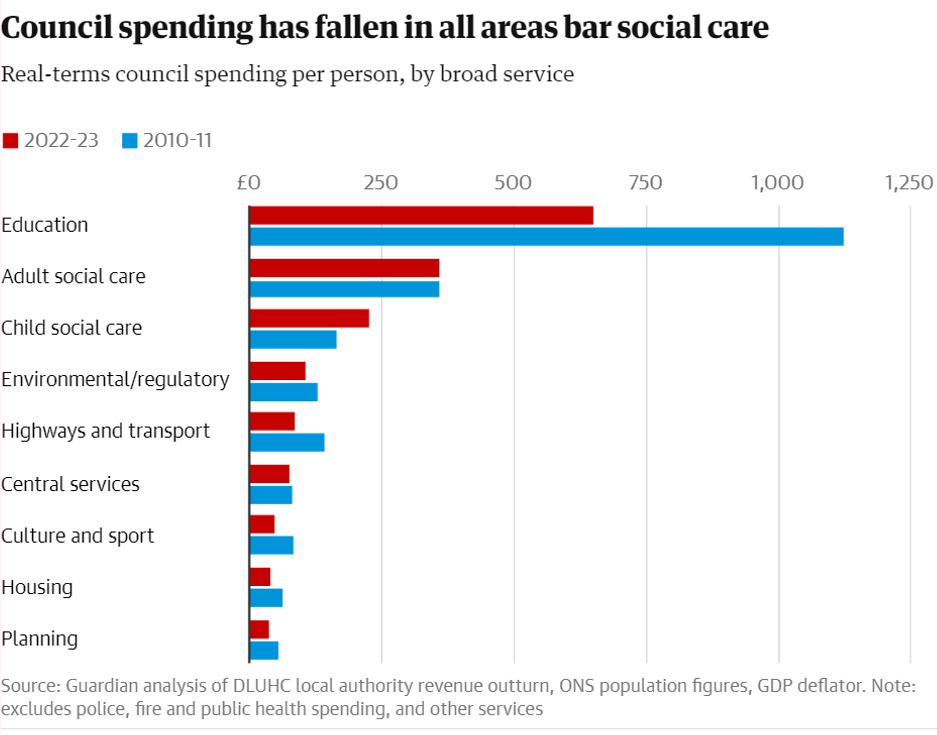
Source: The Guardian
Just before Christmas, the Department for Transport published the results of research into the capacity and capability of local councils in relation to local transport. While local councils rated their capability to deliver transport projects positively (91% rated their capability as being very or fairly good), this was less the case in terms of capacity (54% rating their capacity this way).
Delving into the detail, one factor affected this positive perception very significantly: the ability of the council to bid for and win funding. Bid and win a lot? You’re feeling good. You suck at bidding? Bad times ahead for you.
And when capacity is delivered, it is focused on getting projects done and not planning. As the summary of the report states:
A majority of authorities had Local Transport Plans (LTPs) and felt they were important, however, many reported struggling to set aside capacity to carry out strategic planning. Consequently, many authorities did not have a pipeline of deliverable transport schemes.
Councils literally do not have the time to write their strategies, and to create a pipeline of schemes to get funded. This has chimed strongly with my own experience, and that of local councils I have spoken to.
Yet talking to well-meaning people working in strategy fields and setting visions of the future, this work seems to be in a parallel universe. Where the vision of the future alone will change minds, and suddenly all will be well. And maintaining that vision of the future is important. But to use a maritime metaphor, dreaming of sun-drenched islands is no good when water is pouring through a massive hole in your ship’s hull.
For me, the way that transport is governed and funded in the UK is fundamentally broken, with only radical devolution of transport powers, funding and ability to raise funds being a sustainable long term solution. After an immediate cash injection from government to stave off the immediate crisis.
This situation raises a fundamental question for those of us still writing transport strategies, and I know many of you are updating Local Transport Plans now. You want to be ambitious, yet you want your strategy to be deliverable as well. This is where you need to think of your strategy slightly differently – where it goes from a set vision of the future with key deliverables, to being that of an ask.
This is where you set out that this is the possible future, and we challenge you, government, to fund us to achieve it. And if you fund it, we will achieve these policy goals that you have, and generate a bid return for the Treasury. But if you don’t fund us, you won’t get that, and you will get this instead.
Being bold when everything around you is going wrong is a tough place to be in, and I entirely sympathise with all local council employees out there. All we can do is fight for something better.
What you can do: Write to your MP to ask them what they are doing to ensure that your local council is getting adequately funded. And if they fob you off with some weaselly-worded nonsense, don’t give it up. Write back.
If you are a Council employee, there are a number of strategy tools that you can use to explore ideas for creating something visionary that is within your means. Maybe start off with a workshop on 15% Solutions or on Critical Uncertainties.
👩🎓 From academia
The clever clogs at our universities have published the following excellent research. Where you are unable to access the research, email the author – they may give you a copy of the research paper for free.
TL:DR – Different cities integrate public transport and e-scooters to different degrees of success.
Sustainability assessment of inter-urban crowdshipping – A case study approach
TL:DR – Combining shipments and passenger journeys using online platforms could help reduce emissions.
TL:DR – Boosting transit can be more beneficial for some compared to others.
E-bike use and ownership in the Lake District National-Park UK
TL:DR – E-bikes can act as an effective substitute for car trips even in very rural areas.
✊ Awesome people doing awesome things
A big win this week for the Friends of Beeston Station in Nottinghamshire. They have spent 7 years campaigning for new lifts at the station, and this week work started on the ground to actually build them. Now, just a few hundred more stations to make accessible…
📷 Out and About
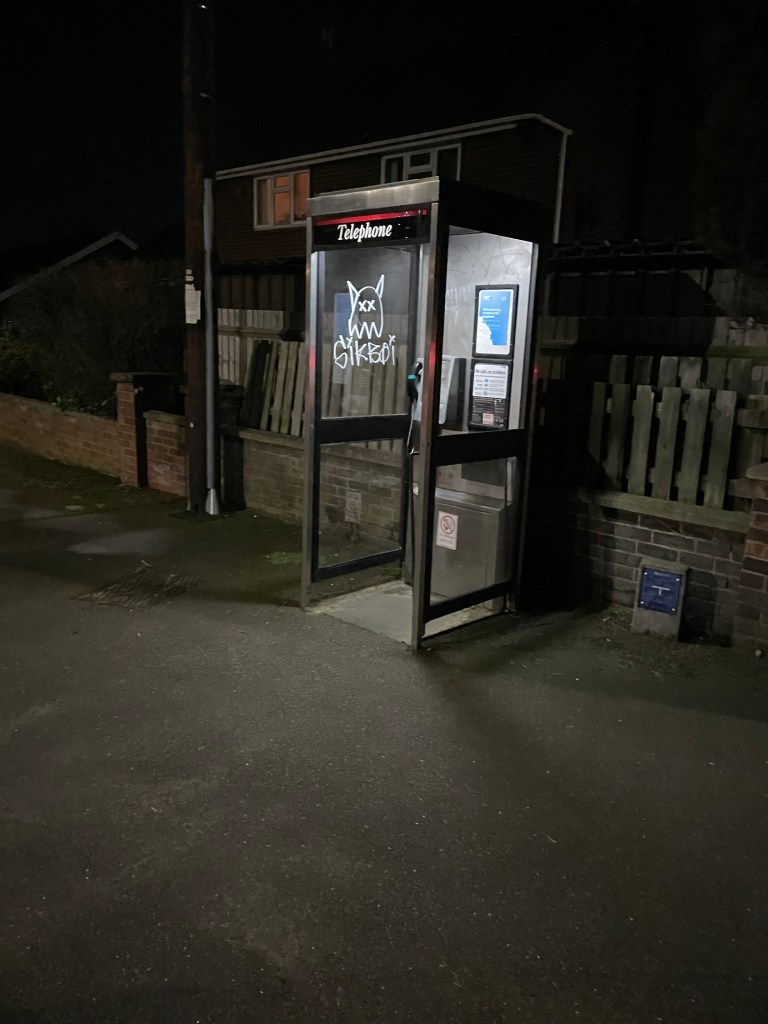
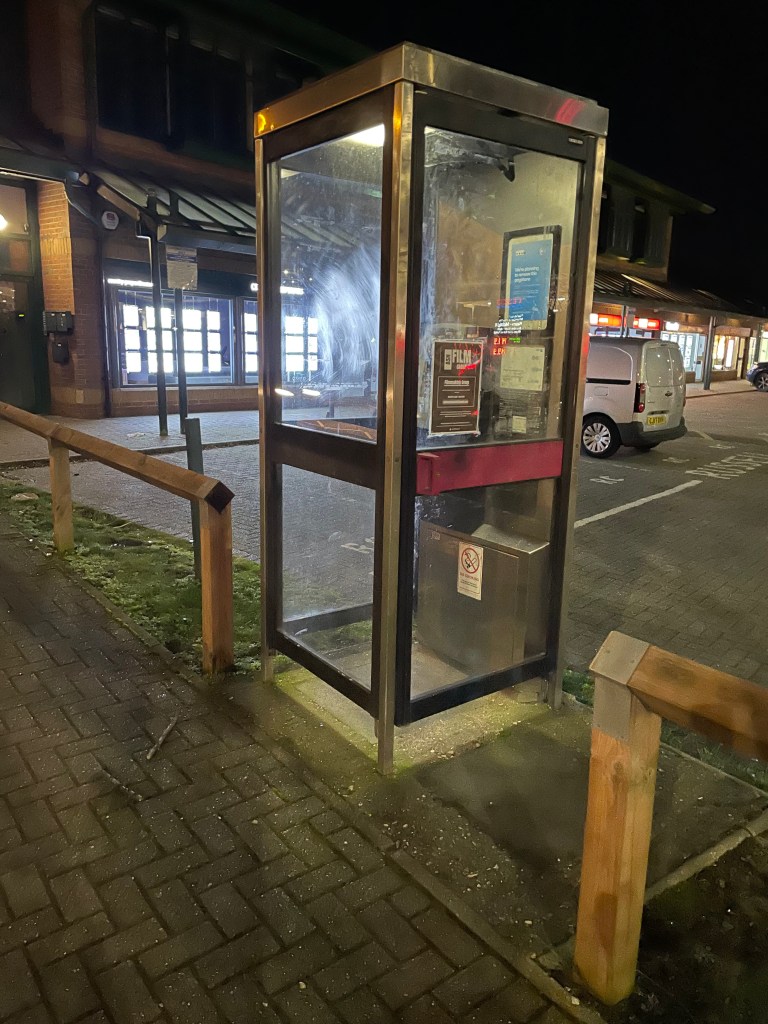
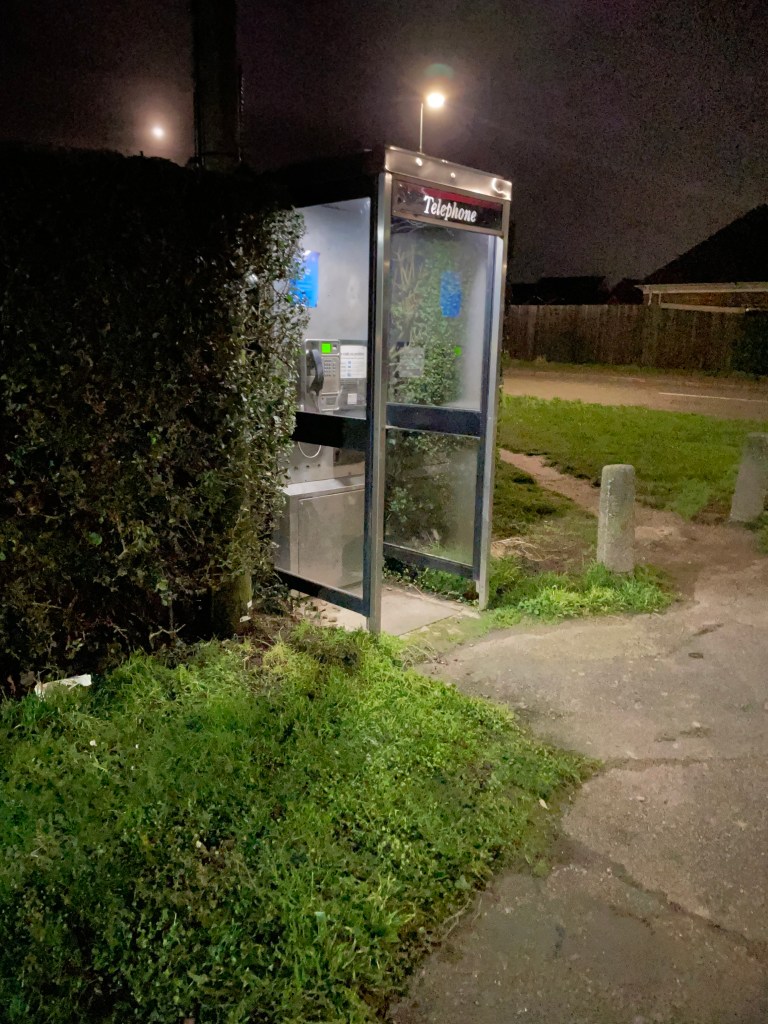
These pictures may just be the last of these examples of street furniture that have graced the streets of Flitwick for the last 50 years, but will shortly be removed. The BT Phone Box has slowly disappeared from British streets since the turn of the century as mobile phones have become widely adopted. And while some bemoan their loss, I can understand why they are being removed. BT are consulting on their removal, but to be honest its a foregone conclusion.
To put some context behind these, the first (at the junction of Denel Close and Ampthill Road) was used 12 times in 2022. The second (at The Russell Centre) was the busiest by far, being used a whopping 37 times in 2022. Meanwhile the last (at the junction of Hinksley Road and Althorp Close) was used just 7 times in 2022. Once these are gone, Flitwick will have no public payphone anywhere.
📺 On the (You)Tube
In this fun video, Geoff (and a friend) travel on the 4-times-a-day 347 bus route in London. Taking in the only part of London outside the M25.
🖼 Graphic Design

Source: Our World In Data
The United Nations believes we have passed a point known as peak child. This means that as a result of declining fertility rates, the number of children globally will first stabilise, and then start to decline. Fewer children has huge transport implications.
📚 Random things
These links are meant to make you think about the things that affect our world in transport, and not just think about transport itself. I hope that you enjoy them.
- What awaits us? (aeon)
- We are living in a ‘digital dark age’ (The Conversation)
- Could combatting loneliness extend the lives of people with obesity? (New Scientist)
- Guardrails Aren’t Designed To Work On Giant EVs: Study (Jalopnik)
- Is the Red Sea effect on container shipping being overblown? (Hellenic Shipping News)
📰 The bottom of the news
In the comedy film Hot Fuzz, Simon Pegg was in an iconic scene where has was chasing a swan around trying to catch it. This kind of thing happens a lot, on account of swans generally doing what they like and them being absolute beasts to catch. As the police in Devizes, Wiltshire found out just recently.
👍 Your feedback is essential
I want to make the calls to actions better. To do this, I need your feedback. Just fill in the 3 question survey form by clicking on the below button to provide me with quick feedback, that I can put into action. Thank you so much.