
This blog, plus additional exclusive content, was published last Friday on my free Mobility Matters newsletter. You can sign up for the newsletter by clicking here.
The UK has a crisis in nature, and we don’t realise it. The people of England romanticise the rolling hills and green and pleasant land. The Scots take pride in the rugged beauty of the highlands and the coasts. The Welsh Valleys are practically embedded in the nations national psyche. But what we see as natural is anything but.
From the rapid industrialisation of the 19th century to the post-war agricultural boom that ripped out thousands of miles of hedgerows, our relentless pursuit of economic expansion has decimated the natural world. Today, the United Kingdom holds the unenviable title of being one of the most nature-depleted countries on the planet. The statistics are a sobering read. Since 1970, the abundance of priority species has plummeted to just 37% of its baseline, and nearly one in six species in Great Britain now stares down the barrel of imminent extinction. Over 150 species have already been wiped from our shores since 1500.
Our record on nature is one that would shame any country that claims it is in love with its natural world as much as we claim to be. Research by the Woodland Trust showed that between 1998 and 2025, the UK added 300,000 hectares of new woodland. But this misunderstands the relative ecological value of different habitats. New tree planting is better than no planting at all – of that there is no doubt. But ancient woodlands provide complex habitats for fungi to blossom, and hollows for nesting birds. Only one in fifty native woodlands retains more than a single veteran tree per twenty hectares. Replacing such habitats with new planting is, for the time being at least, like replacing the grass on your lawn with astroturf.
It is against this backdrop and history of ecological armageddon that the UK government plans to deliver rapid and aggressive economic growth. Transport infrastructure is a key plank in that, with plans for new public transport corridors, bike lanes, and bypasses. Alongside 1.5 million new homes and completely transforming the energy grid. One of the most fundamental questions we must ourselves as a profession is whether we wish to see this growth at any cost. Can our need for new infrastructure ever be reconciled with protecting and enhancing our natural world?
One way by which policy makers have attempted to reconcile this is do what economists do: put a value on it. For many decades, economists viewed nature as an externality. When a bulldozer tore up a wildflower meadow, the only economic values that mattered were the costs of fuel and the value of the trips the new bypass would create.
But what if instead of externalising the costs of flood mitigation, pollination of plants, and carbon sequestration, we internalised that cost? Welcome to the world of Natural Capital. A good example of this can be found in the Treasury’s Green Book, where under some policies analysts and scheme promoters being required to calculate the Shadow Price of Biodiversity. This is a formula that seeks to calculate the precise economic cost of a project, forcing policy makers to directly confront the costs of what they plan to do.
This is not the only example of using market mechanisms to attempt to sway matters in the favour of the natural world.
The flagship policy born from this philosophy is mandatory Biodiversity Net Gain (BNG), which came into full, statutory force in 2024. The premise is seductively simple: if you build a housing estate that destroys 10 units of biodiversity, you are legally obliged to create or fund 11 units of biodiversity elsewhere, ensuring a 10% “net gain” for nature. It is a market-based panacea, creating an overnight, booming industry of habitat banking. Private landowners and farmers are now setting aside tens of thousands of acres to restore wetlands, dig ponds, and sow meadows, selling these newly minted biodiversity units to developers for upwards of £30,000 to £50,000 a piece. Industry analysts predict this will balloon into a £3 billion market within the decade, injecting vital private capital into rural conservation. To prevent cheating, the government has set punitive prices for their own statutory credits—destroying a highly distinct river habitat could cost a developer over £160,000 per unit on the private market, or an eye-watering £230,000 if forced to buy from the state.
The Planning and Infrastructure Act 2025 takes such market logic to its next stage. Deeply frustrated by the delays caused by local protests, the sudden discovery of protected newts on building sites, and the meticulous demands of project-level environmental assessments, the government has now moved to rewrite the rulebook entirely. This Act represents the most radical shake-up of British environmental law in a generation.
The government’s argument is that assessing environmental impact on a slow, project-by-project basis is both economically crippling and ecologically short-sighted. Instead, the new Bill proposes a strategic approach. Rather than forcing a housing developer to painstakingly survey their specific field for protected bats or badgers, the region will be governed by a sweeping Delivery Plan. Developers will simply pay a predetermined financial tariff into a massive central Nature Restoration Fund. In return, their specific project is exempted from the stringent checks of the Habitats Regulations, and the pooled funds are used by government bodies to buy land and create large, strategic nature reserves elsewhere.
This idea actually had its roots in a successful piece of nature conservation regulation. Instead of having developers and infrastructure providers dig isolated ponds as part of their developments to protect the very rare (but, from my own experience, somehow everywhere) Great Crested Newt, developers took part in District Level Licencing. This is where they contributed to a central pot for regional conservation bodies to build high quality wetland habitats where the Newts could thrive.
There is one small problem with this, however. This kind of thing works well for amphibians, who thrive in such habitat types. But the majority of natural ecosystems have very different needs to the humble Newt. Just because one thing works well for a specific species or a specific type of habitat, does not that idea is transferrable.
My fundamental objection, however, is that by placing a financial value on nature, market mechanisms seek to make natural habitats a tradeable commodity, either by intent or by accident. By simply buying credits or paying into a central pot, then nature becomes a financial transaction. As if nature is a problem to be solved by just throwing money at it. It completely ignores the more fundamental value of nature to our wellbeing, and it also ignores how nature works.
The most effective mitigation strategy for nature is a simple one: do nothing. Above everything else, nature needs space. It needs the space to feed, to have shelter, to raise their young, and ideally free from their apex predator: human beings. If given a choice between having a £1 million in the bank, or having open land of an equivalent value donated to them, many conservation charities will take the land as it can be used to establish habitats and whole ecosystems, even without their direct intervention. What many of us may see as an untidy field or worthless scrub that has been neglected for years is likely in fact a rich and complex ecosystem once you look under the surface.
Sadly, when it comes to transport infrastructure, we deny nature that space. Roads and railways are the vital connections that spur economic growth. The evidence behind this is undeniable. They slice landscapes into isolated fragments, with noise and light pollution scaring animals and birds well away from the carriageways and tracks.
For years, we have convinced ourselves that we can have our cake and eat it, if only we mitigate. Lets take bats as an example. If a new road must go through a known bat habitat or corridor, they need to put up a bat gantry. This is a wire mesh bridge strung high above the carriageway. The theory being that bats will safely glide over the traffic.
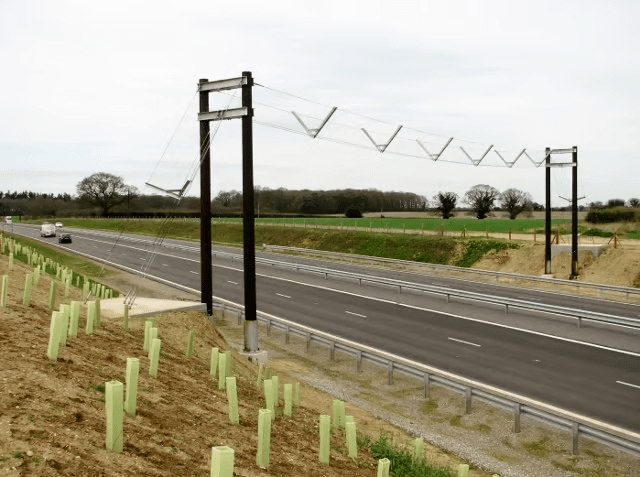
A bat gantry over the Norwich Northern Distrubutor Road (Source: Evelyn Simack)
The problem with this, however, is they don’t. For reasons unknown to us, the stubborn little things continue along the same hedgerows their ancestors did. And if a road is in their way, they take their chances with the lorries rather than head to the bridge just down the way. A study concluded that bat gantry’s are largely ineffective and are only used by a small proportion of bats, even up to 9 years after construction.
I will mention HS2 at this stage, not because of the infamous bat tunnel, but because of how it defines its No Net Loss Metric. Independent reviewers have heavy criticised this approach. It assumes that the habitats of ancient woodland and soils that have evolved since the last Ice Age could be offset by planting a million trees elsewhere. Trees that will need to take up to 30 years to reach ecological maturity, and up to 300 years to recreate the habitats lost.
By now you are probably thinking that I am taking the position that all infrastructure investment should be halted if one bat or newt might get disturbed by it. This is not my point in the slightest. My point is two-fold, my first point is simple. As part of how we appraise projects we look at nature in completely the incorrect way. We look at it in a manner of an accountant looking at a ledger.
Nature is not a commodity to be traded. You cannot neatly equate a century-old, species-rich hedgerow in Kent with a newly seeded patch of rye grass in Yorkshire. The government’s Statutory Biodiversity Metric, the algorithm used to calculate these trades, has been fiercely criticised by ecologists as a blunt instrument. It actively penalises messy, successional habitats—like the bramble and scrubland vital to nightingales and butterflies—labeling them as “degraded,” while rewarding fast-growing, low-diversity grasslands that are cheap to implement and quick to show green in a project assessment.
Worse still is the temporal deficit. A developer brings in the chainsaws today, instantly eradicating a functioning ecosystem. The compensation—perhaps a newly dug pond or a field of thin saplings—may not reach its promised ecological value for a decade, or even thirty years. What happens to the local population of dormice or great crested newts in the intervening decades? They die. We risk playing a sophisticated accounting trick, allowing the destruction of nature today in exchange for the mere promise of nature tomorrow.
Building on this, existing tools designed to prevent such destruction, such as Habitat Regulation Impact Assessments and Strategic Environmental Assessments, are woefully inadequate for the job they were designed for. More on that another time, as I research on this matter more.
My second point is that we attempt to assess the relative merits of the economic impact of a scheme and the degree of habitat loss in a consistent manner. Assuming we actually factor in species loss at all in our decision making, we try to do so as an economic value. We need to realise right now that when it comes to the natural world and the economy, we are comparing apples and pears when we make decisions.
Economic growth is important, critical even. It makes us richer as a nation, and more prosperous as a society. It underpins investment in our public services and public realm, and supports the social safety net that we as a society have decided is necessary.
But so too is nature, for different reasons. There are immense physical and mental health benefits from being out in the natural world. Trees and plants provide the air we breathe. The bee pollinates crops and other plants. The wetland stores flood water away from people’s homes and businesses. When people say that you cannot put a value on it, you can’t. Is it even rational to put a value on something as important as that?
Our current appraisal mechanisms attempt to rationalise the value of such things, to come to a logical and therefore reasonable conclusion as to what is the best option. I happen to believe that, in an attempt to be rational and evidence based, we misunderstand the value of the economy and nature. We should judge schemes on their economic value, and their ability to stimulate income and create jobs. But part of our indicator set where we try to judge the merits of the scheme should be on the habitats it loses (and creates), and the species lost (or given new life).
More than anything, we need to change our practice so that we don’t waste money on expensive mitigation that is likely to fail. When it comes to the biodiversity performance of new projects, our practice needs to create protected, connected habitats and ecosystems that gives nature a chance to thrive, and not just a few tufts of grass or planting pots in the middle of a street.
Reflecting this, I see hope. Not in terms of government policy – that’s all in on economic growth, and I am very sure there are a few higher up in government departments who would pave over the countryside to get a few more percentage points onto GDP. But I do see hope in terms of deploying the principle that nature needs space, and we should give that to it.
As an example, “green bridges”—massive, soil-covered structures heavily planted with native vegetation—have proven highly effective at connecting habitats and offering species sanctuary. The Scotney Castle Landbridge over the A21 and the green bridge over the A556 successfully reconnect severed habitats, allowing badgers, amphibians, and invertebrates to traverse the landscape safely. Recognising this, National Highways has begun building massive new green bridges across the A30 in Cornwall and the M25. Yet, these structures cost tens of millions of pounds, and even they are plagued by poor post-construction maintenance, with vital ponds left waterlogged and overrun by invasive weeds. In many cases these are teething issues that need working out as such new practices become mainstream.
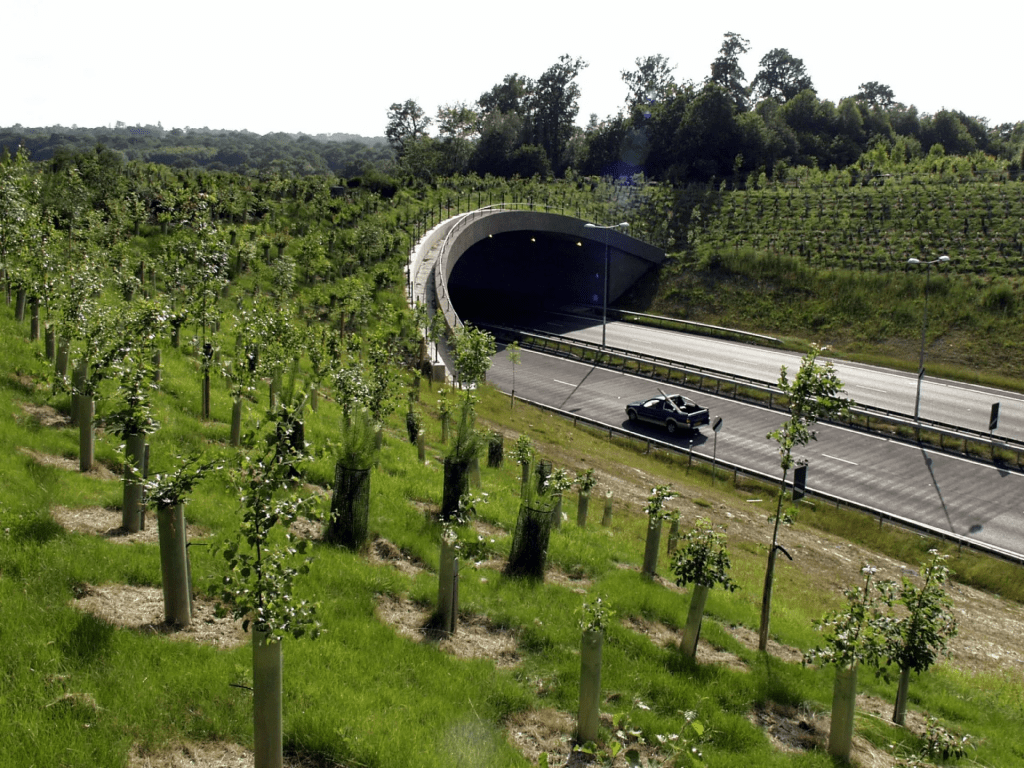
The Scotney Castle Landbridge (Source: Fira)
We find ourselves at a juncture as a profession. We say warm words about the environment, and we have taken steps to integrate nature into how we value the impacts of schemes. But we have taken the wrong ones. We have created an accounting system that tells developers and schemes promoters that it is perfectly acceptable to destroy complex, ancient, irreplaceable ecosystems, so long as the spreadsheet balances out with a newly planted field of saplings twenty miles away. Forests, grasslands, wetlands, ponds, rivers, estuaries, and even our marine waters are not numbers of spreadsheets.
You cannot financially compensate for losing a 300 year old oak tree or a species rich meadow. We cannot mitigate our way out of losing ancient hedges or a water course. We try to have our cake and eat it, and we simply cannot.
When I see arguments for and against schemes framed as the economy verses nature, I envision it as a battle between rationalists and storytellers. The rationalist will provide you with evidence that your new road will increase the number of jobs at the local factory, and make the town better off. The storyteller will weave a narrative of innocent animals being forced to lose their homes to the machine of progress. Mole, Ratty, Otter, and Badger losing their peace as Mr Toad charges around in his car.
Both of them speak to an inner truth. We are talking about comparing our wealth and sense of prosperity, against how we value our role as a steward of the natural world. You are judging two very different things, and this is not reflected in how we assess schemes. Maybe the rational thought of metrics and economics has its boundaries.
My position on this kind of thing is somewhat simple: lets do what works. In investing in infrastructure we invest in something that, overall, has demonstrated that it can stimulate economic growth. Yet when it comes to nature, the strategies we deploy are ones that don’t play into what nature needs, or they only improve on an awful baseline. We try to convince ourselves that we are doing good by nature, and maybe in some instances we are. But that practice is the notable exception and not the rule.
If we continue to treat biodiversity as a mere accounting exercise—trading ancient soil for futuristic promises—we may soon find our ledgers perfectly balanced, while the woodlands outside our windows fall silent. Our challenge is to find another way. To support our own prosperity while giving nature the space it needs to thrive. To date we have yet to find that path. It’s critical that we do.
 Mobility Matters