

Good day my good friend.
I haven’t had to do a public service announcement in a while, but here is one. For the next couple of weeks I will be presenting my work on how to make friends and influence councillors at Active City York in, well, York, and Transport Practitioners Meeting in Manchester. For the latter, I will also be presenting work done with Scottish Rural and Islands Transport Community on Rural and Island Mobility Plans, presenting with the always-excellent Renee van Baar. If you are around, come and say hi!
🗓️ Mobility Camp is back, and this September we are going to Cardiff. It promises to be an amazing day. It would be amazing if you can be there, or maybe sponsor the day.
💼 I am also available for freelance transport planning consultancy, through my own company Mobility Lab. You can check out what I do here.
⚠️ We are not ready for what is coming
This week, I had the pleasure of attending a workshop on resilience put on by the UK Roads Leadership Group. To cut a long story short, the Department for Transport wants to understand the challenges facing local councils in improving the resilience of their local road networks (apart from just giving them more funding). It was in the lovely old Town Hall in Reading, which I highly recommend visiting if you are there – the flapjack in the café is amazing. Anyway…
The big elephant in the room was climate change, of course, and many insightful presentations from the Met Office, British Geological Survey, and the Mining Remediation Authority (for the latter, if you don’t know them, they are the people you call if a sinkhole appears). The data presented was dire. A few snapshots from my own notes included:
- In the next decade, there is a 50/50 chance that the UK will experience 40C again;
- Temperatures of 45C are not out of the question;
- There is an increase likelihood of storms dumping around 200mm of rain in a few hours over the next 10 years. To put that in perspective, the 24 hour record for the UK is 314mm, set on the Honister Pass in Cumbria in 2015, and 100mm ground London’s transport system to a halt in 2021.
A common theme throughout the day was how our infrastructure was built for an entirely different world compared to today, and how we are designing things today that are not up to the task of dealing with future anticipated changes to the climate. We know instinctively as professionals that things are going to change over the 60 year design life of the schemes we are building, but does it factor into what we do?
We can start by taking a look at the historical mean temperatures here in the UK from the Met Office, and their excellent online data.
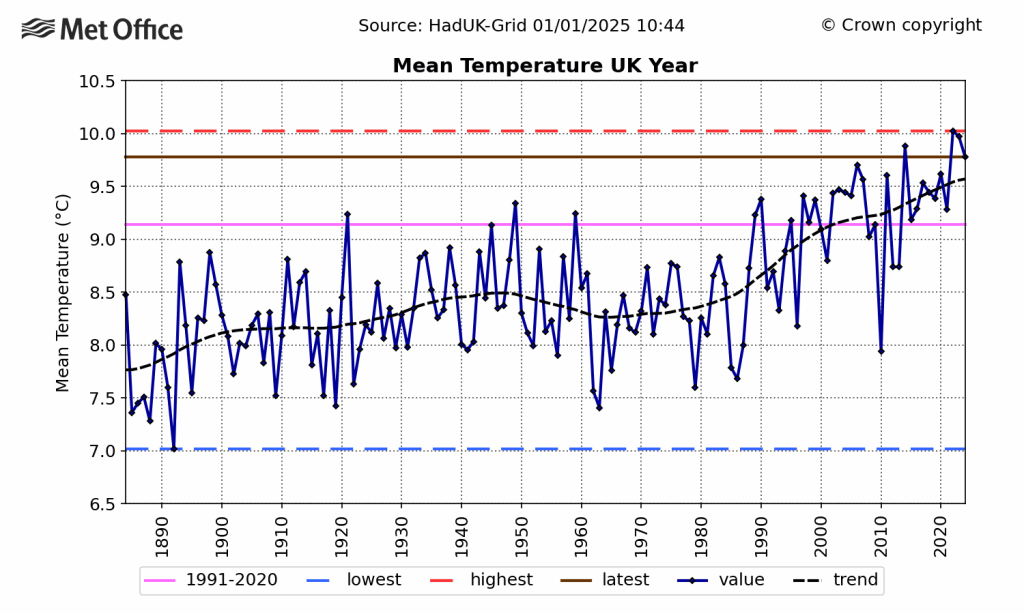
Mean temperature in the UK by year (Source: Met Office)
You can see from this data quite how much things have changed over the last 120 years. The mean temperature has risen by around 2C since 1900. But to put this into further perspective, I’ve reproduced this and overlaid some key events in transport history in the UK and across the world.

Mean temperature in the UK by year, with major transport events (Source: Met Office)
To put this in perspective, the Channel Tunnel between England and France was opened in a year 1C cooler than today. The first German Autobahn was opened in Berlin a full 2C cooler than today. This is not distant past stuff. The Wright Brothers was within the lifetime of people who were still alive in the last few years.
Our transport infrastructure is currently flexing against climates that it was not designed for at the outset. But in addition to this obvious engineering challenge that we face in the present, is the one that we are leaving ourselves for the future. Lets take the UK’s estimated change in annual temperatures under the IPCC climate change scenarios.

Projected Average Mean Surface Air Temperature in the UK compared to 1995-2014 reference period under multi-model IPCC scenarios (Source: World Bank)
Similar to what we did previously, I am going to map the adoption of 3 key design documents for new infrastructure (the Design Manual for Roads and Bridges version 1, Manual for Streets, and LTN 1/20), and a 60 year design life of schemes created under these design guides.

Projected Average Mean Surface Air Temperature in the UK compared to 1995-2014 reference period under multi-model IPCC scenarios, and major transport design guidance (Source: World Bank)
What this makes clear is that our current design guides are suggesting standards for infrastructure and streets for the next 60 years based on a base year that is highly unlikely to play out even in the most optimistic climate change scenarios. Just to clarify, scenario SSSP 2-4.5 is the current scenario which the world is on track for. One which none of the design guides are anywhere close to designing for.
In case you are wondering what my point here is, it is this. Our design guides are based upon best practice and evidence reflecting the needs of the here and now. But the things we are building are likely to last at least 50 years into a world where we have a reasonable idea of how the climate will change. Our design guides need to be resilient against the futures that we have in store, with their principles and standards tested against a variety of scenarios. Otherwise, we will be doing nothing to prevent the problems that we know are coming.
There are pockets of good practice on some schemes, particularly where interfaces with rivers necessitate scheme designs being resilient to a variety of flood events. But this is reliant on the proactive work of engineers to happen, as opposed to being standard practice. And the way to achieve this is to ensure that designing against the future climate is built into our design standards.
If we don’t do this, the planners and engineers of the future will be wondering what on Earth we were thinking. Still, at least it might mean the road maintenance budget goes up.
 Mobility Matters
One response to “🚧 What We Are Building Towards”
Indeed – this is also why the ecosystem services of street trees are going to be so important!
I look forward to hopefully meeting you in York.
Also – is there any way of getting back the read function on your blog? I really liked that feature!
Beth – Safe, Sustainable Travel Torbay and Volunteer BYCS Bike Mayor of Torbay
LikeLike