
By downloading this file, you can listen to this newsletter on the go, or as an alternative to your screen reader. And it’s in my voice! 😊
Good day my good friend.
Currently, the UK is going through what could be termed a typically British spring. Namely, its freezing cold one day, hot the next, wet the following day, and snow showers the day after that. I heard once that Britain doesn’t have seasons, it has weather. I think that is very true, with this week being a perfect example.
Hopefully by the time this newsletter goes out, it will be dry because I am currently sorting out my garden and my new water butts (barrels, actually) need moving into place. And yes, I am getting extremely middle aged.
📕 I have co-authored a book on Mobility-as-a-Service, which is a comprehensive guide on this important new transport service. It is available from the Institution of Engineering and Technology and now Amazon.
💼 I am also available for freelance transport planning consultancy, through my own company Mobility Lab. You can check out what I do here.
🗯 Method in the madness
One of the most interesting projects I have ever been involved in was a research project on the future of transport to inform the Ministry of Defence’s Global Strategic Trends document. Working with people from the Development, Concepts, and Doctrine Centre – now called Defence Futures – this was a classic trend research and scenario planning exercise. Where we explored all kinds of technological, social, and economic trends that are influencing the world of transport.
This work was fascinating not because of the scale of it, but the question it sought to answer: what does the future of transport mean for the interests and defence of the United Kingdom and its overseas territories and allies?
We are used to exploring the future of transport within a defined context which is usually related to strictly transport-focussed questions. But the joy of working on this project was to explore the future differently. Namely, what do changes in transport mean for the defence of the nation?
Turns out its a lot, which I will come onto shortly. But I have thought about this project a lot recently with President Trump making all kinds of announcements that, on their own, seem crazy. Like annexing Canada and Greenland, as well as launching an invasion of Panama. In addition to dividing up Ukraine. There has been much in the way of political commentary on these matters that I won’t raise your heart rate with here.
One of the key observations of our work was that for global superpowers, there are three ways by which you can project power. The first is militarily, through having substantial armed forces deployed on a global scale, able to act in response to any situation anywhere quickly. Currently, the best armed force in the world at doing this is the US Armed Forces, and its not even close.
The second is through wielding economic power through global institutions. Notable examples of this being through the imposition – and lowering – of tariffs on trade, as well as international agreements on areas of common interest. Climate change being a good example of the latter.
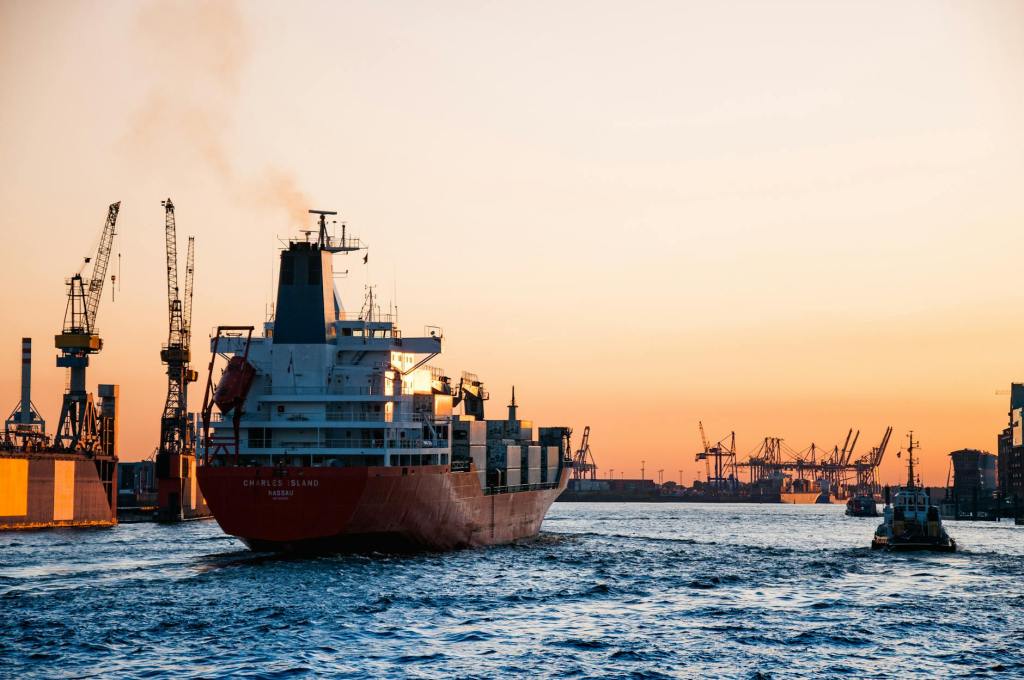
The final one, and perhaps the most critical for transport, is asserting control over global supply chains. In transport’s case, those are the major logistics corridors that traverse the world, carrying the bulk of the world’s trade. And this, I feel, partly explains the actions of the Trump administration.
When you look at changes in global trade and its current nature, two key conclusions emerge. The first is that while trade is global, much of it tends to be concentrated in several key trade corridors that are plied by ships all over the world. Some of the most notable are:
- The Trans-Pacific Route between Eastern Asia and North America, with an estimated 22 million TEU of trade passing along this route in 2022
- Asia to Europe, which shifts over 1 billion tonnes of freight a year
- The North Atlantic Routes between Europe and North America
- The Intra-Asia Routes across the South China Sea and Indian Ocean
Due to features such as geography and shipping companies wanting the fastest possible route between two ports, such routes inevitably encounter significant choke points. The World Economic Forum studied the shipping intensity of key shipping routes throughout the world and identified the following as major shipping choke points:
- The English Channel, which is traversed by 500 ships every day, as well as having some of the busiest routes for passenger ferries in the world;
- The Strait of Malacca between Indonesia, Malaysia and Singapore, through which roughly a third of global trade passes;
- The Strait of Hormuz between Iran and Oman, which provides access to the Persian Gulf, which carries 20% of global trade of natural gas;
- The two major shipping canals of the world: The Suez Canal and the Panama Canal, both of which drastically reduce ship journey times by reducing their need to navigate around two capes of the world (Good Hope and Horn respectively).

Map of the density of shipping traffic around the English Channel (Source: World Economic Forum)
Any country who wishes to have significant influence over global trade need to only project its influence over these key corridors. The English Channel and the Straits of Malacca and Hormuz are international waterways, and their management is subject to the United Nations Convention on the Laws of the Sea (UNCLOS). While countries do have authority over vessels passing through their territorial waters, the general presumption is that shipping should continue unhindered.
The Panama and Suez Canals are also subject to UNCLOS, being two of just three canals subject to this law – the other being the Kiel Canal in Germany. In the case of the Suez Canal, the Constantinople Convention stipulates that
The Suez Maritime Canal shall always be free and of commerce or of war, without distinction of flag.
Consequently, the High Contracting Parties agree not in any way to interfere with the free use of the Canal, in time of war as in time of peace.
The Canal shall never be subjected to the exercise of the right of blockade.
Meanwhile the Panama Canal is further subject to a Neutrality Agreement between the USA and Panama, which permits passage of ships regardless of its flag.
Whilst the legalities are clear on the transit of ships, the practicality is less so. A country or a leader can, unilaterally, decide to shut a canal for any reason, simply ignoring international law. The most famous example being the Suez Canal being closed for 8 years between 1967 and 1975 as a result of the Six Day War.
A further complication in canals such as Panama and the Suez is around ownership. While the rules around ship transit is clear, maintaining the independence of ownership is not. This appears to be the case in Panama, with Chinese investment increasing along many of the canals ports, much to the ire of the current US administration.
Thus, while the legal authority to ‘control’ canals is subject to international law, diplomatic and military power can be projected against these key choke points on supply chains as a way of exerting strong influence upon them. China has been doing so in the South China Sea for some time, while there was a strong military response to rockets from Yemen being fired at ships heading to the Suez Canal, to name but two examples.
The second key conclusion is that, while the old trade rules of geographical proximity still apply, supply chains have become longer over the years. But critically, trade is shifting towards alignment with geopolitical allies. In an analysis by McKinsey using a rough measure of ‘geopolitical distance,’ it revealed that trade among geopolitically distant partners had begun to decrease.
Some of this can be explained in trade policy. For example, the USA has shifted its trade focus away from China towards Europe, Mexico, and other Asian countries. Other explanations are political. For example trade between the UK, Germany, and Russia dropped sharply in response to the invasion of Ukraine in 2022, while India’s trade with Russia has surged since then.
Their analysis points to an interesting possibility. Namely that trade becomes more fragmented, with geopolitically similar partners trading with each other more closely (e.g. Western nations trading more with each other and less with China), and consequently much more challenging to assert power over.
A further aspect to all of this is the impact of climate change, but not in the way that you think it does. With Arctic Sea ice reducing in its extent each year, this opens up the Arctic Ocean to use for shipping. A frequently-cited example is the Northwest Passage, a route through the Canadian archipelago and past Greenland that would link the Atlantic and Pacific Oceans. And consequently provide a more direct route between Asia and Europe than even the Suez Canal.
In 2013, the Nordic Orion transited the Northwest Passage with an ice breaker escort. In doing so, it shave 4 days and $200,000 of cost off its route between Vancouver in Canada, and Pori in Finland. So you can see its value. To the point where 3 separate countries: Canada, Greenland, and Russia, assert territorial claims over the Arctic. In the Northwest Passage, the US also asserts a territorial claim, while Canada asserts that its an internal waterway and not a sea route.
Current estimates are that the Northwest Passage will become ice free for several months of the year by the end of this century. While Antarctica is covered by the Antarctic Treaty that forbids any non-peaceful purpose on the continent, the Arctic is governed by informal international arrangements. For any nation wishing to stake a claim over the Arctic region, the establishment of military operations in that area can give a significant degree of control on global trade in a warming world.
So this leads us to a position right now where the worlds of transport and geopolitics are increasingly mixed. While you may have your own views on the President and his views of the world, announcements of US plans for Greenland, Canada, and the Panama Canal actually make economic sense. Having a significant degree of influence over major trade routes of today and the future is one way of exerting considerable power, even if you don’t invade.
For us in the UK, it does pose a challenging question. To what degree does the UK accept ownership and leverage of its key trading assets? When it comes to the sea, British territorial waters are quite well settled. Apart from the UK’s claim to the sea around Rockall. This is well established in international agreements, and in our own legislation in the Territorial Sea Act of 1987. But when it comes to our port infrastructure, questions of ownership arise.

Map of UK territorial waters (Source: ResearchGate)
If we look at the UK’s busiest ports by freight tonnage in 2023, we see a variety of ownership models sat within a variety of countries. By order from the busiest port:
- While the Port of London itself is operated by the Port of London Authority, the main container terminal is at Tilbury. Tilbury is privately owned by Forth Ports, whose primary shareholder is PSP Investments, the Canadian public sector pension fund.
- Grimsby and Immingham and Southampton are owned by Associated British Ports. Whose major investors are Omers Infrastructure (Canada), Anchorage Ports LLP (Canada), Cheyne Walk Investment Pte. Ltd (ultimately owned from Singapore), and the Kuwait Investment Authority.
- Milford Haven is one of the trust ports of the UK, which is wholly owned and operated by its own trust, with no external investment.
- Liverpool is operated by the Peel Group, based in Manchester. These in turn are owned by the Whittaker Family and Olayan Group (Saudi Arabia).
In our work, we made the assumption that considering the trading and geopolitical arrangements at the time (late 2010s), maintaining such ownership and investment structures was probably viable. Or the investment is at least worth the risk. However, we noted that should the UK’s geopolitical status change, there is a significant probability that such ownership structures may be looked upon less favourably by Government, who may wish to assert more control over critical national infrastructure.
It has been a few months since the Trump administration started, and 3 years since the Russian invasion of Ukraine. Whilst publicly there is no change in position on infrastructure ownership, I would not be surprised if in the halls of Whitehall, the question of ownership is being raised. With the geopolitical winds blowing cold, all aspects of national security and protecting British interests are likely to be being discussed as much as deploying British peacekeepers in the Donbass.
We often like to think that transport and geopolitics are separate things. But transport is the arena in which geopolitical games are played. While you may have your own views on the policies of various governments, they have very real impacts on global transport systems. We ignore this at our peril.
👩🎓 From academia
The clever clogs at our universities have published the following excellent research. Where you are unable to access the research, email the author – they may give you a copy of the research paper for free.
TL:DR – Broadly yes, in that earlier adopters are higher income earners. And the effect of subsidies reduces over time.
Is international shipping in right direction towards carbon emissions control?
TL:DR – What do you think? Though where policies are more stringent, the trend is downward.
TL:DR – All railways lead to Budapest.
TL:DR – If people perceive their time to be more limited, it affects how much they use public transport.
😃 Positive News
In the latest move in bus franchising, South Yorkshire has confirmed that it is going to take buses back under public control. Buses could be up and running by 2027. And in a shocking bit of news, one operator in Glasgow publicly admits that franchising is no barrier to bus operators.
In Derbyshire, an old railway line will be put back into use. As a walking and cycling route. The former Little Eaton branch line will be converted into a greenway, serving schools and employment areas. And they have the funding to build it.
Ross-on-Wye studied whether pedestrianisation would be a good thing for the town. To the shock of nobody, it is. Lets hope that they crack on with it.
Also, Transport for London have launched their own consultation on plans to pedestrianise Oxford Street. You should fill in the survey pronto.
🖼 Graphic Design

Rates of urbanisation by countries close to Bangladesh, and Bangladesh (Source: Our World In Data)
A significant trend driving transport demand across the world is urbanization. While around half of the global population lives in urban areas now, that is forecast to increase to over three-quarters by 2050. In a highly urbanized country like the UK where over 80% of the population live in an urban area, we tend to forget how important this trend is.
📺 On the (You)Tube
In a light-hearted video this week, the guys behind the All The Gears YouTube channel bought the cheapest bikes on Amazon, and tried to cycle the length of the Isle of Wight. Let me put it this way: their first breakdown was within 5 metres of the start.
📚 Random things
These links are meant to make you think about the things that affect our world in transport, and not just think about transport itself. I hope that you enjoy them.
- The Worst 7 Years in Boeing’s History—and the Man Who Won’t Stop Fighting for Answers (Wired)
- What really happens to everything you recycle (The Economist)
- The Swarm of People Intent on Saving Our Bees (Smithsonian Magazine)
- Beginning with Seeds: Restoration in the Wake of Wildfires (Emergence Magazine)
- A Battle for the Soul of the West (The Atlantic)
📰 The bottom of the news
The British Wildlife Photography Awards is always a source of joy. And this year is no exception to that. My personal favourite is the picture entitled “Red Deer Stag Shaking Off Rain.” We do live on a blessed isle.


 Mobility Matters