
By downloading this file, you can listen to this newsletter on the go, or as an alternative to your screen reader. And it’s in my voice! 😊
Good day my good friend.
I mentioned a couple of weeks ago that my newsletters would be punchy. And this week is especially so. I am writing this as I speed through the Kent countryside on a Javelin service from Canterbury to London. Can I write this newsletter by the time I get home in a couple of hours? Lets see shall we?
📕 I have co-authored a book on Mobility-as-a-Service, which is a comprehensive guide on this important new transport service. It is available from the Institution of Engineering and Technology and now Amazon.
💼 I am also available for freelance transport planning consultancy, through my own company Mobility Lab. You can check out what I do here.
❓ Why do we do it?
These last couple of weeks I have all over much of the South East as part of a public consultation on a Draft Transport Strategy that I helped write for Transport for the South East. I am on the way back from a roadshow in Canterbury (just approaching Ashford International right now), having had such roadshows in Southampton, Portsmouth, and Brighton. I’ve also presented the strategy to the Chartered Institution of Highways and Transportation, the NHS, Gatwick and Heathrow Airports, and TfSE’s own Transport Forum.
I like talking to the public about transport. Its honestly a sector I love being a part of, and explaining why its important to people brings me great joy. But the most important reason why I like it is because it always reminds me of why I do this job.
Its to make a difference to people’s lives in a real, tangible way.
Last week, I shared the story of a lady in Brighton who uses the buses to see her family. Those kinds of things strike a real chord with me. We often forget about the fundamental importance of transport of simply allowing people to get out and experience the world, and bringing joy to their lives through collective experiences.
Time and time again, people tell me at consultation events not about the technical details of schemes, or even about how traffic flow changes. They tell personal stories about how transport schemes affect their day to day lives.
During the last two weeks, people have told me how the new seating as part of a pedestrianisation scheme has made the feel of a street so much nicer, and how they chat to their friends on the train while going to watch the football. They tell me how the new buses in their town are harder to get wheelchairs on and so they feel embarrassed to ask people to move, and how people glare at them for being teenagers.
I will be honest with you. I want the world to be more equitable, and to reduce carbon emissions. Those things are absolutely essential. But what drives me is making people’s every day lives better. My work is not funding new railways, or securing funding for better buses. Its helping people to enjoy their lives and to see family and friends.
I see a lot of discourse online about how we need to reduce the number of trips people make. That does not sit well with me, even though we are achieving it. Good transport is essential to a happy life, as it allows people the opportunity to do things they love, with the people they love. You can make a case that certain kinds of trips by certain modes (namely cars and planes) should be minimised to achieve wider social goals. And there is a logic to that.
But this is a technocratic way of looking at a problem and proposing a solution, without taking account of the humans at the centre of it. Saying to people that they must reduce the amount they travel means you are telling them to do less of what brings them happiness. That may not be the message that is intended, but that is the message that is heard.
The last two weeks have reminded me that when we get transport right, its a wonderful thing to people. And we need to recognise that travelling is inherently good. We just need to craft a transport system whereby the most sustainable and equitable means of travelling is the obvious choice.
👩🎓 From academia
The clever clogs at our universities have published the following excellent research. Where you are unable to access the research, email the author – they may give you a copy of the research paper for free. (I’m currently approaching Ebbsfleet International, if you are still keeping track)
Impacts of bicycle facilities on residential property values in 11 US cities
TL:DR – The effect is highly variable, and can often depend upon property types close to facility types.
TL:DR – In Bogotá, Colombia, new cable cars increased accessibility and leisure activity among the poorest in society.
The road lobby and unhealthy transport policy discourse in Aotearoa New Zealand: A framing analysis
TL:DR – Car lobby lobbies for policies that defend cars, using tactics tried and tested by the likes of the tobacco industry.
The gender data gap in e-micromobility research: A systematic review of gender reporting
TL:DR – Women are under-represented in research on e-scooters and e-bikes, and something must be done about it. I agree.
😃 Positive News
There is a lot of news being shared that buses are increasing in frequency across the country. Examples that I have seen include the Park and Ride in Shrewsbury, Wokingham, Wrexham, and Oxford. New routes have also started running in Milton Keynes and to serve 115 FC. Oh, and Cambridgeshire and Peterborough has moved a step further towards bus franchising.
Active Travel England have allocated a load of money towards making improvements to active travel across the UK. My local council got £176k. But lots of other areas got much, much more.
The West Midlands is getting more trams! Or at least an extended network. The extension between Wednesbury and Brierley Hill has started work.
🖼 Graphic Design
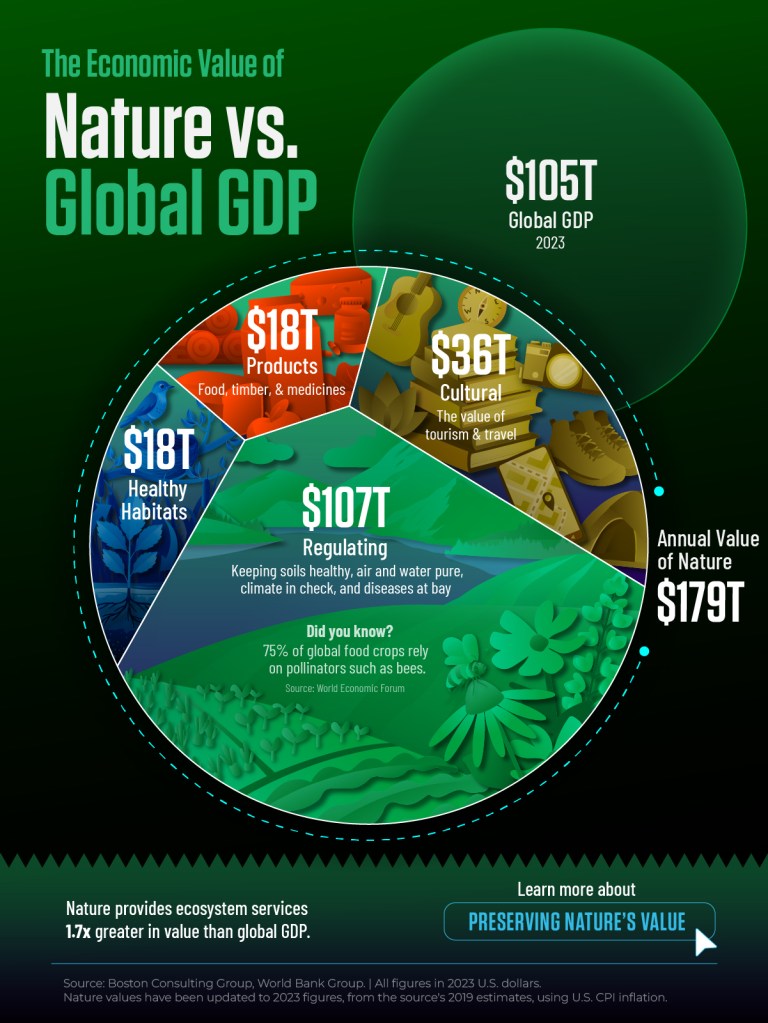
The value of nature (Source: Visual Capitalist)
I hate the term ‘ecosystem services.’ Its such a transactional name for what is essentially a function of ensuring our world supports life. But even if you look at this through an economic lens, the value of nature is clear. Nature is 1.7 times more valuable than the global economy.
📺 On the (You)Tube
Turns out that mega projects are really hard to build. The Japanese are building a levitating train between Tokyo and Nagoya. And the project is running late. Very late. As this video by B1M explains.
Speaking of which, my Thameslink service left St Pancras and is half way to St Albans. Better get a move on.
📚 Random things
These links are meant to make you think about the things that affect our world in transport, and not just think about transport itself. I hope that you enjoy them.
- Here’s How All Online Maps Are Handling the ‘Gulf of Mexico’ Name Change (Wired)
- Why Gen Z Will Never Leave Home (Maclean’s)
- Should People Be Told? (Arctic News)
- Anti-Monopoly Is the Path Forward (Democracy)
- Notes from the “politics factory” (Science)
📰 The bottom of the news
You probably have heard of padlocks being left on bridges. But how about tomatoes? Because those are being left on a bridge in Dublin.
For those of you who have kept track, I am finishing this newsletter just as I leave Leagrave station. So just in time! 😊
 Mobility Matters