

By downloading this file, you can listen to this newsletter on the go, or as an alternative to your screen reader. And it’s in my voice! 😊
Good day my good friend.
Over the coming couple of weeks, I will be spending a lot of time out and about as part of a public consultation on a Draft Transport Strategy that I helped write for Transport for the South East. As a result, newsletters will be slightly more to the point than normal over those weeks, as I spend most of the rest of my week trying to catch up with work.
Regardless of all of that, lets get things going.
📕 I have co-authored a book on Mobility-as-a-Service, which is a comprehensive guide on this important new transport service. It is available from the Institution of Engineering and Technology and now Amazon.
💼 I am also available for freelance transport planning consultancy, through my own company Mobility Lab. You can check out what I do here.
❌ Doing nothing is not an option
How do you make a councillor do what you want them to do?
You may have experienced it. You have spent months perfecting this scheme that will revolutionise cycling in your area. Its almost perfect. Then you take it in front of the Cabinet Member for Highways, and they say…no?
Clearly this is another example of politicians just not getting it. Am I right?
I actually think that this is an example of us not getting it. And by it, I mean an ounce of political awareness.
In this very newsletter a couple of weeks ago, I stated that a positive and constructive relationship between councillors and officers was a necessary pre-condition for getting favourable decisions on sustainable transport schemes.
Too often, we as professionals do nothing to develop this relationship outside of something that is transactional. In some respects this is inevitable, as not all councillors can know all officers. Which makes the job of senior officers more important in creating an environment of trust and safety between cabinet members and officers.
Luckily, there is a lot we as professionals can do to make this happen. Based upon my own research into the importance of this relationship in sustainable transport decisions, there are several things that you can do right now to tip the odds of favourable decisions ever so slightly in your favour:
- Establish the ground rules for engagement. The first time you speak, state what you are asking for, and ask them what they need to know to make the decision you need from them. If you cannot provide it, end the conversation there. If you can, tailor your conversation around that.
- Show how your idea helps them to achieve their campaign promises. There should be ample evidence online of what they campaigned on. Find it. Make the line between your idea and their promises crystal clear.
- Show how your idea helps them achieve the Council Plan. Again, make this link very, very clear.
- Use crystal clear language. Keep the technical jargon to a minimum. Be explicit and straight with them, and use clear language to say what you mean. If you must use technical language, ask if it needs to be explained.
If you have the time and the resources available, you can take things up a notch further:
- Establish a political liaison. This could be a single officer or small team who’s responsibility is to ‘speak councillor.’ They help members of the transport team in communicating what they are doing, and develop a trustful relationship with councillors.
- Commission regular public surveys on sustainable transport. The purpose of such a survey is not to understand what people think of sustainable transport, but to understand how pertinent it is to them on an ongoing basis. For example, how important is it in relative terms to other services? This provides you with evidence to inform discussions with decision makers.
Even then, success is not assured. But by taking these small steps, the odds begin to edge ever in your favour. And every victory is built on a lot of small wins.
👩🎓 From academia
The clever clogs at our universities have published the following excellent research. Where you are unable to access the research, email the author – they may give you a copy of the research paper for free.
The use of urban analytics in strategic planning – A case study of the greater Sydney region plan
TL:DR – Despite the extensive use of evidence, the role of data analytics in supporting decision making is far from direct.
Unveiling inequalities: The intersection of gender and income in accessibility in Curitiba, Brazil
TL:DR – Women tend to travel a lot less than men, except in the highest income groups, where women’s travel is dominated by short-distance car trips.
TL:DR – A lot of factors explain the hesitance of electric vehicle owners to offer up their electric vehicle to the energy grid. This includes issues over battery degradation, and daily mobility patterns.
High-speed rail network and regional carbon emissions: Carbon lock-in or unlocking?
TL:DR – High speed rail is good for the climate.
😃 Positive News
I also have a couple of personal stories this week. I have been out this week in Portsmouth and Brighton at some roadshows, talking to the public about the Draft Transport Strategy we created at Transport for the South East. And the comments were positive.
Not about the strategy, but about transport.
People LOVE buses. We had numerous comments about how the buses in Portsmouth and Brighton are amazing, and allow people to get around with ease at all hours. And to be fair to the people in Brighton, they do have an amazing bus company. Common praise included how a happy driver made people happy, and that the buses were really frequent.
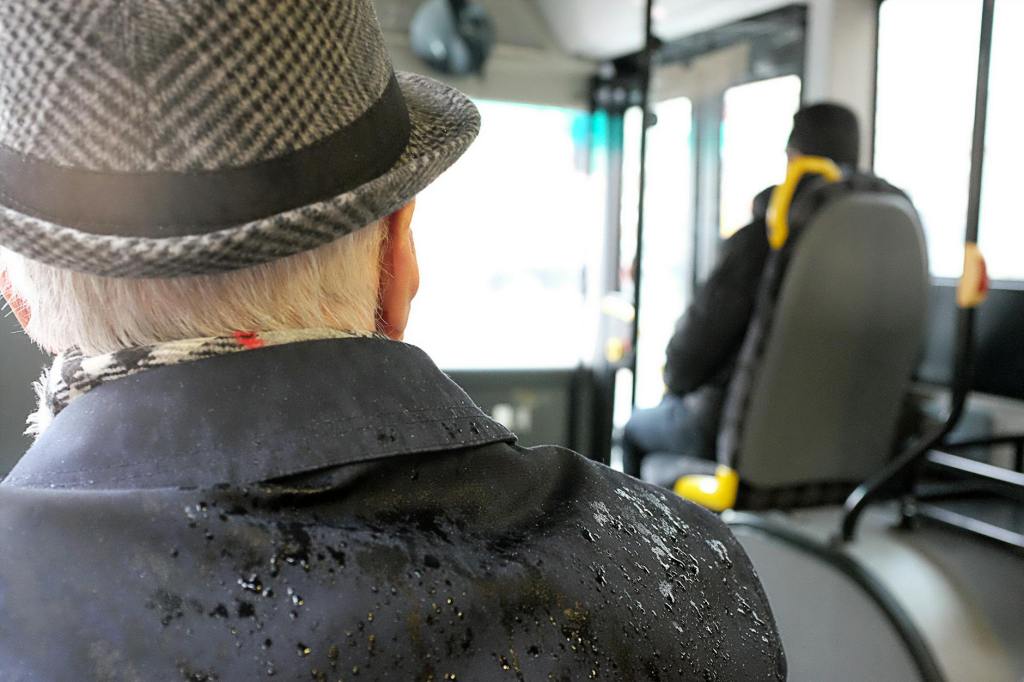
Another one was the story of an old lady from Brighton, in her 80s she told us, who told us about how wonderful her free bus pass was. In her words.
One day I can go and visit my daughter in Worthing, and the next day I can go and have a cup of tea with my son and his family in Lewes. All for free! I don’t have a car, and so the free pass and the buses being great means I can see my family. Isn’t it wonderful?
That, my friends, is why I do my job.
🖼 Graphic Design
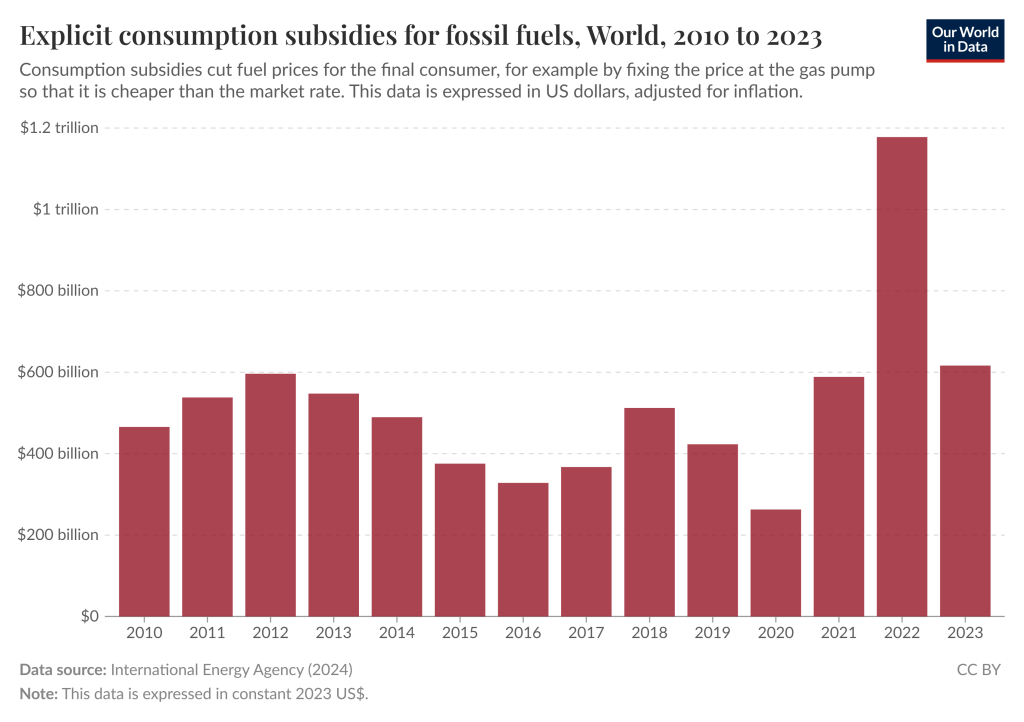
Consumption subsidies for fossil fuels across the world by year (Source: Our World In Data)
If you told someone that we are subsidising something that is destroying the world, you would be told you are mad. Yet we are subsidising the consumption of fossil fuels. This has been highly variable. It peak in 2022 at $1.2 TRILLION in subsidies globally – largely due to the Russian invasion of Ukraine. But it has fluctuated between $300bn and $600bn globally.
📺 On the (You)Tube
Recently I have been reading a lot about the degrowth agenda. Namely where human prosperity continues without economic growth being the imperative. Us transport planners know that economic growth decoupled from transport growth some time ago, but if you want a more comprehensive introduction to this interesting idea then this video by DW Documentary called ‘Is prosperity without economic growth possible?’ is well worth a view.
📚 Random things
These links are meant to make you think about the things that affect our world in transport, and not just think about transport itself. I hope that you enjoy them.
- The deadly DC plane crash raises a major question about air travel safety (Vox)
- Antarctica in 2025: Drivers of deep uncertainty in projected ice loss (Science)
- Lessons for the End of the World (New Yorker)
- Accidental Rancher: Community and Loss (The Daily Yonder)
- Uber CEO warns robotaxis can’t find a fast route to commercial viability (The Register)
📰 The bottom of the news
When getting off a plane, you need to check you have a few things. Your passport, tickets, wallet, bags, the usual. The rest is up to the ground crew, who in the case of one family in New Zealand failed in their job. By failing to unload a family’s cat. After a flight to Australia, Mittens was left on board and took the return flight back to New Zealand, before being sent back to Australia. Needless to say, Mittens was not happy.

 Mobility Matters