
Good day my good friend.
A public service announcement for the next two newsletters. As I have a deadline of next Wednesday for some work, I am really stretched for time. You will receive something on Monday and Wednesday, but it will be to the point.
📕 I have co-authored a book on Mobility-as-a-Service, which is a comprehensive guide on this important new transport service. It is available from the Institution of Engineering and Technology and now Amazon.
💼 I am also available for freelance transport planning consultancy, through my own company Mobility Lab. You can check out what I do here.
🚗 We are using our cars less
On Monday evening, I attended the Transport Planning Society’s Transport Planning Day celebrations in London. It was a lovely event where I got to meet some of you lovely people (special shout out to Orla, Anna, Mark, Christian, Ben, and Jack – you know who you are 😉), and it tackled a nice and simple issue – reducing car use. The discussion was wide ranging and thought provoking, with the general consensus being that reducing car use is politically challenging, and a very hard message to sell.
The thing is, I disagree. And the reason why I disagree is simple: we have been doing it for the last 20 years, and nobody has noticed.
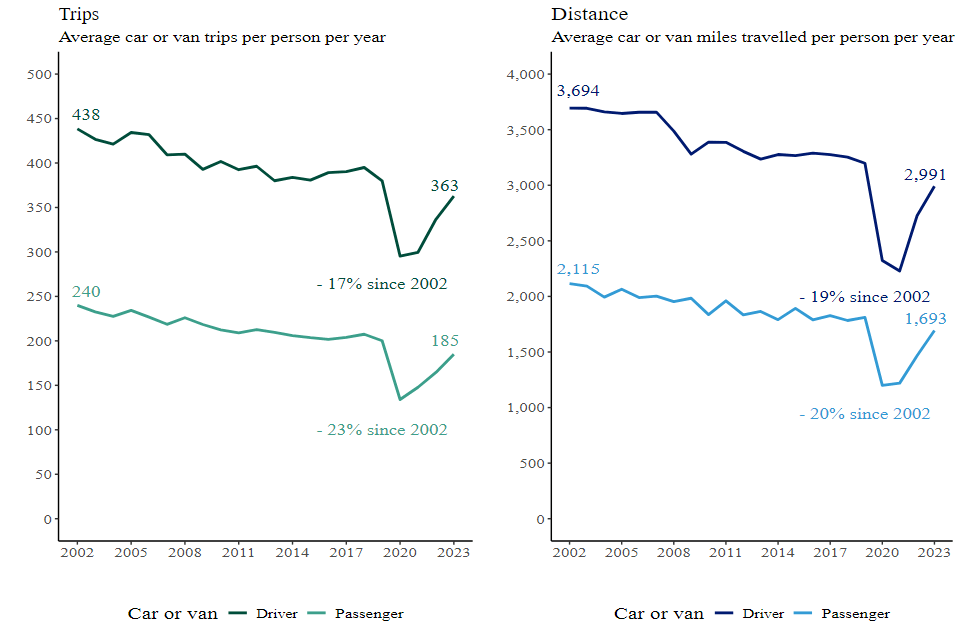
To show what I mean, we need to crank out the old reliable of transport statistics, the National Travel Survey. Namely, this figure right here.

What this shows is something extremely stark. In terms of the number of trips, distance travelled, and hours travelled on average per person per year, we travel less than we did at the turn of the millennium. While the 2023 figures can partly be explained by a long-run COVID-19 impact, the trend before the pandemic hit on each of them was very, very clear. It was downward.
When we look at car trips and distance, its the same. A downward trend since the start of the millennium. Around a 17% reduction in car driver trips, and a 19% reduction in distance covered by car drivers.
In many respects, we are failing downwards. If you take the overarching narrative around transport policy being that we have failed to do something meaningful for the last 20 years, the fact that we are failing yet still reducing personal trips and distance by all modes and cars specifically is nothing short of amazing.
But this does not tell the whole picture of course. As some things have very much gone up. For example, between 2000 and 2023 the amount of vehicle kilometres driven on English roads has increased by 13%, while the amount of vehicle kilometres driven by cars has increased by around 7% in the same time period.
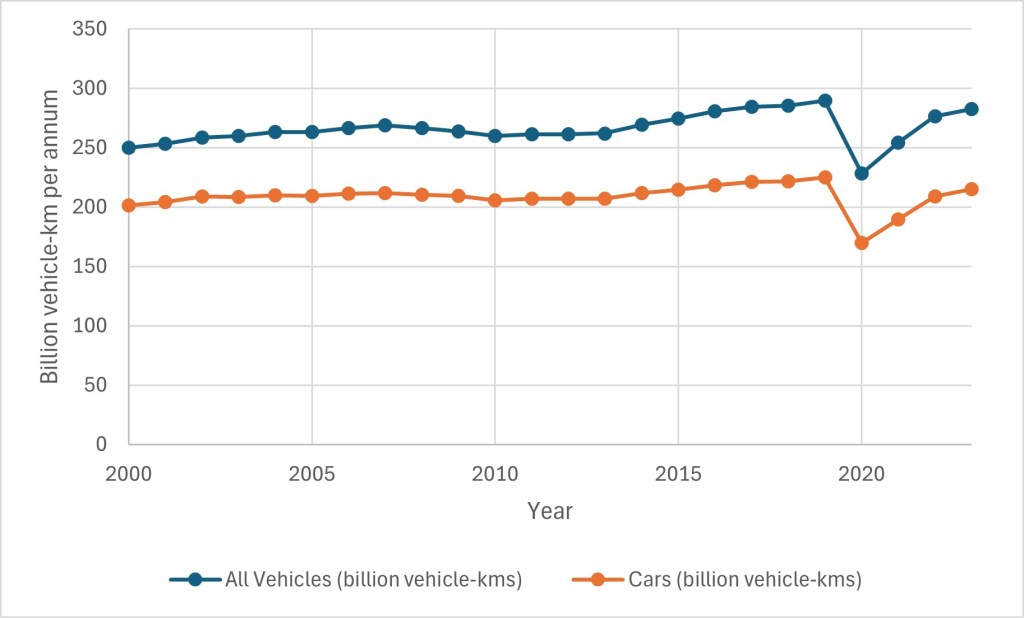
Vehicle-kilometres in England per annum (Source: Road Traffic Statistics)
The statistics also show that the number of vehicles registered, including cars, has also substantially increased during this time. Substantially so. Since 2000, the number of registered vehicles has gone up by 37%, while the number of registered cars has gone up by 32%.

Total number of registered vehicles in England (Source: Vehicle Licencing Data Tables)
Yet when we combine the amount of vehicle kilometres by the vehicle fleet size, something interesting happens. What this is shows is that the average vehicle-km per vehicle per annum has broadly slightly reduced. For cars, the drop between 2000 and 2023 was 8%, while for all vehicles it was 4%.

Average vehicle-km per vehicle per annum (own analysis)
So taken in conclusion. Individually we are driving less, but collectively we are driving more and own more vehicles, which are not being utilised as much. The Department for Transport, in its modelling guidance, primarily puts this effect down to population growth. For good reason. In 2000, the UK population was 59 million people, and it was around 68 million people in 2023. One could reasonably assume that, had the population not grown as it has, we would in fact be seeing less traffic on our roads right now.
That’s incredible to think about, given the litany of transport policy failures since 2000. We have successfully managed to reduce personal car use and personal travel and we have done it almost by accident.
Things like this remind me of the first thing that I was taught as part of my Transport Planning Master’s Degree. Transport is a derived demand. I think that we forget that sometimes. We can do all that we want to encourage modal shift and reduce car use. But we are talking about people’s lives. And shifts in how they live their lives will likely matter more than any policies we come up with.
But this also poses a significant challenge. To tackle things like the climate emergency, we need to reduce the amount of car travel there is in terms of vehicle kilometres. If we assume that the population will continue to grow, one can only think of the truly monumental reduction in personal car use that is needed. I would guess that if the target to reduce overall use was 20%, personal car use would need to drop by likely more than 30% to even stand a chance of achieving that goal. Considering that over 20 years we have reduced car use by 17%, that is a tall order.
👩🎓 From academia
The clever clogs at our universities have published the following excellent research. Where you are unable to access the research, email the author – they may give you a copy of the research paper for free.
The bright side of low-carbon technology sharing in a capital-constrained supply chain
TL:DR – Sharing technology is good.
TL:DR – Free public transport does not improve air quality.
TL:DR – In some cases, a shift to lower carbon fuels for aviation may lead to an overall increase in energy use.
The biosocial health of U.S. long haul truckers: Syndemics of the road
TL:DR – Forget what you think you know about the health of those who do long haul freight.
📺 On the (You) Tube
I don’t think Not Just Bikes is a fan of driverless cars.
📻 On the Wireless
Remember the start of the COVID-19 pandemic? When all the stores emptied of essentially everything. The 99% Invisible podcast goes behind the scene on how the world’s supply chains buckled under the strain of COVID.
📚 Random things
These links are meant to make you think about the things that affect our world in transport, and not just think about transport itself. I hope that you enjoy them.
- How to Not Die in Silicon Valley (Wired)
- Last Days of Soho (The Fence)
- The Other Side of the World’s Largest Dam Removal (Hakai Magazine)
- The metaphors of artificial intelligence (Science)
- How close are we to an accurate AI fake news detector? (The Conversation)
👍 Your feedback is essential
I want to make the newsletter better. To do this, I need your feedback. Just fill in the 3 question survey form to provide me with quick feedback, that I can put into action. Thank you so much.



 Mobility Matters