

Good day my good friend.
This week is a bit of a crazy one. So you will have to forgive the bluntness.
📕 I have co-authored a book on Mobility-as-a-Service, which is a comprehensive guide on this important new transport service. It is available from the Institution of Engineering and Technology and now Amazon.
💼 I am also available for freelance transport planning consultancy, through my own company Mobility Lab. You can check out what I do here.
🔭 Those who predict, don’t have knowledge
A nice little fun quote by ancient Chinese philosopher Laozi there. And I couldn’t help but think about this when reading an old book last week, which reminded me how hard it is to predict the future.
That book was written in 1919 by Claude Grahame-White and Harry Harpur. It is called Our First Airways – Their Organization, Equipment, and Finance, and I found it at the Bull Window Bookshop in Lewes. As you can guess by the title, what they are speaking of was the newest form of transportation at the time – aviation.

An old book
This was a time barely 16 years after the very first flight at Kitty Hawk, North Carolina. Planes had been a key part of World War I, having just come into military use prior to war breaking out. And if there is anything that spurs technological development, its the necessity of war, sadly. So the outlook for this new technology is optimistic. As the book itself starts off by saying…
“The aircraft industry, now and in the future, must receive not only the financial support of the Government, but also the moral support and engagement of the entire nation.
No cry for retrenchment, however desirable in other directions, must be allowed to retard the progress of aeronautics.
Money spent on aircraft is a form of national insurance – an insurance against our peril should some enemy, attacking us by air, endeavour to strike a blow so sudden and so paralysing that the whole nation, crippled and disorganized, would be compelled to sue for immediate peace.”
On a slight aside, I cannot help but read this – nay, the entire book – in the tone of Received Pronunciation. People from Britain who have ever watched clips from the BBC from the 1960s will know EXACTLY what I am referring to. Anyway.
In this book, the authors set their case for the establishment of the first airways, spreading forth from London to Paris and New York. In a manner that they themselves describe as “unashamedly propaganda.”
In their vision, air corridors would be established between major airfields, with aircraft carrying up to 25 business passengers as well as high value cargo that needs to be transported quickly and thus at high value. Every 10 miles along the corridor would be air strips of 60 acres in size, fully equipped with mechanics and replacement aircraft, so that should aircraft run into a spot of bother they could simply land, transfer the passengers and cargo to another aircraft and fly again. To give an idea of scale, you can fit about 80% of a football pitch in an acre.
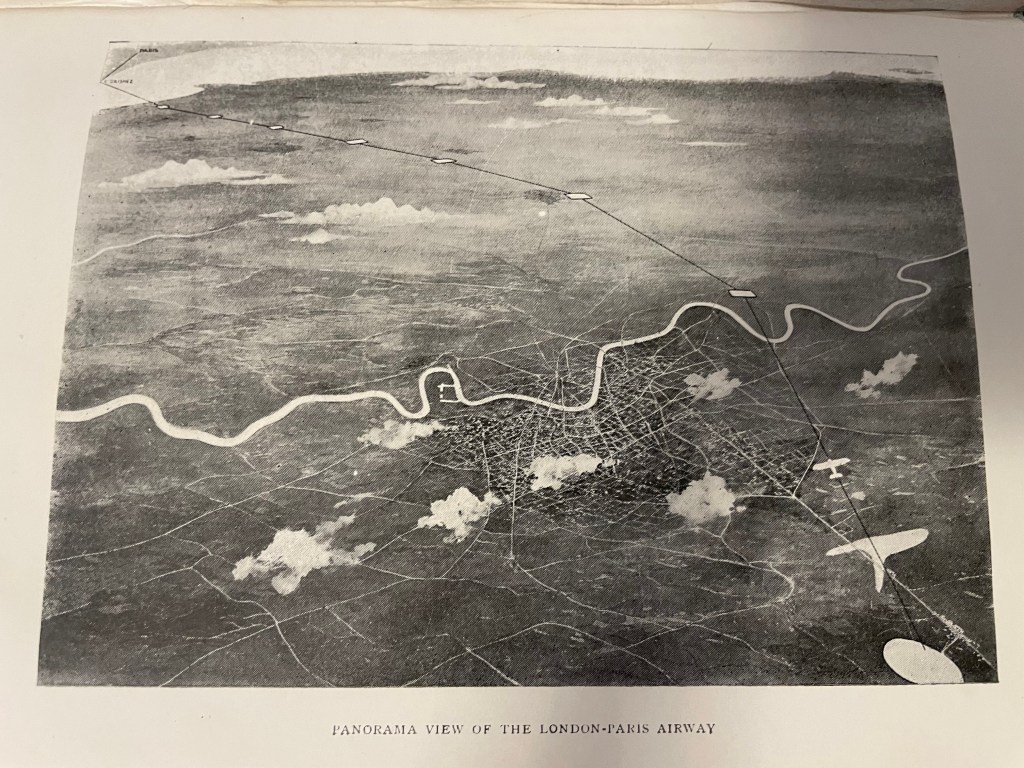
A photo from the book showing the London to Paris Airway
It demonstrates this through the London to Paris route. It also mentions a route via New York in passing, saying something about potentially having stop-over strips in the Azores, and seemingly forgetting Iceland exists.
The economics behind this, once you finally remember what 2s 6d is, is essentially that this will be faster than the train and boats at the time (they estimate a flight time between London and Paris of 2 to 3 hours), and so people on higher incomes who value their time will pay for it. Which seems to make some kind of sense. It also says that engines won’t be mounted on wings but instead be between the cockpit and passenger cabin. Which is…interesting.
The book sets forth a vision for what the first air routes will be like and their passenger offering, the latter based on the idea that speed is what will drive the experience. But it contains an important lesson for the challenges of prediction when it comes to technologies and transport.
Looking back on these, they seem laughable in an era where aircraft can fly from Europe to Australia without stopping. But within the context of the time, this is likely to have been seen as somewhat visionary, and based upon the practicalities of the technology of the time.
The idea of having air strips every 10 miles had been proven already, by the Italians in World War I. First class and combined passenger and freight traffic had been proven on the railways, with the richest in society often being the first adopters of faster transportation technologies. Notably another new kid on the block at the time: the car.
It was also not outside the realms of possibility as in 1919, the very first international air service started. Between London and Paris. It had on board the pilot Bill Lawford, George Stevenson-Reece of the Evening Standard, two grouse, leather, and Devonshire cream. It was flown by Air Transport & Travel Limited, who now go by another name – British Airways. Barely a year later, KLM launched its first international air route between London and Amsterdam. Both of them flew non-stop, and without the need for a series of air strips, just in case.
The predictions that we make around technologies are often based on our current understanding of their capabilities. So often we make predictions about things like autonomous vehicles, artificial intelligence, and mobility as a service that is based upon our understanding of what that technology can do now. In reality, if these technologies change the world, they are likely to change it in a way that we cannot yet envisage. Their mere existence gives rise to new possibilities, and it is up to human creativity and ingenuity, as well as a lot of experimentation, to come up with what works.
Both Claude Grahame-White and Harry Harpur would likely have imagined that the technology in aircraft would improved. But I dare say they could not have imagined that within 60 years, middle class Brits would have been flying to Spain for a few days on holiday, or that London to New York could be flown within 3 hours.
I think that we need to sometimes take a step back when discussing the future of transport and the technologies involved, and really start to think about the opportunities they could create. Only when that happens can we start to think about how much a technology could change the world. Its hard to say that the technology written about in this book from 1919 has not done that.
👩🎓 From academia
The clever clogs at our universities have published the following excellent research. Where you are unable to access the research, email the author – they may give you a copy of the research paper for free.
The impact of congestion charging on car ownership: Evidence from a quasi-natural experiment
TL:DR – Yes, it does help to reduce car ownership.
TL:DR – Deliver high speed rail, reduce emissions.
TL:DR – Yes.
Complementarity and substitution between public transport and bicycles
TL:DR – Less distance between public transport stops, bicycles substitute.
📺 On the (You)Tube
It is important that electric vehicles make some kind of noise for all sorts of reasons. But what kind of noise should it make?
🖼 Graphic Design
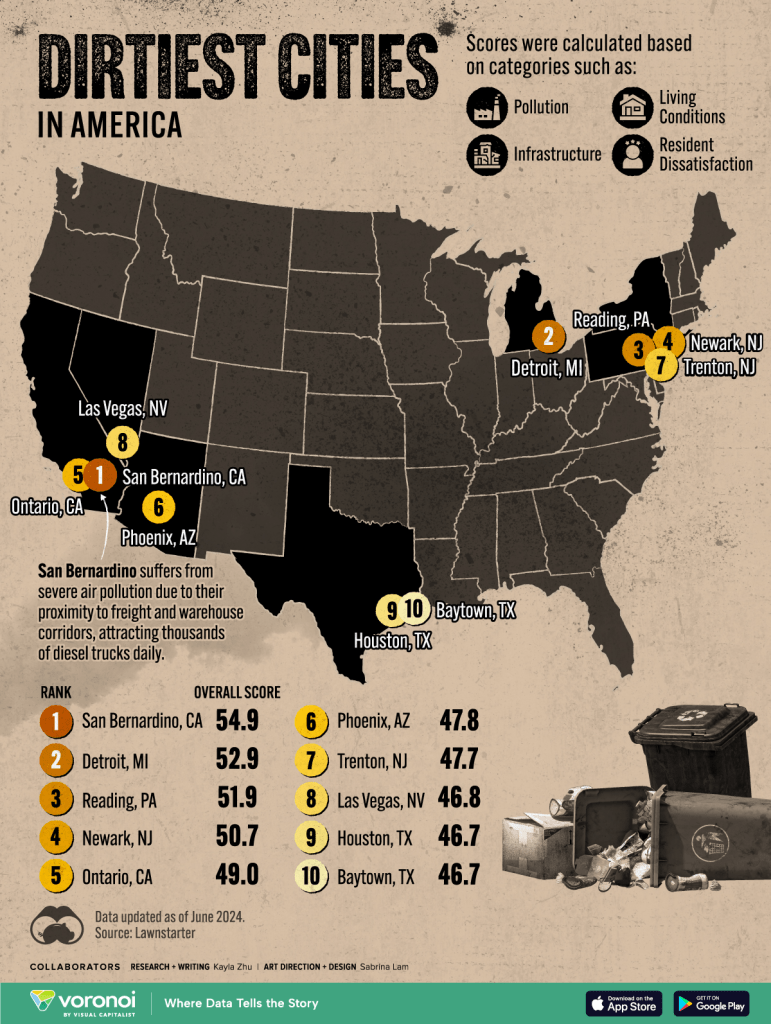
The Dirtiest Cities in America (Source: Visual Capitalist)
Cars and lorries are a big source of dirty air. It’s no shock to see that they play a big role in what cities are the dirtiest.
📚 Random things
These links are meant to make you think about the things that affect our world in transport, and not just think about transport itself. I hope that you enjoy them.
- Why history continues to shape racial inequality in the US (Vox Dev)
- No, America’s battery plant boom isn’t going bust – construction is on track for the biggest factories, with over 23,000 jobs planned (The Conversation)
- Project 2025’s Elimination of Head Start Would Be Disastrous for Rural Families, Advocates Say (The Daily Yonder)
- Policy evaluation and the causal analysis of public support (Science)
- Chimpanzees will never randomly type the complete works of Shakespeare (New Scientist)
👍 Your feedback is essential
I want to make the newsletter better. To do this, I need your feedback. Just fill in the 3 question survey form to provide me with quick feedback, that I can put into action. Thank you so much.
 Mobility Matters