

Good day my good friend.
While many of us enjoyed the extra hours sleep on Sunday morning, I am not. For right now, I am writing this to kill some time for an hour, as my lovely dogs have no concept of the clock change, and instead decided I must serve them breakfast at the ‘old’ time. They don’t tell you these kinds of things before getting a dog, so consider this a public service.
📕 I have co-authored a book on Mobility-as-a-Service, which is a comprehensive guide on this important new transport service. It is available from the Institution of Engineering and Technology and now Amazon.
💼 I am also available for freelance transport planning consultancy, through my own company Mobility Lab. You can check out what I do here.
👍 Finally, some ambition
In a world where there is a lot of climate bad news, and a lot of broken promises on climate change, having some hope and ambition is hard to come by. Which makes any flicker of it much more valuable. So on Saturday, when the Climate Change Committee in the UK advised that the UK should be much bolder in offering up its Nationally Determined Contributions (NDCs) to cutting emissions, this was very welcome.
The headline made the, well, headlines. Achieving an 81% reduction in carbon emissions by 2035 compared to 1990 levels. As of 2023, UK carbon emissions have been cut by around 53% compared to 1990 levels, to give you an idea of where things are at currently.
This 81% is necessarily ambitious, but what does this mean for transport? Sadly, the CCC letter to Ed Miliband does not go into detail on the calculations, instead stating that in order to provide the advice it had to speed up its analysis that underpins the advice for Seventh Carbon Budget due to report next year. But the advice within the letter does contain some interesting insight.
For one, the advice is based upon accelerating the roll out of existing technologies and deployment of emerging technologies to help reduce emissions quickly. The letter specifically recommends re-instating the 2030 phase out for new petrol and diesel cars, and removing planning barriers to electric vehicle charging points. As well as planting lots more trees and restoring peatland to act as carbon sinks.
A really interesting insight from the letter is on the role of international aviation and shipping (IAS). These are excluded from NDCs. If Britain’s share of these were included in its NDCs…
by 2035 IAS emissions will be the third largest source of emissions in the UK and by 2050 IAS will be the second largest source after agriculture.
As such emissions are being dealt with at an international level, the response so far has been floundering. Even the CCC itself says this.
If this seems a bit techno-focussed to you, this should not be a shock. The CCC’s own data for the Sixth Carbon Budget shows that if behaviour change alone were delivered, total transport emissions by 2050 would barely reduce compared to now. Primarily due to more trips being taken by people and businesses.
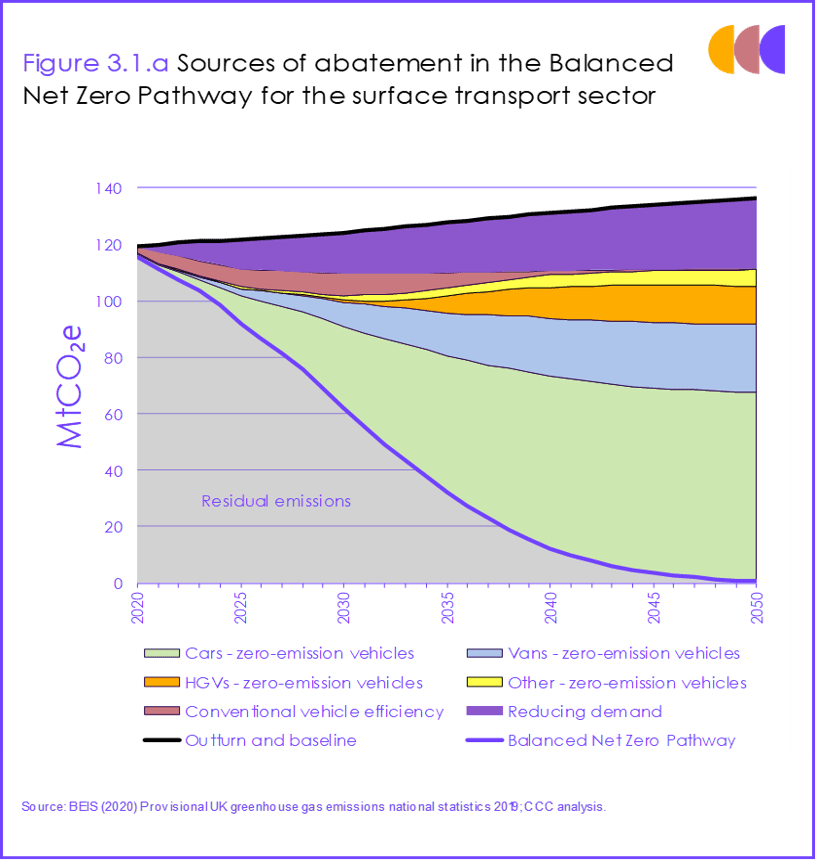
Technology is estimated to do a lot of the heavy lifting, along with policy initiatives to encourage more sustainable travel. While you might not like electric vehicles, and there are lots of other benefits to active travel and public transport regardless of carbon emissions, electrifying the vehicle fleet is essential to achieving Net Zero.
So there we have it. Expect to spend more time than planned rolling out electric vehicle charging points and working with the Energy System Operator and Distributed Network Operators to enhance electricity generation and distribution capacity. As well as rolling out more bike lanes and improvements to public transport. Your country, and your world, depends on you doing it. Good luck.
👩🎓 From academia
The clever clogs at our universities have published the following excellent research. Where you are unable to access the research, email the author – they may give you a copy of the research paper for free.
TL:DR – Cable cars could improve the accessibility of many urban areas.
TL:DR – Doing this could substantially improve transit coverage.
TL:DR – No.
Factors associated with speeding behavior: Literature review and meta-analysis
TL:DR – Think about moral norms and the past behaviour of drivers much more.
📺 On the (You)Tube
Inland waterways are the method of transportation that we think least about. Yet its importance cannot be understated.
🖼 Graphic Design

The lighthouses of the Great Lakes (Source: r/dataisbeautiful)
This is data visualisation done really well. In this case, the location of lighthouses around the Great Lakes.
📚 Random things
These links are meant to make you think about the things that affect our world in transport, and not just think about transport itself. I hope that you enjoy them.
- These Are the Rumors and Misinformation to Watch for on Election Day (Scientific American)
- Earth is now gaining less heat than it has for several years (New Scientist)
- Dots in a murky sky (Science)
- San Francisco Will Pay $212 Million for Its Train System to Ditch Floppy Disks (Wired)
- The massive dock workers’ strike, explained (Vox)
👍 Your feedback is essential
I want to make the newsletter better. To do this, I need your feedback. Just fill in the 3 question survey form to provide me with quick feedback, that I can put into action. Thank you so much.



 Mobility Matters