
Good day my good friend.
No time to waste, lets get straight to the newsletter.
📕 I have co-authored a book on Mobility-as-a-Service, which is a comprehensive guide on this important new transport service. It is available from the Institution of Engineering and Technology and now Amazon.
💼 I am also available for freelance transport planning consultancy, through my own company Mobility Lab. You can check out what I do here, and if you want to chat then email me.
🚍 How to save a public transport network
Don’t you forget about what has probably been the most successful example of transport policy and project planning, anywhere. Because of it, a public transport network is alive and kicking. Ok, enough with the Simple Minds puns, what am I talking about?
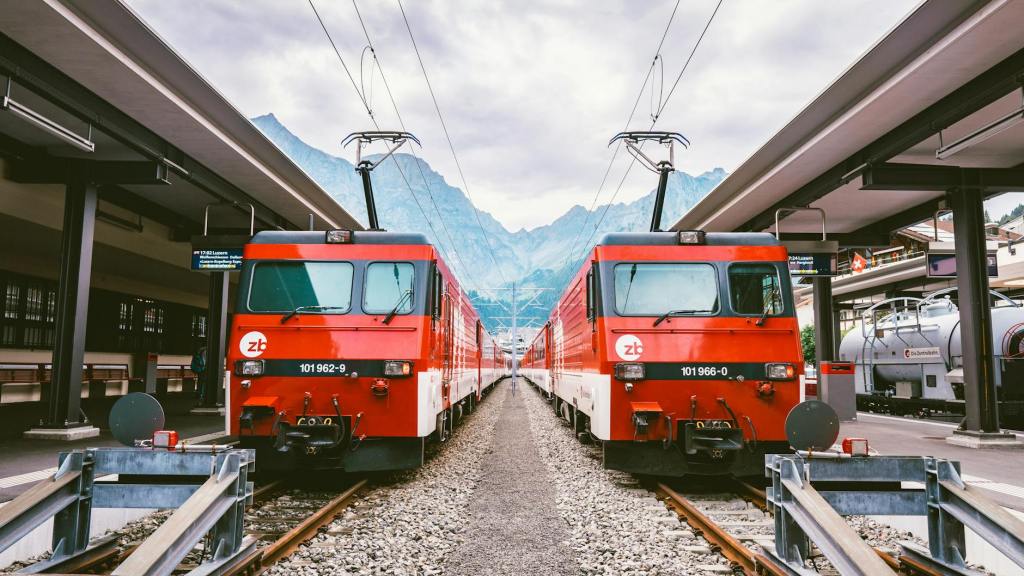
Back in the 1970s, the Swiss Federal Railways (SBB) was in trouble. Much like its other European peers, the construct of significant highway networks across the country had eaten into its passenger numbers. The trains were costing more to run, and carrying fewer passengers than they were before. Many countries railways, including British Rail, decided that what was needed was faster journey times to compete with the private car.
The Swiss, being…well…the Swiss, decided to do something different. They deduced that what passengers valued more than simply faster journeys was a regular, reliable, integrated service. So that is what they did. And working with the Federal Government, they developed the Taktfahrplan.
Well, I say it was the Swiss Railways and the Federal Government. The reality is more extraordinary. Over the winter of 1968/69, the “Spinner Club” – a group of timetable engineers led by Samuel Stahli – met every Monday evening after work and devised a new timetable for the entirety of Switzerland based on a simple idea. Every station should have services calling at it at the same time every hour. They presented it to the Swiss Railways, who liked it so much, the whole Spinner Club were invited to be part of a working group to put the timetable into action.
While the first integral timetable was rolled out across the railways in 1974, this idea of a regular service every hour at the same time did not get completely rolled out until 1982. By this time, this policy had become more refined:
- National services would call at Swiss railway stations at the same time every hour
- The major cities and towns of Switzerland would be linked by at least an hourly service
- Regional trains would be timed to provide connections to these national services
- The major bus operator, Postauto, would time all of its services to meet with services at local train station.
The above also acted as an informal hierarchy. Namely, the national rail service first, the regional rail service second, and local public transport providing the connections.
Such a simple change, based upon something that has been known for a long time. Many people would rather a regular, reliable public transport service as opposed to one that is fast. Not that fast isn’t valued, incidentally. And its not as is the Swiss Railways has not done its part to improve journey times, but even when this was done then this was to improve frequencies as well.
A big project that was kick-started in the 1980s was Rail 2000. Under this, a loan of 5.4 billion francs was made to SBB for infrastructure measures, including the new Mattstetten – Rothrist, Muttenz – Ölten, Zurich Airport – Winterthur and Vauderens – Villars-sur-Gläne routes. The introduction of such routes and line speed enhancements gave rise to another possibility – introducing a half hourly service on some routes.
The result of this? The Swiss railway keeps on breaking records. More passengers, more routes, more reliable services. Its a public transport system that is the envy of the world.
All of this based upon a very simple idea. Provide an integrated public transport system, with railways at its heart and local public transport providing the connecting services. Maintain connections between major centres in a consistent, reliable way, and boost line speeds where you can. Keep things simple, do it well. We could do well to remember this.
👩🎓 From academia
The clever clogs at our universities have published the following excellent research. Where you are unable to access the research, email the author – they may give you a copy of the research paper for free.
TL:DR – Different land use strategies work in reducing car commuting in the suburbs compared to the inner city.
The elephant in the room: Long-haul air services and climate change
TL:DR – If long haul flights were an elephant, Nellie would take up about half the room and spend her time daring us to talk about her.
Unlocking neighborhood density
TL:DR – Density is really complex and interesting. For example, while different areas have different densities, crowding can occur anywhere.
TL:DR – Putting numbers to urban vitality is tricky.
📺 On the (You)Tube
Yeah. Needless to say that they are not a fan of these trains.
📻 On the Wireless
The 99% Invisible podcast is always an excellent listen. But their latest episode on manhole covers in Japan is right up their street, and is a great listen. It makes me somewhat jealous when all I get to see is a small Anglian Water sign.
📽 Out and About
On my regular trip to Lewes, I managed to get a short video of something I have wanted to video for a long time. At the end of platforms 3 and 4 at the station is the entrance to the Lewes tunnel, which takes the line to Cooksbridge and Wivelsfield, from where the service continues to London Victoria. And as I was waiting for my London-bound train, a train to Eastbourne and Ore came the other way. This is the result.
📚 Random things
These links are meant to make you think about the things that affect our world in transport, and not just think about transport itself. I hope that you enjoy them.
- Clean Energy Transition Faces Looming Metal Supply Crunch (OilPrice)
- Britain’s workforce faces the crisis of its life as productivity has fallen to Victorian-era lows and youth worklessness spikes (Fortune)
- The Double-Edged Sword of Semiconductor Export Controls (CSIS)
- Balancing the Books: Five Novels that Explore the Complexities of the Stock Market (Literary Hub)
- The master plan to end EV “range anxiety” forever (Big Think)
👍 Your feedback is essential
I want to make the newsletter better. To do this, I need your feedback. Just fill in the 3 question survey form by clicking on the below button to provide me with quick feedback, that I can put into action. Thank you so much.


 Mobility Matters