

Good day my good friend.
I am writing this with the righteous fury of an annoyed Superman. So this will either be one of the best newsletters I have written, or it will crash and burn. You have been warned.
📕 I have co-authored a book on Mobility-as-a-Service, which is a comprehensive guide on this important new transport service. It is available from the Institution of Engineering and Technology and now Amazon.
💼 I am also available for freelance transport planning consultancy, through my own company Mobility Lab. You can check out what I do here, and if you want to chat then email me.
💩 Cut the c**p
Few news stories annoy me nowadays. I’ve spent 30 years surfing the internet, and my ability to get annoyed at news stories and posts burned out a long time ago. But sometimes it comes back. And recent article about electric vehicles have really grinded my gears.
EV demand has crumbled, apparently. Electric demand is waning, also. Demand for diesel is surging and could be making a comeback. Surely, the future is bleak for electric vehicles?
No, this is market growing pains and companies counting on constant significant growth to justify upscaling production of electric vehicles. But before we get into that, lets look at the UK picture, and for this we will use the Department for Transport’s Vehicle Statistics.
The most commonly referred to statistic is new vehicle registrations. Whilst petrol and diesel registrations are still the most prevalent single fuel types, since 2019 the growth in all types of electric vehicles (plug-in hybrid, hybrid, and battery electric vehicles) has been substantial. In 2019, these type of electric vehicles accounted for 9% of new vehicle registrations. In 2023, that was 39%.
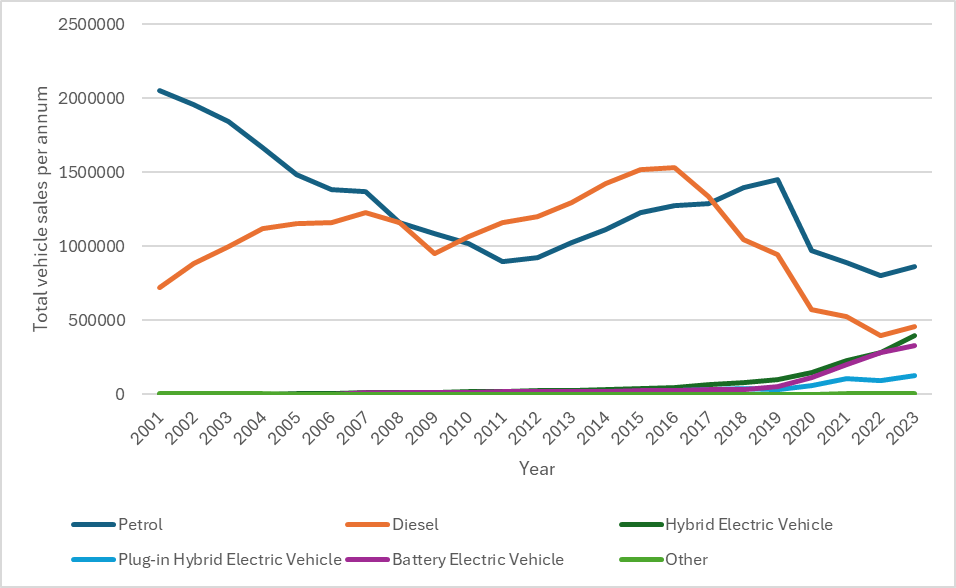
Total new vehicle registrations by fuel type (Source: Department for Transport)
For what its worth, I think that this rise as a percentage is a factor of two things. One is the growth in electric vehicle registrations. But two is the overall decline in new car registrations. In 2019, there were 2575399 new vehicle registrations, compared to 2173276 in 2023, a 15% reduction in registrations – and even 2023 was a rebound year.
When broken down as a percentage of the vehicle fleet, there is still a long way to go. As of the end of 2023, 8.4% of the vehicle fleet is some kind of electric vehicle or hybrid vehicle. In 2019, this was 2.3%. This is to be expected, as significant growth in electric vehicle sales has only really happened in the last few years. As the vehicle fleet naturally churns, with the average age of a vehicle currently running at 9.3 years old (as an owner of a 12 year old Honda Jazz, I can believe this).

Percentage of vehicle fleet by different fuel types (Source: Department for Transport)
What is driving this growth in sales is a complex range of factors. Legislative pushes like the Zero Emission Vehicle Mandate, the US’s Inflation Reduction Act, and China going all in on EVs can provide impetus for accelerating the production of electric vehicles globally. There has also been heavy discounting of EVs in order to stimulate sales, and now some lower budget EVs like the Dacia Spring are coming onto the market which are catering for those on more reasonable budgets.
There is also evidence that the appetite for EVs is increasing among consumers. 38% of European consumers expect their next car to be an EV, and 80% expect to get an EV in the future, with only 22% thinking they will not get an EV. Hardly a market that is suffering from a lack of interest. Although it should be noted that issues around range anxiety and the cost of EVs do remain, as well as demand being concentrated in China, the EU, and the USA (though it needs to be noted that around two-thirds of new cars globally are sold in these markets).
A further dynamic is the introduction of new competitors into the EV market, especially from China. If you need proof of the impact of this, the old car manufacturing industry playbook of lobbying for, and getting, import taxes on competitors from Asia who are doing things cheaper and better is alive and well in both America and Europe. Such as it was for Japanese car manufacturers, so it is now for Chinese car manufacturers.
There is some evidence that the growth in EV sales is not as significant as it has been in previous years. And that there is some evidence that EVs are being held in storage areas as the growth has not been as strong as in recent years. The 40% growth predicted is not manifesting itself in the way it was anticipated. In technology adoption terms, this is what is called “the chasm.”
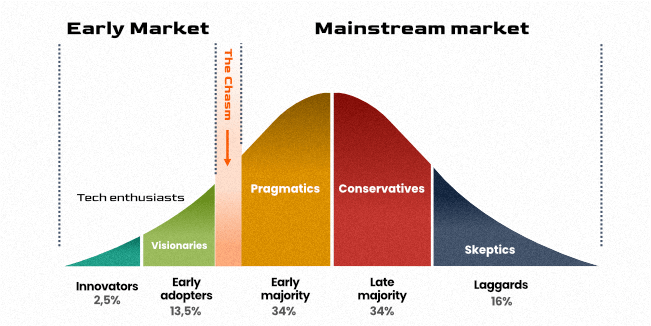
The technology adoption curve (Source: mdevelopers)
The idea behind the chasm is simple. When a new technology is introduced, there are a lot of eager early adopters who value the solution for it being innovative. But the pragmatics want comfort and reliability, for your solution to almost blend into the background and be effortless in its use.
What happens next is critical. EVs need to make the transition from essentially a luxury good to a standard, reliable vehicle, that is cheap to run and easy to maintain. For manufacturers, this is a dangerous time. Move too early, and millions in research and product development are wasted. Move too late, and you lose early mover advantage.
The response of the Society of Motor Manufacturers and Traders is a simple one: extend tax breaks for home charging, halving VAT on new electric vehicles, and scrapping changes to Vehicle Excise Duty. These have the combined effect of narrowing the chasm by stimulating sales, and consequently de-risking investment in developing and selling electric vehicles. The subtle hint being that manufacturers cannot discount forever.
In all, electric vehicles have seen significant growth in the last 5 years. That is a good thing, and mis-reporting statistics gives the impression that EVs are in the doldrums. They are not. But they are at a critical juncture. Moving from early adopters to pragmatic consumers is a hard leap to make. I would argue that it is a leap that is essential if we are to meet our climate targets. The only question is how. And I never thought I would say this, but on this occasion, the motor industry may be right.
👩🎓 From academia
The clever clogs at our universities have published the following excellent research. Where you are unable to access the research, email the author – they may give you a copy of the research paper for free.
TL:DR – Price and quality may impact on people’s choices to use autonomous ferries. Maybe.
Rural travel burdens in the United States: Unmet need and travel costs
TL:DR – It’s more of a pain for rural residents to travel to meet their every day needs. Especially if they are people of colour.
Towards a history of transit etiquette: the development of orderly boarding practices in Tokyo
TL:DR – The research calls for more research on etiquette and contestation in urban space. I suggest asking why does someone getting on a train before I get off it make me extremely angry very quickly.
Rethinking automobility in the suburb: Experiences with carsharing in a Danish suburb
TL:DR – Tailor the car clubs to the area.
📺 On the (You)Tube
Geoff Marshall plus Tube Moquette Designers = Strangely compelling video.
🖼 Graphic Design
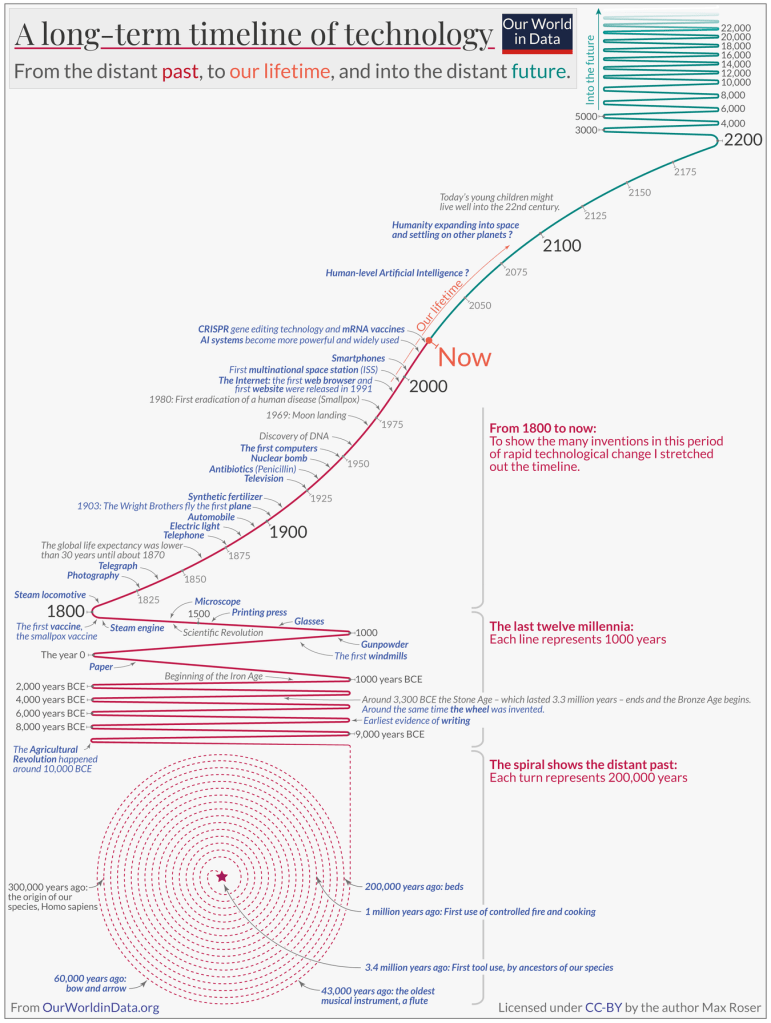
A long term timeline of technology (Source: Our World In Data)
Wow, us humans have invented a lot. This is a seriously impressive graphic by Our World in Data.
📷 Out and About
Last week I was out and about in Eastbourne, on the Sussex coast, discussing coastal flooding. But I got to see some good examples of public realm improvements. Including some placemaking in the town centre, and the largest public bandstand in the country. Maybe the presence of musicians on the street should be an indication of a good public space?


📚 Random things
These links are meant to make you think about the things that affect our world in transport, and not just think about transport itself. I hope that you enjoy them.
- Hurricane Milton Shows How a Storm’s Category Doesn’t Tell the Full Story (Wired)
- The Panama Canal needs more water. The solution could displace thousands. (Grist)
- Taxes are not About Urbanism (Pedestrian Observations)
- Twenty years after its discovery, graphene is finally living up to the hype (Science)
- How the Philippines sequestered carbon while reducing poverty and creating jobs (VoxDev)
👍 Your feedback is essential
I want to make the newsletter better. To do this, I need your feedback. Just fill in the 3 question survey form by clicking on the below button to provide me with quick feedback, that I can put into action. Thank you so much.




 Mobility Matters