

Good day my good friend.
Well, last Friday was rather lovely and much needed. A day of switching off from everything, and just focussing on having some relaxation time. Its amazing what just a day of putting your feet up can do for the energy levels. And looking ahead to the next couple of weeks, boy is it needed.
📕 I have co-authored a book on Mobility-as-a-Service, which is a comprehensive guide on this important new transport service. It is available from the Institution of Engineering and Technology and now Amazon.
🚌 The surprisingly complicated world of getting kids to school
There are relatively few statutory duties when it comes to providing transport services in the UK. But one that does exist is the provision of a service us transport planners almost never consider. Namely getting children to and from school.
The duties on local authorities in respect of transport to and from school is largely based on the Education Act 1996. These duties are summarised by the Local Government Association as:
- Provide free transport if a child is below 8 years old and is attending their nearest suitable school which is beyond a walking distance of 2 miles.
- Provide free transport if a child is aged between 8 to 16 years old and attends their nearest suitable school which is beyond a walking distance of 3 miles.
- Make transport arrangements if a child attends their nearest suitable school and cannot be reasonably expected to walk because the nature of the route is unsafe.
- Make transport arrangements if a child attends their nearest suitable school and cannot be reasonably expected to walk because of their special educational needs, disability or mobility problems.
- Provide free transport if a child is entitled to free school meals, or their parents are in receipt of maximum Working Tax Credit, and:
- they attend their nearest suitable school and it is beyond 2 miles from their home (and the child is aged between 8 and 11)
- they attend one of their three nearest suitable schools and it is between 2 and 6 miles from their home (and the child is aged 11 to 16)
- they attend a school that is between 2 and 15 miles of their home if their parents have chosen it on the grounds of their religion or belief, and having regard to that religion or belief, there is no nearer suitable school (and the child is aged 11 to 16)
This is an expensive obligation. This cost is also rising, especially for transport for those with Special Educational Needs (commonly referred to as SEND), where costs have risen from £727m to £1.4bn in just 5 years. Estimates of the total cost for home to school transport vary, but lets say between £1bn and £1.5bn every year is a reasonable estimate.
This is an obligation that is driven by demand. Local authorities can set out policies for how they will deliver such services, but the obligation remains, and local authorities will have no idea how much it will cost until the school year rolls around. And they cannot just decide to not meet it, otherwise they will be breaking the law.
This is a case where the wording of the law gives useful flexibility to local authorities. In that it only specifies home to school transport that needs to be provided for free to certain groups in certain situations. It does not specify how, just that free transport may be provided.
The typical means of transport is the school bus and taxis. The former of which is a good earner for bus companies, and the latter of which drives a lot of the cost of providing such transport. But this is not the only way that this can be done.
A common method is to literally pay the cost of a bus or rail season ticket if there is a bus or rail route within reasonable walking distance. In places like London, this goes one stage further by providing free travel on all buses and trams for those aged under 15 years old, and for those aged 16 years old or over, free travel on such modes for school travel. As the majority of trips are likely to be to and from school, and with bus fares capped at £1.75, this makes sense for Transport for London to avoid the administrative burden of monitoring these extra trips.
But some local authorities are being even more creative. Some are offering to pay the fuel or running costs for a set mileage for some parents or those offering to share a lift. Most commonly for SEND students who may have specific needs that only parents and carers can provide. This is calculated usually by measuring the shortest driving distance to school, and giving parents a School Transport Mileage Rate (STMR) in a single payment based upon 4 return trips per week at 45p a mile (the standard HMRC mileage rate used for tax purposes).
I cannot help but think on whether such an approach could also be applied to other modes of transport. For example, lets say a cycling school bus was put on by the school, arranged by a group of volunteers, running a set route each day. The volunteers could be compensated for their journey cost of the total return journey mileage of the route each day, 4 days a week, at 20p a mile (again, a standard HMRC rule for accounting cycling mileage for tax purposes). While the children get vouchers to buy school bicycles and safety equipment from local cycle retailers.
Another thing could be e-scooters. Whilst the current rules do not allow anyone without a driving licence to use an e-scooter (and consequently most if not all young people), local authorities could work with local operators to ensure that trips to and from a set e-scooter parking area before are covered by the local authority. And consequently are free to the school children and their families.
A common tactic used by local authorities in the past has been to spend money on upgrading walking and cycling routes to and from school to ‘safe’ standards. Thus meaning that school transport, especially for those judged to have qualified for home to school transport on the basis that there is an unsafe route, does not need to be provided. However, the case for doing so often fails for one or more of three reasons:
- The rising costs of physical infrastructure upgrades, and the timescales involved in delivery of such infrastructure, make this challenging to deliver in time for each school term, and make the financial benefits uncertain;
- The highest costs of home to school travel are in SEND, who may have specific travel needs and are likely to need dedicated transport even if the routes are upgraded;
- Business cases for upgrading such routes initiated by school travel teams are narrowly focussed on the costs and benefits to the school travel budget, and rarely consider the wider benefits (and costs) of upgrading such infrastructure.
While there is a lot of potential within home to school transport to do things radically differently and in a way that may reduce carbon emissions, and costs, as always we need to be mindful that there are factors outside of our requirements that significantly affect what we can do.
The County Council’s Network identifies that a big factor in the increasing costs of home to school transport is more young people being eligible for Education, Health, and Care Plans. Which sets another statutory duty on local authorities to provide transport to meet those needs. A decision that has an outcome for the child in mind, with little thought given to transport.
In all, this is a sector that is likely to see radical change over the coming years, either through choice or through force. The financial pressures on already over-stretched local authorities will increase, and unless a new act of Parliament is passed the law will not change. So this is a sector worth keeping an eye on.
👩🎓 From academia
The clever clogs at our universities have published the following excellent research. Where you are unable to access the research, email the author – they may give you a copy of the research paper for free.
TL:DR – Shipping companies sent ships around the Cape of Good Hope, and put on more ships to maintain frequent port calls.
TL:DR – If you own a car, you like it. If you don’t, you think cars suck.
Promoting Sustainable Transportation Modes: A Systematic Review of Behavior-Change Strategies
TL:DR – Go for personalised interventions, setting goals, and getting feedback.
TL:DR – Women make more DRT trips then men do.
📷 Out and About
After the recent heavy rains, the River Great Ouse in Bedford is flooding. This is what it was like when I went on a dog walk along the river on Saturday.
📖 Bedtime Reading
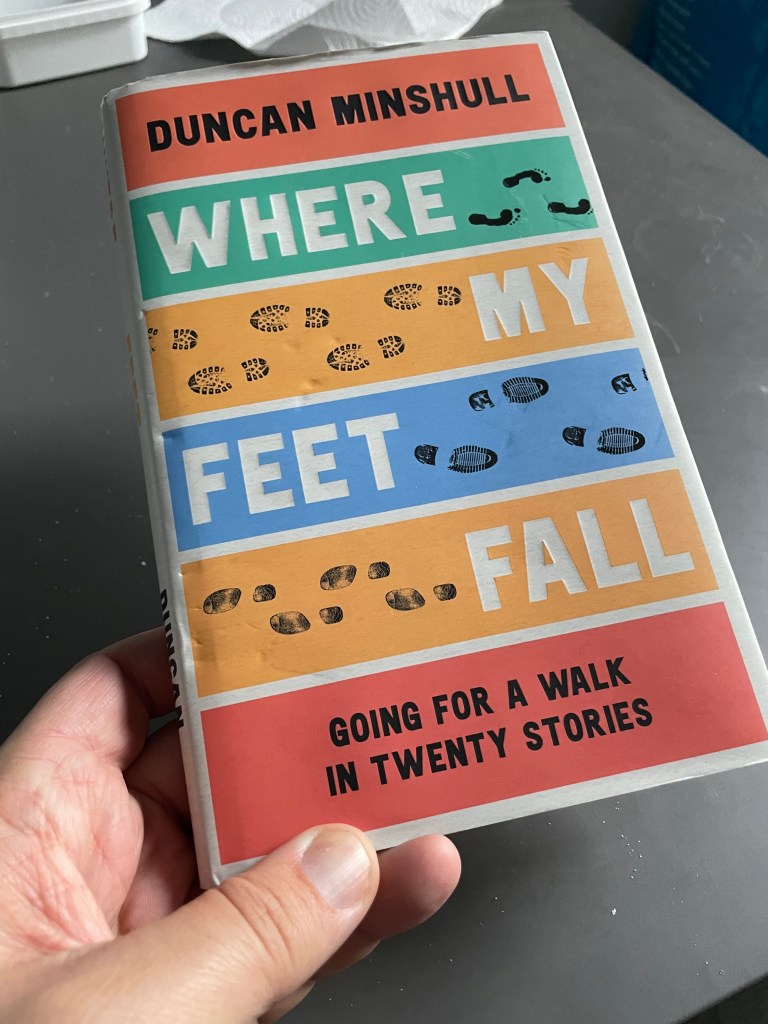
I am currently reading my way through Where My Feet Fall, a collection of short stories and essays about experiences of walking. Its very good, and makes me reflect on why walking should be valued. Its the most human experience any of us can have. The ability to experience the world in all of its glory, using our own steam.
📺 On the (You)Tube
Who could have seen that moving a runway at an airport would be so controversial? 🙄 This time, its the turn of Aspen / Pitkin County Airport.
📚 Random things
These links are meant to make you think about the things that affect our world in transport, and not just think about transport itself. I hope that you enjoy them.
- Above the waves (Highlands Rewilding)
- Quick Note on Capital City Income Premiums (Pedestrian Observations)
- Inside Kamala Harris’s Big Economic Pitch (New York Times)
- 45 Degrees North: Misunderstood Manners (The Daily Yonder)
- These Record-Breaking New Solar Panels Produce 60 Percent More Electricity (Wired)
👍 Your feedback is essential
I want to make the newsletter better. To do this, I need your feedback. Just fill in the 3 question survey form by clicking on the below button to provide me with quick feedback, that I can put into action. Thank you so much.


 Mobility Matters
One response to “🏫 Schools Out”
Hi James
Just picking up on the ‘Schools out’ blog – certainly thought provoking. This was mentioned at the Quality Bus Conference (apologies I can’t remember the speaker, but at the same time I can’t take the credit!). Essentially reminding us that this is a derived demand, in many cases due to the schools choice policy. Many children don’t attend their nearest school and so, the need for transport is created unecessarily. Whilst the London model works on one level, there are two key points to remember: firstly, there is a relatively good network making it easy to use their Zip cards to get to school. Secondly, you get huge concentrations of children in bus stations and interchanges in the afternoon. Even with the majority who are not misbehaving, they tend to hang around and it can be intimidating to vulnerable people. Many of these centres regularly have police PCSO presence just to ensure things don’t get out of hand.
Regards
Rob Hudspith
LikeLike