

Good day my good friend.
Friday of this week is going to be my first proper day off for a while – as in not having to do any event organising, errand running, or travelling for family reasons. So I look forward to a day of putting my feet up and playing The Legend of Zelda: Echoes of Wisdom all day. Because video games are my way of switching off. I am very much looking forward to it.
📕 I have co-authored a book on Mobility-as-a-Service, which is a comprehensive guide on this important new transport service. It is available from the Institution of Engineering and Technology and now Amazon.
⛑ What do we do to make change inevitable?
With many changes in society and technology, there comes a point where change is not only desirable, it is inevitable. As in something becomes so obvious a thing to do that not doing it is sheer idiocy, even if you try and stop it. This concept of tipping points is increasingly being spoken about in conversations on climate change, where the IPCC defines a tipping point as a
critical threshold beyond which a system reorganizes, often abruptly and/or irreversibly
In relation to climate change, these are often spoken about negatively, like if an ice sheet collapses or methane gets released. But tipping points can be positive and negative. In fact the Global Tipping Points Report 2023, which is an amazing report that you must read, identifies a series of positive tipping points as well as the negative ones. But more importantly, positive tipping points can reinforce one another.
A good example is that of electric vehicles. As the price of batteries has come down, so has the price of electric vehicles. This in turn makes them more accessible to the average consumer, who buys them. Which in turn provides money for research and development by manufacturers into better battery technology with longer life and greater range, with the incentive that if they don’t a competitor will. Which in turn improves electric vehicles, and you get the drift.
We are now at a positive tipping point in the energy sector. As I write this, the very final days of coal power in the UK are happening, with the Ratcliffe-upon-Soar power station due to close on 1st October. Part of the reason for this is because solar panels and wind turbines have become so cost-effective compared to fossil fuels. The numbers behind this are staggering. Just a few snapshots for you:
- More than three-quarters of new energy capacity in the USA is renewable energy
- Germany is installing record numbers of solar panels
- Last year, Pakistan installed nearly the equivalent of a quarter of its total energy grid capacity in solar panels
- In 2025, renewable energy will surpass coal as the leading global source of electricity
Again, this is easy to see why this is happening. Renewables are cheap and easy to install, and issues around variability of generation are easily solvable – notably through ‘flexing’ demand (e.g. using more energy when the sun is shining) and batteries. Installing new gas and coal plants has, in effect, become a bad long term investment.
So, if we are to tackle the climate emergency, what kind of tipping points are needed in transport. We know from the Committee on Climate Change that the two biggest things that the UK needs to do in order to decarbonise its transport system are electrification and behaviour change (or reducing demand).

Sources of carbon abatement in the Balanced Net Zero Pathway (Source: Climate Change Committee)
For electric vehicles, we are lucky in that we already have a leading country on the adoption of electric vehicles – Norway. So we can infer from their data what tipping points might be in terms of electric vehicle sales. This data is shown below.

Market share of electric vehicles (new vehicles) in Norway (Source: Statista)
The interesting thing to learn from Norway is that its path does not follow that of a vertical hockey-stick graph, but showed consistent increases over time. With the exception of 2020, but I am assuming that there is a COVID effect there. But the graph starts to get appreciably steeper between 2016 and 2017.
To me, this would indicate that once the percentage of new vehicles being electric vehicles passes 27%, the upward trend starts to steepen. Potentially passing a tipping point. In the UK, to date in 2024, 17.2% of new vehicles sold are pure electric vehicles. It also needs reminding that achieving just this tipping point and only for cars would reduce transport carbon emissions by nearly 50%.
I need to caution this observation based on the facts that (a) its based on a one country sample size, (b) plenty of other factors affect electric vehicle uptake, and (c) this is based off a visual reference of a graph, so hardly statistically reliable.
The more tricky tipping point to define is behaviour change. It leads to the inevitable question of at what percentage of trips being by sustainable modes are needed to effectively make using a car socially undesirable. The simple fact is – we don’t know yet what this behavioural tipping point will be. But I would like to offer some observations that may help in the hunt for this.
What we do know is that the main determinant of whether people travel by car is literally having access to one. Consequently, I would expect a behaviour change tipping point to include a vehicle ownership trigger. We know that 22% of households have no access to a car. So maybe achieving an increase in that of, lets say, to 40% might help trigger cascading change that discourages car use.
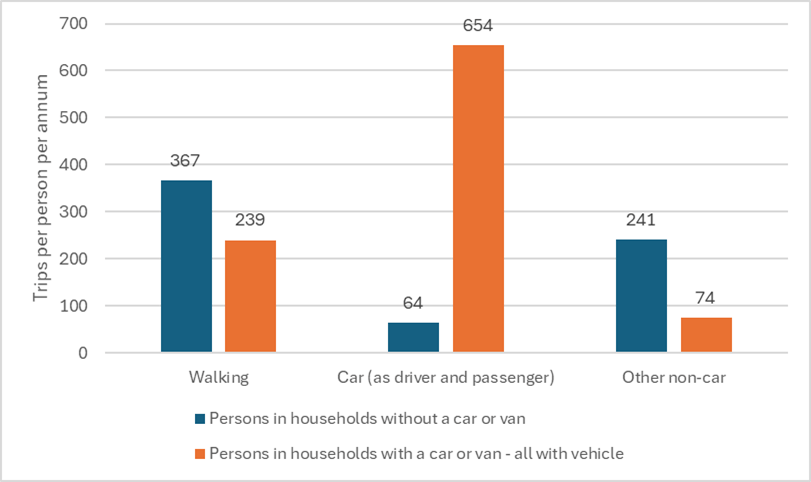
Trips per person per annum by mode by household access to a car – England, 2023 (Source: National Travel Survey)
The second factor is changes in long distance trips. We know from the data in the National Travel Survey that, while total trips per person has remained relatively unchanged (and in fact has gone down), we are travelling further. The data is very clear: 2.7% of the trips we take that are over 50 miles emit 70% of our carbon emissions from transport. Consequently, changes in average miles travelled per annum, or even the percentage of trips that are long distance
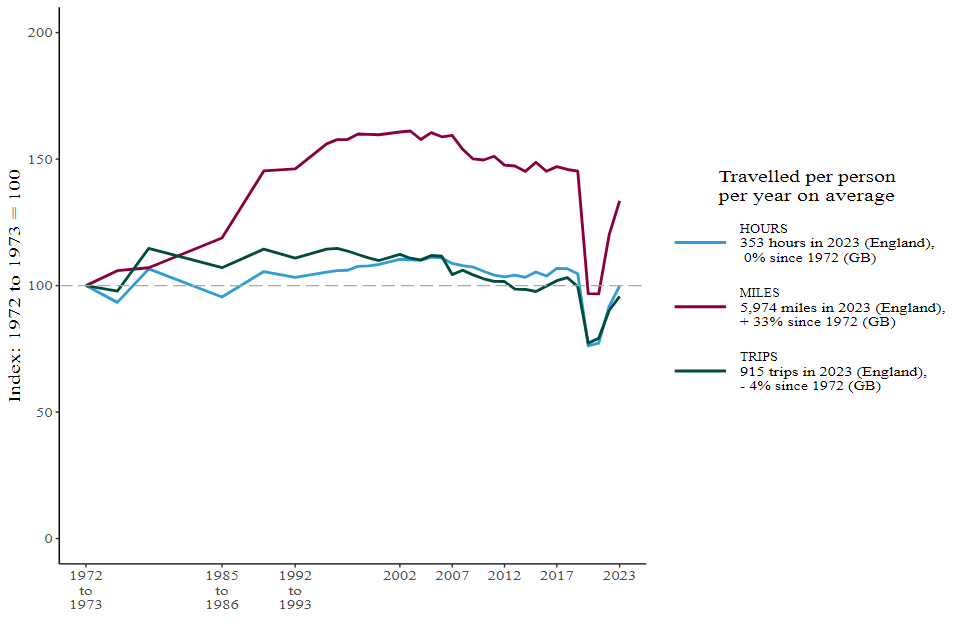
Trends in trips taken, miles travelled, and hours spent travelling: Great Britain (1972 to 1988) and England (1989 to 2023) (Source: National Travel Survey)
To me, this is a highly complex but incredibly compelling matter with all sorts of policy implications. It indicates that rather than having to have policy support to deliver the entirety of the transition, all is needed is to provide policy support to get things to a point where social and economic factors make the change inevitable.
This is something of a transport holy grail for me. Its the point where the right choice is so obviously right, it is stupid to choose otherwise. I hope that someone takes up this mantle of identifying the positive tipping points we need to achieve to make a better world. Because it might just be the most powerful and meaningful bit of research in creating a better future.
👩🏿🎓 From academia
The clever clogs at our universities have published the following excellent research. Where you are unable to access the research, email the author – they may give you a copy of the research paper for free.
Adoption of Chinese cars and the shift to electric vehicles: Early evidence from Norway
TL:DR – When people recommend Chinese cars to friends, they buy them.
TL:DR – Focus on engaging with under-served and under-resourced populations.
Hot and bothered: Exploring the effect of heat on pedestrian route choice behavior and accessibility
TL:DR – People feel the walk is further when its hot, and the effect is exponential as the temperature rises.
Growing disparities in transportation noise exposure across major US cities over time
TL:DR – People in minority groups are more likely to be exposed to noise pollution.
📺 On the (You)Tube
Someone is seriously fan-boying on Stockholm, here.
🖼 Graphic Design

Tracking a Flight with a Radiation Dosimeter and a Barometer (Source: r/dataisbeautiful)
I’m posting this purely because its cool. It also explains why pilots have higher rates of cancer compared to other professions.
📚 Random things
These links are meant to make you think about the things that affect our world in transport, and not just think about transport itself. I hope that you enjoy them.
- Jet contrails may cool the planet by day and warm it by night (New Scientist)
- Death of the Department Store (London Review of Books)
- The Challenge of Preserving Good Data in the Age of AI (Undark)
- Ukraine Is Decentralizing Energy Production to Protect Itself From Russia (Wired)
- A raised platform – regulating the digital economy (Policy@Manchester)
👍 Your feedback is essential
I want to make the newsletter better. To do this, I need your feedback. Just fill in the 3 question survey form by clicking on the below button to provide me with quick feedback, that I can put into action. Thank you so much.




 Mobility Matters