

Good day my good friend.
The final few days of work before you sign off for a week are both tiring and energetic. The latter because you have a break to look forward to. The former because you have a lot of work to get through to get there. So let’s get this newsletter done quickly, shall we?
Mobility Camp is back, and the number one transport unconference is heading to York on Friday 20th September. Book your tickets now! 🎫
I have co-authored a book on Mobility-as-a-Service, which is a comprehensive guide on this important new transport service. It is available from the Institution of Engineering and Technology and now Amazon. 📕
🤏 All schemes great and small
Transport planning has often been said to be obsessed with the big infrastructure projects. I remember reading in Lynn Sloman’s Car Sick how politicians love them. Mainly because they get to don their high-vis jackets and get lots of pictures of them ‘doing things.’ Even today, I often hear from fellow professionals how they really want to work on a big project like HS2 or Crossrail 2. That looks good on the CV, doesn’t it?
Personally, I like to think I see things differently to this. I mean, if you gave me the opportunity to work on HS2 I would jump at it. But the most meaningful projects that I have delivered, and look back upon with great fondness, have often been small in scale, but big in impact.
The one I look back on most fondly (and I often mention here) is Ridgmont Station Heritage Centre and Tearoom. I remember around 10 to 15 years ago when I joined the project, I went on a site visit with ACoRP (now the Community Rail Network), Network Rail, London Midland, and Bedfordshire Rural Communities Charity to see the condition of the old station house. The local Community Rail Partnership had aspirations to turn it into a community hub, and as we went inside the condition was. Well, it looked like it had not been used in 20 years. Which is exactly what had happened.
Notable highlights from the trip was the 1970s wallpaper on each wall, the massive hole in the floor in what was the ladies waiting room, and the bats roosting in the roof. Still, undeterred, we were told on the day that a grant was available to start the work on fixing the building and develop a proper business plan for it to be a community hub. All it needed was 10% match funding. As the total cost of the work was estimated to be £500,000, that was £50,000.
This was the sticking point. Finding that £50,000. The local authorities on the route were asked – no luck. Regional Development Funding was enquired after – no luck. Even Community Funds set up from tax raised by a local landfill were asked after – nope, all used up sadly.
Then one day, I was searching through some old Section 106 Agreements for development that had taken place over the last 10 years in the area. Notably the Marston Gate Business Park, which was one of the major hubs for Amazon at the time. I noticed that as part of one of the warehouse developments, £60,000 had been allocated to a “transport interchange.”
I called the Council’s Planning Obligations Officer at the time to ask what had come of this. I knew my chances of seeing anything were slim – usually the developer asks for the money back if it is not spent, or the funding is used to plug a hole in a project elsewhere. But hey, it was worth a punt.
Boy was it worth a punt. After 10 minutes of paper sifting and exasperated gasps, I got the news that it had not been spent. But that as the time period for the obligation was almost up (it was 5 years from completion, and the warehouse had been completed for nearly that), I would have to be quick. Not only that, I would have to argue with the developer that this work constituted a transport interchange.
What resulted was two weeks of phone calls, emails, and meetings with the developers planning solicitors and our own counsel. With endless back and forths arguing over the semantics of what constituted improving an interchange. Surely bringing an old station building back into use is an improvement? Not if you are a developer with the chance of getting £60,000 back.
In the end, it took a letter from the Chief Executive of Bedfordshire Rural Communities Charity, who hosted the Marston Vale Community Rail Partnership and would take on the lease of the building, to convince them. Not based upon financial matters, the choice to them there was obvious. But playing really hard into their social value and responsibility of being a good neighbour. I helped write the letter.
Eventually, we won. Within 3 months, the £60,000 had been allocated to the project, and a successful funding bid secured the remainder. Following a further two years of wrangling over leases with Network Rail, roof collapses, rising damp, and even laughing at old copies of The Sun newspaper, the building was opened.
Now, it is an attraction in its own right. The Heritage Centre is a delight to any transport geek. The Cream Tea is wonderful. The Friends of Ridgmont Station keep the place looking spick and span. And it has 3 businesses on the upper floors. Its an amazing facility that is well loved by the local community, and provides a meeting place for them. Especially for the residents of nearby Brogborough, who were it not for the tearoom would have nothing.
I have worked on everything from busways, to railways, to bypasses. Yet that £60,000 I found for a small station building has probably meant more than any other project I have ever worked on. It won’t score well on a BCR or anything else determining economic value. But I don’t care. It has meant a lot to a lot of people, and that for me is an amazing feeling. Whenever I pass through the station, I love thinking “I made this happen.”
👩🎓 From academia
The clever clogs at our universities have published the following excellent research. Where you are unable to access the research, email the author – they may give you a copy of the research paper for free.
TL:DR – Bike sharing = tailwind. Ride-hailing = headwind.
TL:DR – The car is very important for them. Because they don’t have to deal with the rubbish behaviour of the rest of us.
TL:DR – People of higher incomes, who don’t own a car, and work from home tend to walk more.
TL:DR – Driver’s make faster decisions when they don’t have the time to think about it. And I couldn’t help but think about this Simpson’s joke all the way through reading it.
📻 On the Wireless
An excellent transport-related podcast to listen to is Talking Headways (I love the play on words in the title). In a recent episode, they talked about an interesting idea called Universal Basic Liveability. For those of you familiar with the idea of Universal Basic Mobility you might get the jist of this pretty quickly.
🖼 Graphic Design
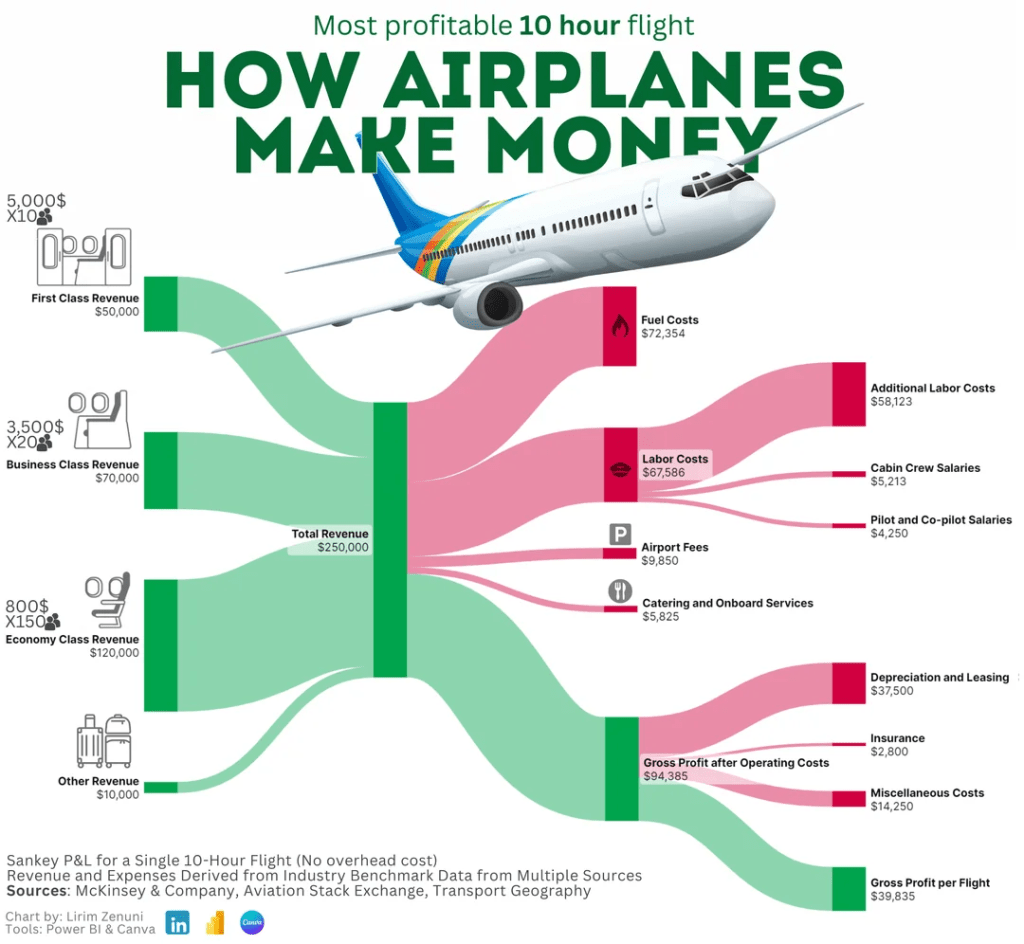
How airplanes make money (Source: r/dataisbeautiful)
The business model of an airline. Visualised.
📚 Random Things
These links are meant to make you think about the things that affect our world in transport, and not just think about transport itself. I hope that you enjoy them.
- What We Need To Know About Ice Cream (Econlife)
- Oslo’s ‘Climate Budget’ Is Building a Cleaner City (The City Fix)
- How did a CrowdStrike file crash millions of Windows computers? We take a closer look at the code (The Register)
- Project 2025 and Public Transportation (Pedestrian Observations)
- Climate Just: supporting equitable responses to climate change through social vulnerability maps (Policy@Manchester)
📰 The bottom of the news
This is something from a couple of years ago, but someone on Reddit asked people what is the funniest thing that they have ever seen on public transport. The thread is well worth a read, because some of the things in there are hilarious.
👍 Your feedback is essential
I want to make the newsletter better. To do this, I need your feedback. Just fill in the 3 question survey form by clicking on the below button to provide me with quick feedback, that I can put into action. Thank you so much.
 Mobility Matters