

Good day my good friend.
As I mentioned on Friday, this is a post that I made earlier, as I am taking some time off this week. So the links may be slightly older than what you are used to. But there is no less goodness inside. So lets get to it!
Mobility Camp is back, and the number one transport unconference is heading to York on Friday 20th September. Book your tickets now! 🎫
I have co-authored a book on Mobility-as-a-Service, which is a comprehensive guide on this important new transport service. It is available from the Institution of Engineering and Technology and now Amazon. 📕
☀ All weathers
It is well know that us Brits talk about the weather. A lot. And I mean a lot. The weather plays an interesting role when it comes to transport networks and how we use them, and one that we often take for granted. Or we at least don’t consider.
The ways by which weather affects the transport network and how we use it can be best categorised in 3 ways, all of which we need to consider when creating and managing infrastructure. These categorisations are:
- Variations in demand, both short term and seasonally;
- Long term wear and tear on the infrastructure;
- Significant and sudden damage to the network.
The first is commonly experienced by those who work in behaviour change. It is usually in the manner of “well, I would cycle if it didn’t rain all the time.” But the weather does have a measurable impact on how we travel.
There is some truth that when the weather is bad, people tend to walk and cycle less. The converse is also true, in that on bright and sunny days people tend to walk and cycle more. Though even these impacts are somewhat marginal. Buses and public transport more generally do not show such impacts as much, but interestingly are much more susceptible to high humidity, which makes the case for air conditioning on public transport much stronger.
The impact of seasons on leisure travel is especially profound, as anyone who has lived in a tourist area knows. In the UK, seaside resorts are often completely rammed on summer weekends with all forms of transport being affected. This is owing to short stay visitors taking a chance on good weather during the summer months.
But interestingly, good weather boosting visitor numbers is more complicated than it seems. For example, outdoor attractions like Zoos have their visitor numbers grow in line with the outdoor temperature, until it reaches 21C after which visitor numbers actually drop. Bad weather, whether it be rain or it being too hot, has such an impact that visitor attractions are being urged to become all weather attractions.
When it comes to the weather and its impact on the infrastructure, I would think that this is obvious, but all weathers slowly chip away at the infrastructure all of the time. To list a few examples:
- Rain can result in water damage to infrastructure without adequate weather proofing, including through rising ground water levels, and constant rain does abrade the surface of infrastructure over time, if somewhat slowly.
- Even a slight wind can take down large things that are poorly balanced and not sufficiently anchored (see the tale of the ship Vasa for an example). But wind also carries fine particles that are responsible for weathering of surfaces.
- Cold weather freezes and thaws any water caught in the cracks of infrastructure, effectively breaking it. This is why there are usually so many potholes around over the winter.
- Hot weather can not only melt the infrastructure surface in some conditions, but it also overheats electrical and signalling systems, causing them to either catch fire or short-circuit
Our infrastructure takes a constant pounding from the elements, and is largely resistant to such punishment. Where we don’t anticipate something, we learn. A notable example being how the Nottingham Tram system painted many of the boxes containing its roadside infrastructure white after it cooked and failed in a heatwave.
The final part is of increasing interest to many infrastructure planners. While all of the above does impact upon the infrastructure, much of the damage caused by weather is during extreme events, which can result in lasting change to a landscape and the infrastructure within it.
For example, during flooding events resulting from heavy rains is when the majority of damage to a river’s banks occurs. This significant scouring of the river banks is the unseen damage of flooding, which can undermine the stability of bridges, embankments, and anything else running alongside it.
Oh, and the extreme weather can impact on the transport infrastructure itself too, obviously. Something the UK is woefully under-prepared for.
As is often the case in transport planning, we assume cause and effect. Bad weather = less people cycling. More extreme weather = more damaged infrastructure. That is all true. But the impacts of weather are much more nuanced than we think, and each impact poses its own transport planning challenge.
But, at the time of writing this, I see that the forecast for when this newsletter will go out is good. So my challenge will be how many panels of my garden fence can I paint in this window of good weather? A somewhat different challenge to failing infrastructure and wet weather impacting on visitor numbers, I must admit.
👩🎓 From academia
The clever clogs at our universities have published the following excellent research. Where you are unable to access the research, email the author – they may give you a copy of the research paper for free.
TL:DR: Ronseal (for those of you who aren’t British, this is what I mean).
Carbon footprint impacts arising from disruptions to container shipping networks
TL:DR – Close the Suez Canal, and shipping carbon emissions increase by nearly 50%.
TL:DR – Noise restrictions place operational challenges on package drone delivery operators, but nothing they can’t get around.
TL:DR – Some the benefits of road safety campaigns are likely to be short lived. Personally, I remember the Green Cross Code Man like it was yesterday.
✊ Amazing people doing amazing things
Sometimes, all it takes is one resident to actually do something in order to make a change happen. John McBarron, of Kilbarchan in Scotland, got fed up with his buses not turning up. So he set up his own Community Transport company, that now runs a bus every half an hour to the local station.
📺 On the (You)Tube
Most of you will know by now that I am essentially a Geoff Marshall fanboy. And his latest video is rather fun, in that he made a London Underground Map out of Lego, with working trains.
🖼 Graphic Design
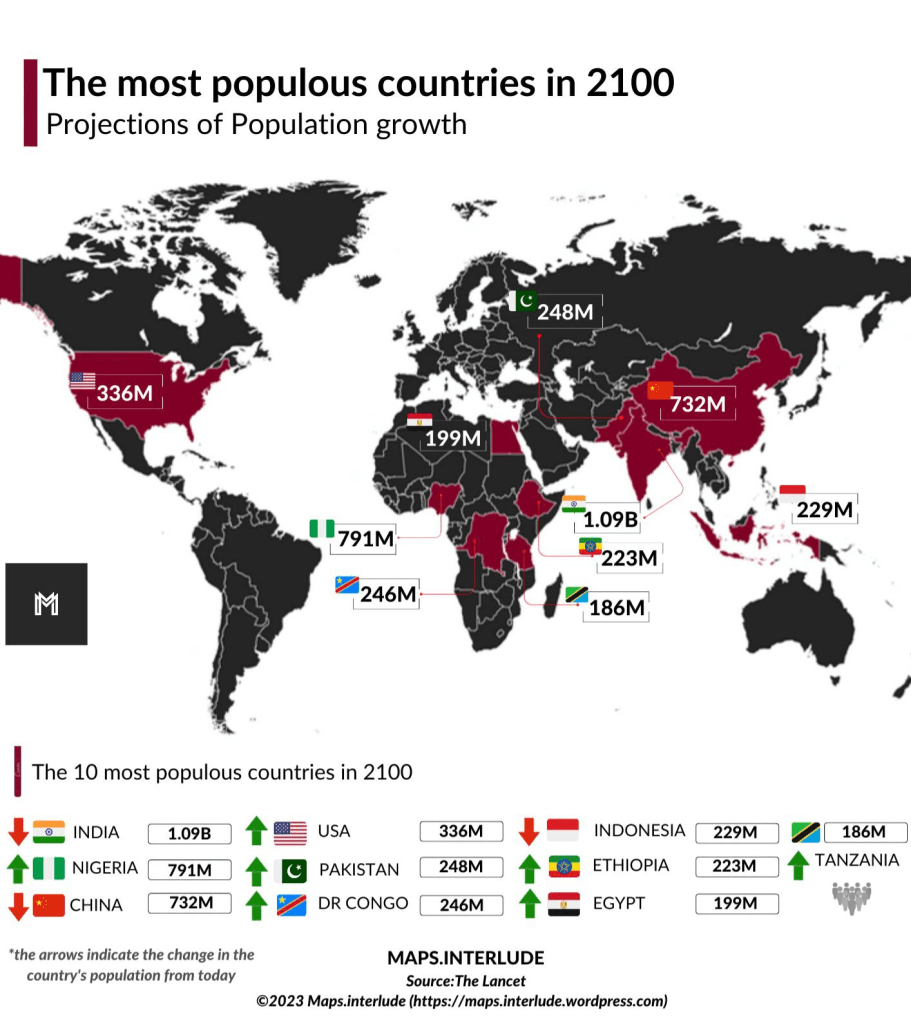
The most populous countries in the world in 2100 (Source: r/MapP**n)
We don’t often talk about population growth when it comes to planning for transport. And here is where the people are likely to be in 76 years. A reminder also that population projections have a habit of being quite accurate (for forecasts anyway).
📚 Random Things
These links are meant to make you think about the things that affect our world in transport, and not just think about transport itself. I hope that you enjoy them.
- Snow Belt to Sun Belt Migration: End of an Era? (Federal Reserve Bank of San Francisco)
- Energy-Efficient AI: New Hardware Could Slash Computing Power Needs by 1000x (ScienceBlog)
- Claims about Anchorage (Marginal Revolution)
- The New Threat to the Chip Industry: Worker Unrest (Wall Street Journal)
- ChatGPT is bullshit (Ethics and Information Technology)
📰 The bottom of the news
In the race between the tortoise and the train, the tortoise won by sabotage.
👍 Your feedback is essential
I want to make the newsletter better. To do this, I need your feedback. Just fill in the 3 question survey form by clicking on the below button to provide me with quick feedback, that I can put into action. Thank you so much.


 Mobility Matters