

Good day my good friend.
I hate watching the England’s men’s football team. I really do. Now I have Mikel Oyarzaba to add to the tormentor’s list, alongside Diego Maradona, Ronaldinho, Gianluigi Donnarumma, Ronald Koeman, Thomas Brolin, Andreas Möller, and us shooting ourselves in the foot for the 50 billionth time. Go on, have your newsletter.
Mobility Camp is back, and the number one transport unconference is heading to York on Friday 20th September. Book your tickets now! 📆
I have co-authored a book on Mobility-as-a-Service, which is a comprehensive guide on this important new transport service. It is available from the Institution of Engineering and Technology and now Amazon. 📕
⚽ Coming home (from the football)
At the time when you receive this newsletter, two major football tournaments will have just finished. Namely the UEFA European Championships (or the Euros), and the Copa América. For a football fan, having such a feast of international football every few years is amazing – apart from England doing their best to age me several years every time they play.
Putting on a football match, let alone of a major international tournament, is a significant logistical undertaking. You have to get several thousands, even tens of thousands, of fans to and from each match safely and without delay. You have to cater for them, keep them entertained before and after matches, deal with journalists and TV crews, and that’s before you think about the players and other club staff.
For transport, this means two things. The first is the safety of fans and other network users, primarily in terms of crowding and risk of violence.
For the former, anyone who has ever had the experience of using public transport after full time near a major football stadium will know this issue. An interesting here is quite how hard crowding is to measure. There are objective measures, usually based around seat utilisation or estimations based on vehicle weights. But this does not take account of the subjective experience. Reviews of the evidence has shown that poor experience of crowding can occur at much lower levels than those shown by objective measures.
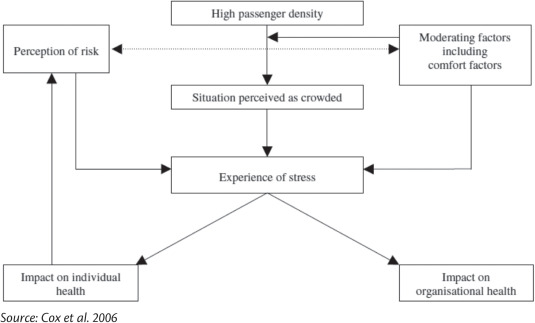
Model of density, perceived crowding, stress, and health (Source: Li & Hensher, 2013)
Even the research tries to ‘objectify’ subjective measures of crowding on public transport. For example, research by Haywood et al (2017) identified 3 drivers of the subjective experience of crowding: dissatisfaction with standing and not being seated, less opportunities to make use of the time during the journey, and the physical closeness of other travellers per se.
In football, crowding is particularly an issue after full time, as fans head home after the match pretty much at the same time. Something that many clubs have been trying is providing facilities so that fans stay on after the match. Notably refreshments, museum tours, and other fan ‘experiences.’ The chance to sell a few more shirts and refreshments is, of course, entirely co-incidental. The Tottenham Hotspur Stadium does this especially well.
Issues of violence are not as prevalent as they were in the heydey of football hooliganism in the UK, but they still happen far too often. As a recent example between Millwall and Portsmouth fans showed. There is a whole avenue of research into the confluence between football, violence, and identity that is very interesting to look at, but far too detailed for here.
I highly recommend you read the book Tracking the Hooligans which went in depth of the experience of police officers trying to keep the peace on public transport when hooligans are around. It speaks of acts of violence both planned and random, with every day passengers protected by a thin blue line. Plus, unfortunately, the mere experience of football fans singing loudly on public transport can be a very intimidating one.
But public transport is not the only way by which people get to and from matches. Research from the Campaign for Better Transport gives the most recent comprehensive data for travel by fans. In a study of Premier League teams at the time it revealed that:
- The train was the most popular way for home fans to get to the game (35% modal share), followed by car sharing (29%) and walking (20%).
- Home fans driving alone made up just 14% of trips
- The train was also the most popular way for away fans to get to games (57% modal share), followed by car sharing (35%), then coach (21%)
- Barely 9% of away fans drive alone to matches
None of this data is that much of a shock. From my own experience as a football fan, travelling to matches is a communal activity. Where you either travel with family from home, or meet up with friends prior to the match and then travel to the stadium. Plus, the consumption of alcohol is usually, but not always, involved. This lends itself to the use of public transport of sharing a car.
From a transport planning perspective, this is also incredibly useful. Public transport has many advantages, but one that is often unseen is its ability to transport lots of people into and out of an area very quickly. For example, if you are leaving the Emirates Stadium after a match and taking the Piccadilly Line from the nearby Arsenal station, the 798-capacity trains running every two minutes southbound into Central London can clear 11,000 people in half an hour. Walk a little further to Finsbury Park station, and the National Rail services provide even more capacity.
Putting on a show at the football doesn’t just rely on the silky skills of the players and the tactical acumen of the manager. Transport planners and other transport professionals all play a role in making sure the beautiful game goes off without a hitch. But much like the referee, when we do it well, we are not noticed.
👩🎓 From academia
The clever clogs at our universities have published the following excellent research. Where you are unable to access the research, email the author – they may give you a copy of the research paper for free.
Going the distance: Gender differences in travel in Montréal, Canada
TL:DR – An interesting finding here is how much more stark the gender differences in travel are for low income households.
Decarbonising shared mobility: The potential of shared electric vehicles
TL:DR – Electrify shared use cars and you get less carbon emissions. Shocklingly.
TL:DR – Men are more likely to take their children to school if both parents are well educated. Otherwise, its still a ladies job.
TL:DR – A framework is testing based upon community capability to deliver transport change. It could work.
✊ Amazing people doing amazing things
I get frustrated that having a safe crossing point sometimes needs a campaign, but I am always in awe at the people behind these campaigns and their dedication to it. In this case, Julia Dowd in Northumberland campaigned for one, and the local council and the housebuilder finally built it. People will thank you for this, Julia.
📺 On the (You)Tube
This is from 2018, but seemed right to share now. In 2018, Southgate station in London was renamed Gareth Southgate station. So naturally, Geoff Marshall went to see it.
🖼 Graphic Design
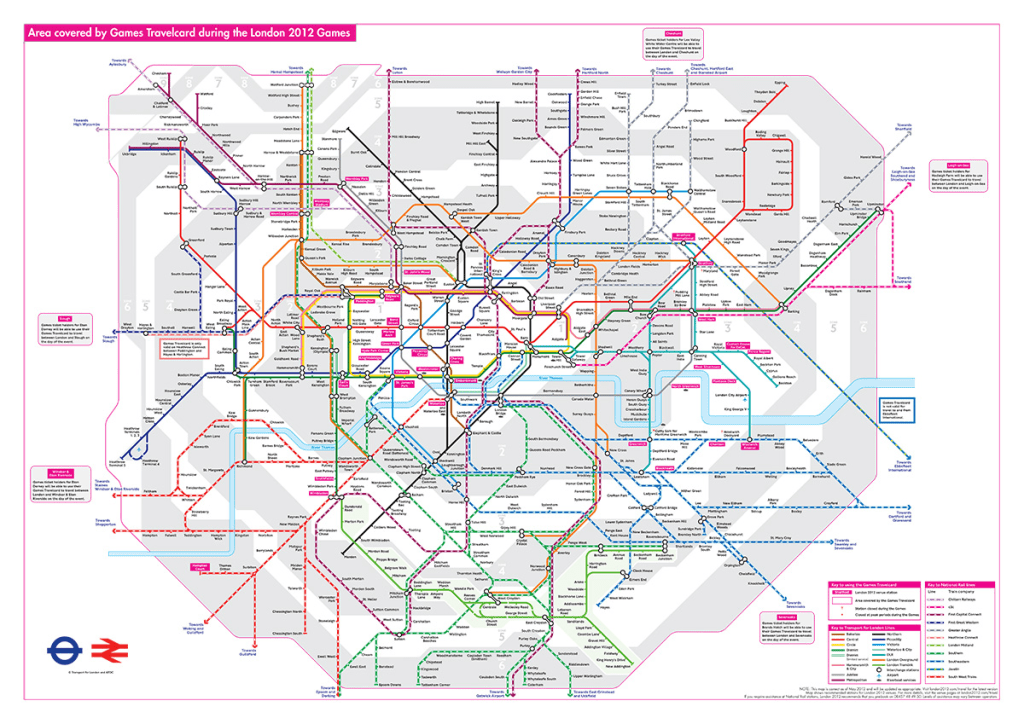
Back in 2012, when London hosted the Olympic Games, a special version of the iconic tube map was produced to show the area covered by the special Olympic Day Travelcard. Thank you to the Wayback Machine for saving this.
📚 Random Things
These links are meant to make you think about the things that affect our world in transport, and not just think about transport itself. I hope that you enjoy them.
- The Future May Not Be As Electric as We Think (Naked Capitalism)
- Analysis: China’s clean energy pushes coal to record-low 53% share of power in May 2024 (Carbon Brief)
- Where Does Beach Sand Come From? (Scientific American)
- Wyoming Road Failure Reveals a Housing Crisis (The Daily Yonder)
- Why consciousness may have evolved to benefit society rather than individuals (The Conversation)
📰 The bottom of the news
At the time of me writing this section (before the final), Three Lions is at number 20 on the UK Singles Chart. Shamefully, the only England football song that is better than that is nowhere to be seen. Clearly, love has not got the World in Motion.
👍 Your feedback is essential
I want to make the newsletter better. To do this, I need your feedback. Just fill in the 3 question survey form by clicking on the below button to provide me with quick feedback, that I can put into action. Thank you so much.


 Mobility Matters