
Good day my good friend.
Just a quick thing to start today’s newsletter. The coming weeks is going to be a bit more busy than usual. While I will do what I can to get a regular newsletter out, in some cases they may be short and to the point. So you have been warned!
Mobility Camp is back, and the number one transport unconference is heading to York on Friday 20th September. Book your tickets now!
I have co-authored a book on Mobility-as-a-Service, which is a comprehensive guide on this important new transport service. It is available from the Institution of Engineering and Technology and now Amazon. 📕
⚡ Is the EV revolution over before its started?
It really depends on what you think the end is. But if you read articles like this one in the Financial Times, this opinion article on The Hill, and in the Telegraph of course, you would think that the revolution in electric vehicles is already over when it has barely started. But what is the reality of this?
A good place to start is the actual statistics, particularly in terms of the total number of vehicles, in this case in the UK. In terms of the overall number of vehicles, electric vehicles, hybrids, and plug-in hybrids have barely made a dent. In the 4th quarter of 2023, while there were nearly 21 million registered petrol vehicles and just over 17 million registered diesel vehicles, there were barely 1.7 million hybrids, and just over a million electric vehicles. Though for the latter, this is up from 500,000 and 213,000 respectively at the end of 2019.
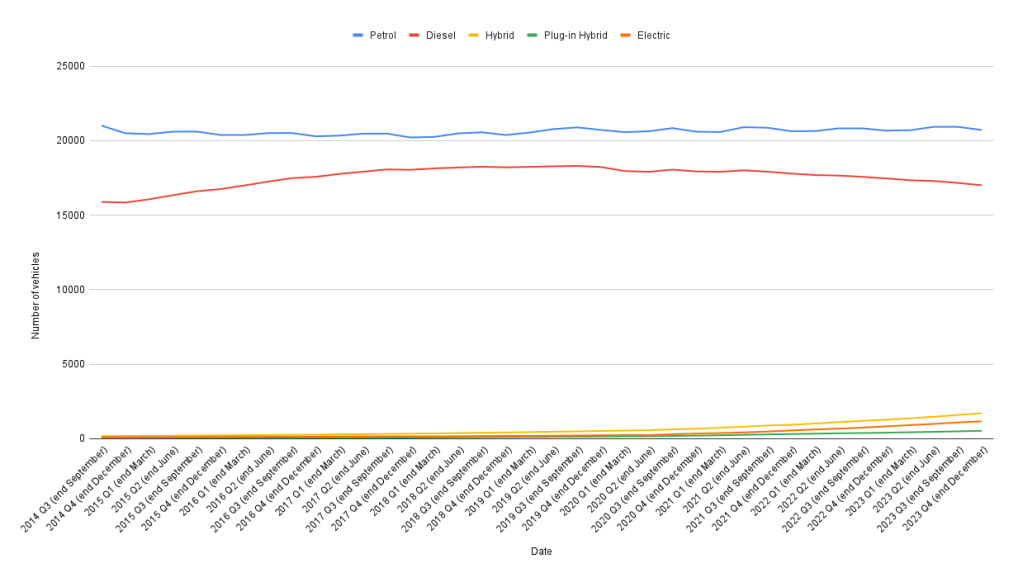
Licensed vehicles at the end of the quarter by body type and fuel type (Source: Department for Transport)
To put that in a percentage, hybrids make up just 4% of the total vehicle fleet, and electric vehicles make up just 2%. So this is hardly reassuring. But when you look at the number of new electric vehicles, things look different. We can see from the data from new registrations that every year since 2019, not only have hybrid and electric vehicle registrations increased, but petrol and diesel registrations have decreased, with the exception of 2023 where every vehicle type saw an increase. So while electric vehicles are still in a minority, there has been exponential growth since 2019.

Vehicles registered for the first time by fuel type (Source: Department for Transport)
This excellent analysis by Our World In Data shows that such a trend is not just happening in the UK, but across many developed economies. While Norway is a runaway leader (93% of new vehicles being electric), China is catching up (38%) as is the EU more generally (22%).

Share of new cars sold that are electric (Source: Our World In Data)
And when you look at car sales, what you can see is that rather than being a threat to the automotive sector, electric vehicles may be its saviour. The sale of combustion engine vehicles globally peaked in 2018 (83.77 million cars), and in 2023 this number had gone down to around 63 million cars, a number lower than in 2010. The difference being that in 2023, nearly 14 million electric vehicles were sold.

Number of new cars sold worldwide by year (Source: Our World In Data)
The data tells part of the story. But not the entirety of it. The other key aspect is the confidence of companies and investors. And having being given the picture of sunlit uplands and rainbows and unicorns, the confidence of the people with the money has been hit. An excellent report by the International Energy Agency summarises these, which I will further summarise into 3 key reasons:
- Increased competition. With Chinese electric vehicles now being exported to western markets (and may soon be subject to trade barriers), the competition is fierce and in some cases is cannibalising itself to try and chase this new market.
- Wild fluctuations in the prices of key materials. Mainly driven by global conflicts and uncertainty, and this is especially a problem with key minerals involved in making lithium-ion batteries.
- Price wars between major vehicle manufacturers. Great for the consumer. Not good if you are trying to make some money in a global market.
An interesting further issue is the vast over-capacity across all areas of the supply chain. Very simply, everyone from the manufacturers to the mining companies digging out the minerals has a lot of equipment (and cars) sitting idle. And if anyone knows your demand and supply curves from economics, if you oversupply then prices do down to stimulate demand. Which is not good if you have hopes to be profitable soon.
Plus, it should be said that some car manufacturers are not all in on electric vehicles. I’m looking at you, Toyota and Hyundai.
To me, the electric vehicle revolution isn’t over because, if I am honest, it hasn’t really begun yet. We are seeing a market that is at the early stages of growth, than in some cases invested stupidly based on stupid growth projections. There will be growing pains with electric vehicles, but they are already a part of the vehicle mix, but not yet in a position to completely dominate.
I would not write off electric vehicles yet. And I certainly would not start changing policies because Tesla has seen their valuation take a hit. But if you are expecting huge growth soon, you are likely to be disappointed. We need electric vehicles to tackle the climate crisis, and the support for electric vehicles is still largely there (apart from a certain political party in America). But the revolution is not here yet. To make that happen, more work needs doing. So lets get to it.
What you should do: Read the excellent EV Global Outlook 2024 by the International Energy Agency. It summarises the situation perfectly.
👩🎓 From academia
The clever clogs at our universities have published the following excellent research. Where you are unable to access the research, email the author – they may give you a copy of the research paper for free.
How do airlines cut fuel usage, reducing their carbon emissions?
TL:DR – Higher fuel prices usually do the trick.
TL:DR – People who order online tend to drive to the store more.
TL:DR – Long distance rail freight, and its impacts on local markets, could cut carbon emissions by around 10%.
Equity in non-motorist safety: Exploring two pathways in Houston
TL:DR – Study shows what we already know. More deprived areas tend to have more collisions.
✊ Awesome people doing awesome things
Here is something that I learned at the weekend. Did you know that red and yellow cards were the brainchild of Hilda Aston, and it was all because of a traffic light and her rather famous husband, the football referee Ken Aston?
After the controversial England v. Argentina World Cup Quarter Final in 1966, Ken Aston thought of the problem of poor verbal communication not informing players whether or not they had been booked or sent off. He stopped at a traffic light on High Street Kensington, and after getting the idea of using colours to indicate whether players had been booked or sent off, he mentioned the problem to his wife Hilda. She then went into the kitchen, and returned with a yellow and red card that she had cut to fit in her husbands shirt pocket. Consequently, red and yellow cards were born.
📺 On the (You)Tube
The always-excellent Paul Whitewick goes in-depth into arguably the most famous robbery in British history – The Great Train Robbery. That took place not very far away from me, actually.
📚 Random Things
These links are meant to make you think about the things that affect our world in transport, and not just think about transport itself. I hope that you enjoy them.
- We have to stop ignoring AI’s hallucination problem (The Verge)
- ‘Laptop squatters’: Cafes in Europe are fed up with space-hogging digital nomads (Euronews)
- The Contradictions of “Progressive Realism,” and How to Overcome Them (The Duck of Minerva)
- Why the media struggle to cover threats to democracy (Good Authority)
- Global economic fracturing and shifting investment patterns: A diagnostic of ten FDI trends and their development implications (VoxEU)
📰 The bottom of the news
The recent bout of bad weather in the UK clearly brought out the pranksters. But even this one had me looking twice. When Thames Valley Police were called out by reports of a crocodile in flood water by the side of a road in South Buckinghamshire, I bet they were thankful at how it turned out.
👍 Your feedback is essential
I want to make the newsletter better. To do this, I need your feedback. Just fill in the 3 question survey form by clicking on the below button to provide me with quick feedback, that I can put into action. Thank you so much.



 Mobility Matters