

Good day my good friend.
Lots to do, little time to do it. So the newsletter will be slightly more snappy than is normal.
Mobility Camp is back, and the number one transport unconference is heading to York on Friday 20th September. Book your tickets now!
I have co-authored a book on Mobility-as-a-Service, which is a comprehensive guide on this important new transport service. It is available from the Institution of Engineering and Technology and now Amazon. 📕
🔃 Destination Unknown
Last week, I introduced an idea that I have been toying with for a while, and am now starting to apply, of mission-driven policy making. Without reposting the entire post again, this is about structuring our transport strategies in a more action focussed way, where we seek to deliver a series of specific missions, for example achieving Net Zero carbon emissions.
But we live in an age of uncertainty, where we need to factor in uncertainty into our decision making on transport planning. Missions are certain, and specify an end goal, and often a clear one (for avoidance of doubt “Reducing carbon emissions” is not a mission, while “Achieving Net Zero by 2050” is a mission). So how do test certain end points against uncertain futures?
The way that I see this is that this is about testing both the pathway and the end mission, and developing them in an iterative manner alongside your scenario planning work. In an idea world, how this would proceed is like this.

To try and summarise this. You need to understand what your missions are, at least in general terms, before you commence your scenario planning activity. These missions come from a mix of your problem statements (all missions need an associated problem or challenge), and derive from your vision which sets the general direction by which you are heading.
Once the scenario planning activity starts, there needs to be a constant process of refinement and direction. The missions provide the direction for the scenarios (namely what are the most critical areas for the scenario planning exercise to look at, helping formulate the primary question this work is seeking to answer). Meanwhile, the scenario planning activity provides the necessary sense-checking of the mission.
For example, through a scenario planning workshop you may identify that in a specific scenario, there may be significant government support for road building. In such a scenario, does a mission to achieve Net Zero by 2050 make sense? Or do the other scenarios seem more hopeful and offset the concerns that this scenario presents? Only through workshopping and discussion can you come to your own conclusions as to whether your missions need are too strong, too weak, or just right.
A key part of these discussions needs to be what are the appropriate measures of success? Namely, how do we know we have achieved our mission? In some areas, like carbon emissions or road casualties, the KPIs may be obvious. But in other areas, such as social exclusion, the outcomes are more “fluffy” or harder to boil down into numbers. Maybe revealing a weakness of the missions-based approach – not everything valued can be numbered.
Once through this stage, as part of options appraisals of different policy packages, you can then start to test how these different policy packages could help to achieve either the end mission, or achieve key points along the pathway. Lets again use achieving Net Zero carbon emissions from transport in a fictional county which has 20 million tonnes of CO2 emissions from transport. You can perform a simple RAG (Red, Amber, Green) assessment as to whether the whole policy package will achieve the end goal.
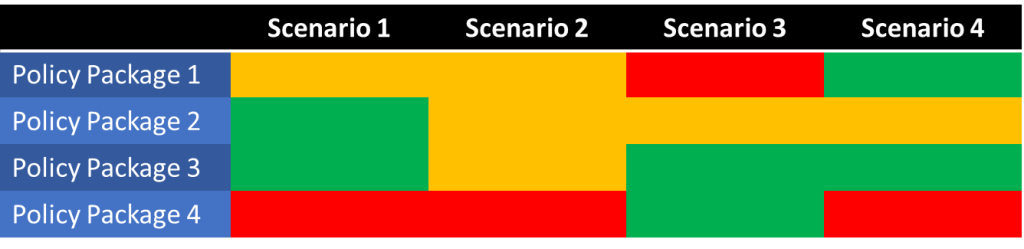
Achieving Net Zero Carbon Emissions by 2050 in a fictional county under different scenarios (example)
But one which I favour is a more detailed look at achieving key waypoints within the missions through different policy packages under different scenarios. In this case, emissions reductions.

Achieving Net Zero Carbon Emissions by 2050 and key interim targets in a fictional county under different scenarios (example)
Again, this is just an example, and in some cases I’ve somewhat skewed the results to try and demonstrate a point. And that point is this. This approach allows you to potentially trade off key policy packages based on achieving the end goal, achieving key interim goals, and ability to deliver across a range of scenarios.
In this example, take Policy Package 1, which is showing an ability to miss earlier goals, but achieve the end one regardless of the two scenarios demonstrated. Meanwhile Policy Package 2 seems like a good bet in Scenario A, but in Scenario B its performance isn’t so sure.
Doing such work won’t make the decision for you, as it merely demonstrates the trade offs involved in different options. And you will have to do background assessments to valid your results (in this case carbon modelling). But it gives the decision maker (you) the information on choosing a path towards your missions that may be resilient against unknown futures.
👩🎓 From academia
The clever clogs at our universities have published the following excellent research. Where you are unable to access the research, email the author – they may give you a copy of the research paper for free.
Expanding Electric Vehicle Adoption in Disadvantaged Communities
TL:DR – The adoption of EVs is much more complex than you think it is, especially when it comes to adoption by disadvantaged communities.
Is school travel excessive? Empirical evidence from Xi’an, China
TL:DR – A lot of kids are travelling a long way to get to school.
Pathway towards carbon peaking cities in the Chinese transport sector
TL:DR – Where there is a will, there’s a way.
TL:DR – Transport practitioners are confused at the different ways of measuring accessibility.
📺 On the (You)Tube
Geoff Marshall has been publishing some brilliant videos recently. And this one on his visit to Stockwell Bus Garage in London is another good one. One for fans of buses and old buildings.
🖼 Graphic Design
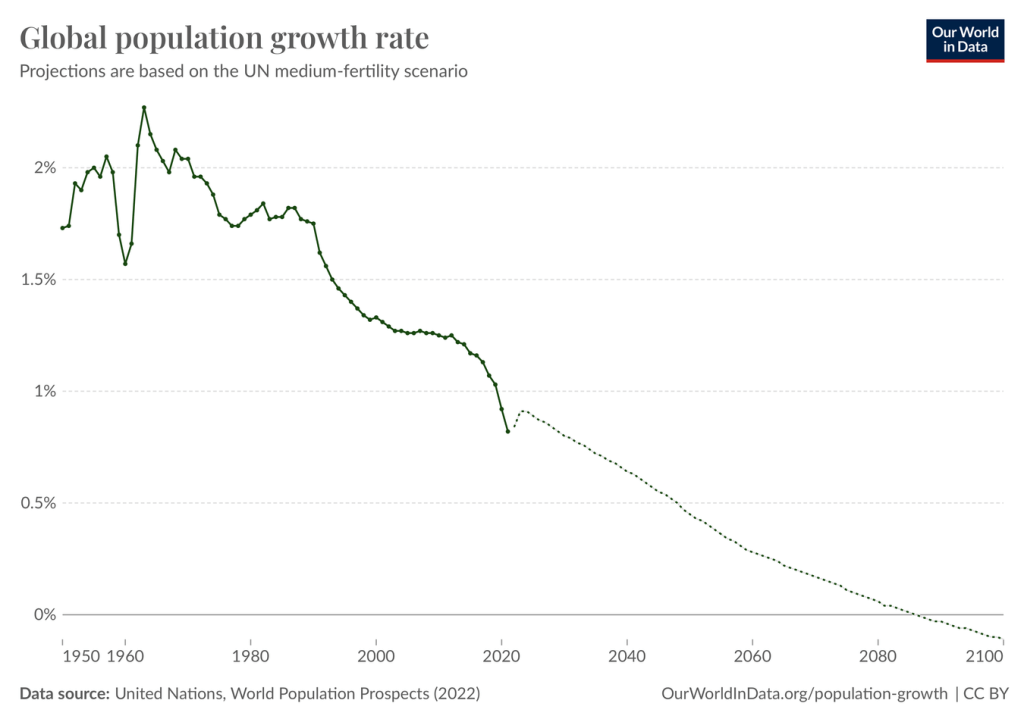
Global population growth rate (Source: Our World in Data)
I have said this for a while now, but one of the more important trends us transport planners will have to consider is that in the future the population will largely cease to grow. And this graph shows just that. Population growth peaked in the 1960s.
📚 Random Things
These links are meant to make you think about the things that affect our world in transport, and not just think about transport itself. I hope that you enjoy them.
- Big tech’s capex splurge may be irrationally exuberant (The Economist)
- This grim but revolutionary DNA technology is changing how we respond to mass disasters (MIT Technology Review)
- Found at last: long-lost branch of the Nile that ran by the pyramids (Nature)
- Can shame make you a better person? (The Guardian)
- Britain is not as broken as everyone seems to think (The Conversation)
👍 Your feedback is essential
I want to make the newsletter better. To do this, I need your feedback. Just fill in the 3 question survey form by clicking on the below button to provide me with quick feedback, that I can put into action. Thank you so much.


 Mobility Matters