

Good day my good friend.
“May you live in interesting times” is, believe it or not, a quote meant as irony. Although its authenticity is doubted, I can safely say that after the last 10 years, and especially after the events of the weekend, I really don’t like it.
I am far from an expert on modern conflicts or on the history of warfare. But if you are struggling to understand what this all means and its implications, here are a few things that have helped me to start understanding this complexity:
- Read the book Does Terrorism Work? by Richard English, which really gives some insight as to whether such tactics actually achieve their aims. Richard English also gave a great TED Talk on just this question.
- Listen to the Blueprint for Armageddon series as part of Dan Carlin’s Hardcore Histories Podcast. It covers the lead up to and the entirety of the First World War, and is probably the best podcast series I have ever listened to. It helps you understand how events can accelerate, and how it impacts everyone from a country’s leader to infantry on the front line.
- Read They Thought They Were Free by Milton Mayer. This deals with how ‘normal’ life can be under both a dictator and during a horrific war, and is an incredible insight into collective blindness.
- Read this Time article by Yuval Noah Harari from the start of the Israel-Hamas War in October last year. As pertinent now as it was then.
The big takeaway that I took from all of these, and from what little I know of warfare from friends who have been in conflict zones, is that it is incredibly scary, it can spin out of control quickly, and awful, awful things can happen. But, us humans are remarkably resilient, and can find pockets of joy even in dark times. And sometimes it is worth just remembering that.
If you like this newsletter, please share it with someone else who you think will love it. The main way my audience grows is through your recommendations. I will love you forever if you do. 😀
I have co-authored a book on Mobility-as-a-Service, which is a comprehensive guide on this important new transport service. It is available from the Institution of Engineering and Technology. 📕
🕶 Where we are going, we need roads
Sorry, Doc, I think you are wrong on this one. This is a view that will probably not sit well with many of you, but I feel that it is time that we touch upon the massive elephant in the room when it comes to climate change and how we plan for future transport systems. And this is an uncomfortable truth: in the future, we will need more roads.
My logic behind this is relatively simple:
- New development is going to happen (whether reusing existing land or building on green fields). Said development needs roads, even if they are just the streets that serve the new development. In the UK, these roads are responsible for the majority of new road building in the country. So unless you don’t want any development anywhere, roads are going to be built.
- New roads can stimulate economic development in less developed areas of the world. The UK is one of a relative minority of countries in the world that has over 90% of its highway network paved. Paved roads open up less developed areas of the world, and allow people in those areas to better access services and jobs. The idea that we cannot afford those areas to have such opportunities that we have from a paved highway network does not sit well with me.
- Providing new public transport and active travel infrastructure may require building new roads. Need to close a level crossing to provide more frequent trains? You may need a new road bridge. Need to provide a high quality and direct cycle route? Your traffic circulation plan may mean that you have a to provide a less direct but necessary alternative route for cars.
But this then leaves us with a challenge. Building new roads is clearly bad for the environment, as so well articulated by the likes of Phil Goodwin in his recent evisceration of the Lower Thames Crossing. So how do we build out highway networks that enhance access and opportunities, while at the same time do not increase carbon emissions? Thankfully, we have the Welsh Government’s Roads Review Panel to give us some ideas on the way forward from here.
The great thing about this panel is that it does not say no to all new road building. In reviewing all of the planned investment in highway infrastructure in Wales, it says that what was planned at the time would add 500k tonnes of carbon to the atmosphere just from construction. As a way forward, it identified what it calls a “Purpose and Conditions” test for all new road projects across Wales.
What this means in practice is that new roads should only be provided for one of four purposes:
- Shifting trips to sustainable travel (e.g. buses or cycling)
- Reducing road casualties where they are very high, and even then through small scale interventions
- Adapting roads to the impacts of climate change
- Providing access to development sites that will achieve a high modal share for sustainable transport
And where road schemes are funded, they are subject to four conditions:
- The scheme should minimise carbon emissions during construction
- The scheme should not significantly increase vehicle speeds in a way that increases emissions
- The scheme should not increase capacity for cars
- The scheme should not adversely affect ecologically valuable sites
Much of the report goes into further detail on matters of how funding should be allocated (towards investment programmes and not just allocating funding by mode), and co-ordination across government departments on investment programmes. All of which is excellent stuff. But I wish to focus on what these tests mean for practitioners.
The first thing it means is that there is an acceptance that in some circumstances, road building is needed. Let us work through a couple of practical examples. Here is a map of areas of risk of flooding from the sea on an annual basis close to the town of Rye in East Sussex in the year 2050. That is a lot of land.

Annual flood levels in East Sussex in 2050 (Source: Climate Central)
Across that red area runs the A259 between Hastings and Folkstone. It would be completely submerged every year from 2050. Under the above rules, it is feasible to abandon the road to its fate and provide a new road to the north so long as it meets the criteria set out (and assuming that the villagers in places like New Romney and Lydd don’t mind moving). In fact, a new road with the same capacity with a lower speed limit, low carbon construction practices, and sustainable travel corridor alongside may be better for the climate. In theory anyway.
Another example is closer to home, namely a planned development called the Marston Valley, to the South West of Bedford (you can check out the developer’s sales job here if you like). This is for a significant development of 5000 new homes, plus businesses, schools, and everything else in between. Surely, surely a development of this scale would not pass such a test?

Marston Valley Masterplan (Source: Central Bedfordshire Council)
Well, that will depend on whether such a development has a commitment to achieving a high modal share by sustainable transport. For example, if there was meaningful action to provide high quality walking and cycling routes within the development, or even a commitment towards car free development like seen in Vauban in Freiburg, Germany, then it could actually meet these conditions. It could also invest in new bus services, or boost the frequency of the Marston Vale Line train service.
As it so happens, the Transport Assessment says that so long as road capacity improvements are made at key junctions then the development is ok, so the current proposal would fail these tests. But that’s not the point. The point is that subject to some key criteria being met, road building can actually be a positive thing.
Personally, I like the the Roads Task Force work not because it approaches infrastructure development in a “all roads = bad” way, but it asks the question of in what circumstances is road building acceptable, and what kind of test needs to be in place to ensure government funding is set in that way? There is already some evidence showing that the tests in Wales are challenging road building to be better, and not banning it outright.
This is the right direction for transport policy making. Roads are a part of our future. Irresponsible road building is not. So lets make it better.
What you can do: As transport policy makers, have a brain storm with your team, and ask yourself under what circumstances are new roads compatible with climate policy? Come up with recommendations on how to do that, and ask how you can action them in your current programme of works. Use the Roads Review work as inspiration.
👩🎓 From academia
The clever clogs at our universities have published the following excellent research. Where you are unable to access the research, email the author – they may give you a copy of the research paper for free.
TL:DR – The long term impacts of transit-orientated development on private car use are very, very small.
TL:DR – On average, drivers spend 90 seconds searching for parking spaces, which is way shorter than previous estimates.
The mobility biography of things and the climate emergency
TL:DR – A biography of things seeks to identify a human connection with objects. This paper applies that idea to transport.
TL:DR – The first generation electric aircraft won’t do much. The second generation likely will.
✊ Awesome people doing awesome things
A little late to this, but the fact that this April Fools turned into a successful campaign for pedestrian crossing safety is quite something. So now we know. If you want drivers to behave, walk around with a brick in hand.
📺 On the (You)Tube
If you are wondering where ships go to die, its Bangladesh. And while the pay is good, its dirty and dangerous work.
🖼 Graphic Design
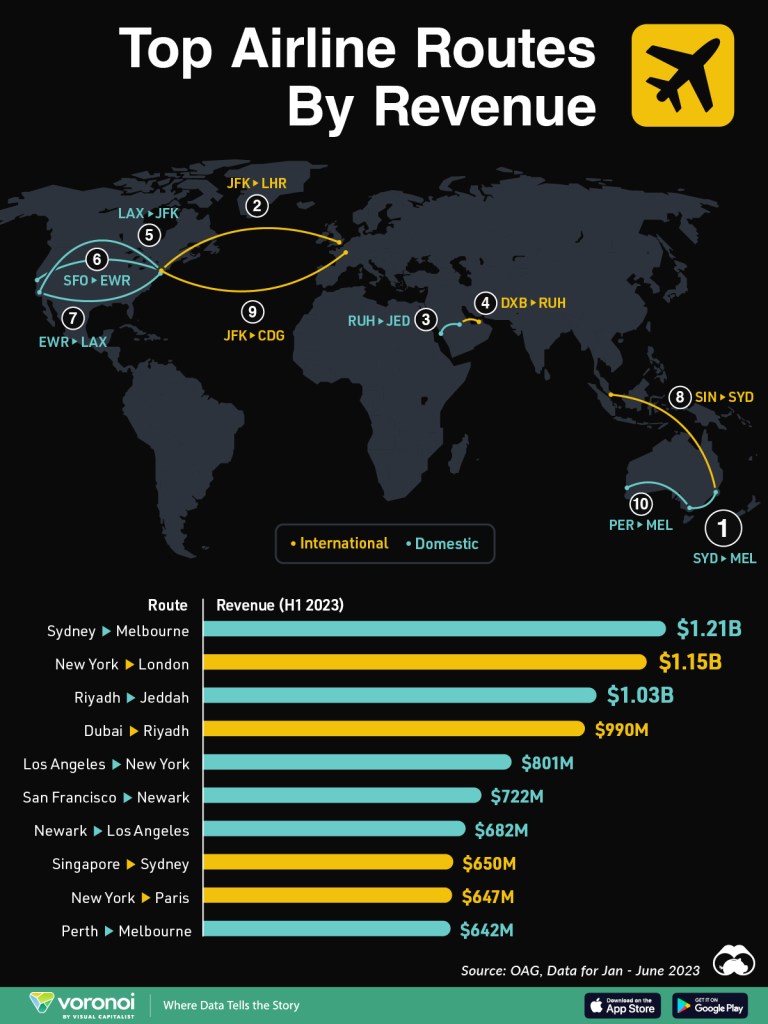
Top air routes by revenue (Source: Visual Capitalist)
Air routes make a lot of money, and these are the routes that make the most. I am amazed at the level of revenue between Sydney and Melbourne, but not at that between New York and London.
📚 Random Things
These links are meant to make you think about the things that affect our world in transport, and not just think about transport itself. I hope that you enjoy them.
- A brief, weird history of brainwashing (MIT Technology Review)
- We’d need to build 36 Milton Keyneses to solve UK housing crisis. Are new towns really the answer? (The Big Issue)
- Making a Marsh out of a Mud Pile (Hakai)
- Not Even Minnesota Is Safe From Earthquakes (Atlas Obscura)
- A short history of India in eight maps (The Economist)
📰 The bottom of the news
This is nothing. Just an escaped racehorse trying to catch a train. I’d love to see their explanation for why they didn’t have a ticket.
👍 Your feedback is essential
I want to make the newsletter better. To do this, I need your feedback. Just fill in the 3 question survey form by clicking on the below button to provide me with quick feedback, that I can put into action. Thank you so much.

 Mobility Matters