

Good day my good friend.
This last winter has been wet in the UK. You know that when a Brit mentions how wet it has been, it has been really wet. In fact, the last 18 months have been the wettest in the UK since we started collecting records. But, even that must come to an end, and just this last weekend was the first stretch of dry weather in some time. Maybe we might have a nice (but not too hot) summer ahead.
Oh, one other thing. You may have noticed that I am writing fewer “what you can do” suggestions now. I am trying to do at least one a week, but if I am honest I have been finding myself repeating advice for a while now. So I am saving it for when a few words of wisdom really matter.
If you like this newsletter, please share it with someone else who you think will love it. The main way my audience grows is through your recommendations. I will love you forever if you do. 😄
I have co-authored a book on Mobility-as-a-Service, which is a comprehensive guide on this important new transport service. It is available from the Institution of Engineering and Technology. 📕
What the school holiday’s teach us about selling a bright future
It is Easter time in the UK, which means that for most of the country school is out. And what comes with it is the inevitable comment about how the traffic on the roads is so much better. For the first week of the holidays its as much of a conversation starter as the weather and how the family is.
But it is also one of the few times where we can practically demonstrate the impact of initiatives that could encourage shift away from single occupancy car. And the impact of what we could so is so obvious it even becomes a matter of conversation.
The impact of the school holiday can be explained largely by two phenomenon: that of a total reduction in trips on the network and the impact on traffic flow on the highway network. We know from the National Travel Survey that the average person takes 62 trips per year for educational purposes, or around 7% of the trips of the average person. Naturally, for different age groups this rate varies significantly, from 35% of all trips for those aged between 0 and 16 years old, and 24% for 17 to 20 years old, to less than 1% for average age group over the age of 30 years old.

Trips by journey purpose by year (Source: National Travel Survey)
But it is not just trips for educational purposes that are of interest. Studies of the National Travel Survey dataset have shown that of the commuting trips, around 5% also include a trip for educational purposes (called “Escort education”). Of shock to absolutely nobody, the majority of these trips are undertaken by women. While studies on this are lacking, we can assume that during holidays, either this trips are not undertaken, or such trips become direct trips to work.
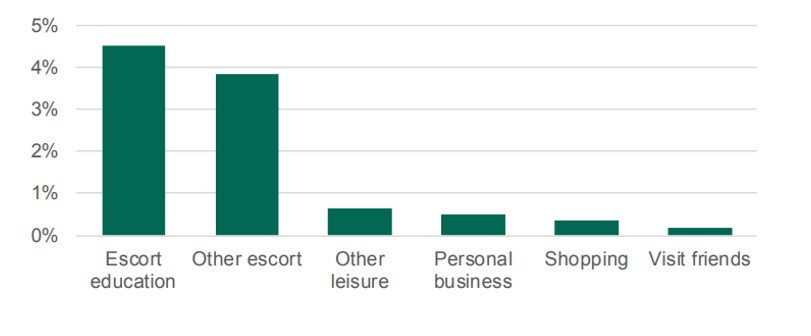
Proportion of trips to work by first destination from home (where
this is not work): England, 2002-2014 (Source: National Travel Survey)
Translating this into trips during the peak hours is somewhat more complicated – unless you want to do expensive roadside interviews that is. Estimates for what percentage of vehicles on the road are for school purposes include 30% in London, 50% in Bath, and results in a 10% spike in traffic according to TrafficMaster. It is reasonable to assume that changes in traffic levels associated with school holidays can be substantial in some areas, with a median estimate of reduction in vehicles on the road of between 20% and 30% not being too radical I think.
This level is important because we know from the characteristics of how traffic flows in accordance with the Fundamental Diagram of Traffic Flow.

The Fundamental Diagram of Traffic Flow (Source: Wikipedia)
What is happening during school holidays is that the volume of cars, and consequently the density of traffic, reduces. We know that as fewer vehicles are on the road then traffic flow increases, and this is particularly the case during congestion, where a reduction in vehicles has an outsized impact on traffic flow. In other words, take cars off a congested road, and watch the traffic roll.
So, in the case of school holidays, if we take between 20% and 30% of vehicles off congested roads, then traffic will flow much better. Hence why during school holidays, traffic flows much better than it does during other times of the year.
We know from our own evidence that modal shift initiatives hold the potential to significantly reduce peak hour traffic. Especially when a variety of measures are delivered in a complimentary manner. We have the evidence showing what a reduction in vehicle trips does to a highway network every single school holiday. I am amazed that we have not used the school holiday as part of our storytelling on what the future could hold with less traffic.
👩🎓 From academia
The clever clogs at our universities have published the following excellent research. Where you are unable to access the research, email the author – they may give you a copy of the research paper for free.
Assessing transport network resilience: empirical insights from real-world data studies
TL:DR – We are not good at collecting data on transport network resilience.
Long distance accessibility by air transportation: a literature review
TL:DR – This has not been studied. And considering some communities rely on air transport (e.g. islands) that should be sorted.
The economics of regional railway regulation under vertical separation
TL:DR – Someone comes up with a model that says “separating infrastructure owners and operators on railways might be bad.”
TL:DR – For students, if its a pain to adopt a Mobility-as-a-Service solution, they won’t do it.
✊ Awesome people doing awesome things
A bus in South Carolina got involved in a crash, and with the driver injured was out of control. One student, Paul Clune, summoned his inner Sandra Bullock, and took control of the vehicle. Though this time, he made sure to keep the bus at about 50mph slower than Sandra did.
📺 On the (You)Tube
We all know that the Dutch cycle more than everyone else. But this video by Bicycle Dutch gives you some data on exactly how much by, and also some of the trends in cycling in the Netherlands.
🖼 Graphic Design
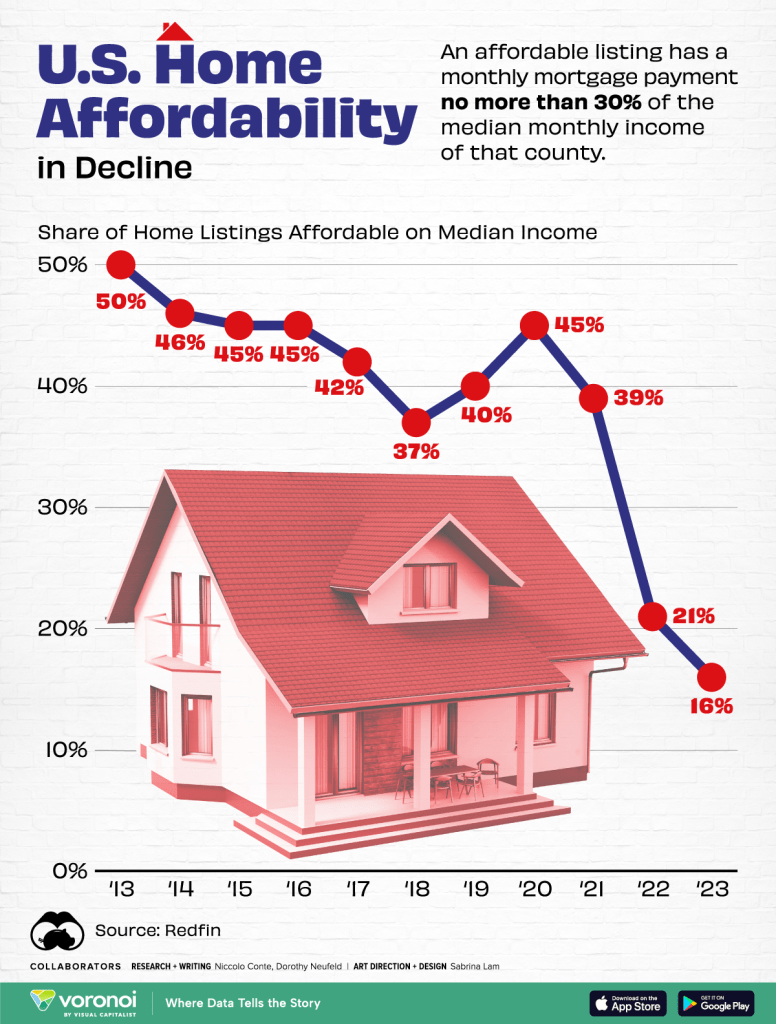
US Home Affordability is in decline (Source: Visual Capitalist)
Houses are becoming much less affordable across the world. But since 2020, housing affordability in the USA has crashed from 45% of listed homes affordable to the median wage, to 16%. That has huge implications for where people live.
📚 Random Things
These links are meant to make you think about the things that affect our world in transport, and not just think about transport itself. I hope that you enjoy them.
- Debunking the ‘billionaire = genius’ myth (Big Think)
- Open Source in Short: Retracing a UK Street 100 Years On (Bellingcat)
- Britain’s loudest birds are booming once again (BBC)
- Why the recent ‘acceleration’ in global warming is what scientists expect (Carbon Brief)
- ‘This is a game-changer’: Australia, once home of glamour flying boats, eyes a seaplane revival (The Guardian)
📰 The bottom of the news
There is a signage civil war going on in Daventry in Northamptonshire. More commonly known for being a vast bank of distribution centres off the M1, in the town the “Daventry Banksie” has been posting signs complaining about potholes in the town. Which were removed, and naturally resulted in more signs being put up mocking the Council. So West Northamptonshire Council decided to fight fire with fire, and its pun game is not strong I have to say.
👍 Your feedback is essential
I want to make the newsletter better. To do this, I need your feedback. Just fill in the 3 question survey form by clicking on the below button to provide me with quick feedback, that I can put into action. Thank you so much.



 Mobility Matters