

Good day my good friend.
Does an open space need something in it in order for it to be used? This protest by one woman by parking her car on an open space near her home caused a lot of heat in Nottingham. But actually…I am with her. Sometimes, you just need to provide an open space, so kids can run around, play football, and even set aside some areas to leave to nature. Sometimes, it is best to do nothing.
If you like this newsletter, please share it with someone else who you think will love it. The main way my audience grows is through your recommendations. I will love you forever if you do. 😍
↗↘↙ We must plan for a complex world
Most of my British readers, and no doubt many of my readers from other fair nations, will have heard of Triple Access Planning. It has recently had a very good handbook published on the idea, which is well worth reading and I won’t summarise here. But the for purposes of this newsletter I will highlight that this is formed of 3 component systems: the land use system, the transport system, and the telecommunications system.
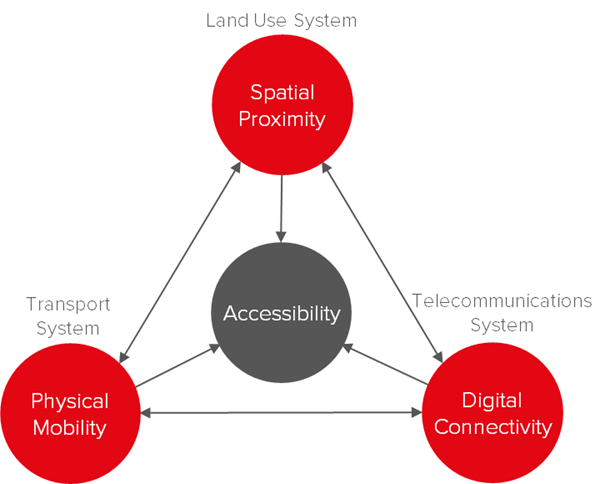
Triple Access Planning in a nutshell (Source: TAP for Uncertainty)
I like this way of thinking not just because it enables planners to start to think about how different measures are resilient against different futures, but in that it begins to expand thinking of transport systems into a wider number of systems to which it is connected. In this case, it considers how digital connectivity is not just providing a transport service in itself, but also how digital services are affecting physical proximity of services.
The reality of the world in which we work is that we operate as one part of a series of complex, but increasingly interconnected systems that, because transport is a derived demand, affect the transport system. You can expand this above framework to a number of integrated and complex systems. I would argue that the following types of systems are also worthy of consideration in transport policy making:
- Energy systems (generation, distribution, storage)
- Water systems (abstraction, delivery, sewerage)
- Food systems (harvesting or importing, distribution, disposal)
- Economic systems (finance, business operations, competition)
- Natural systems (land, rivers and lakes, marine, climate)
You can keep expanding if you really want. For example, the UK Government identifies 13 critical national infrastructures which includes things like chemicals, civil nuclear, and defence as other critical systems to protect. But lets use the above for now, and start to understand the relationship between them.
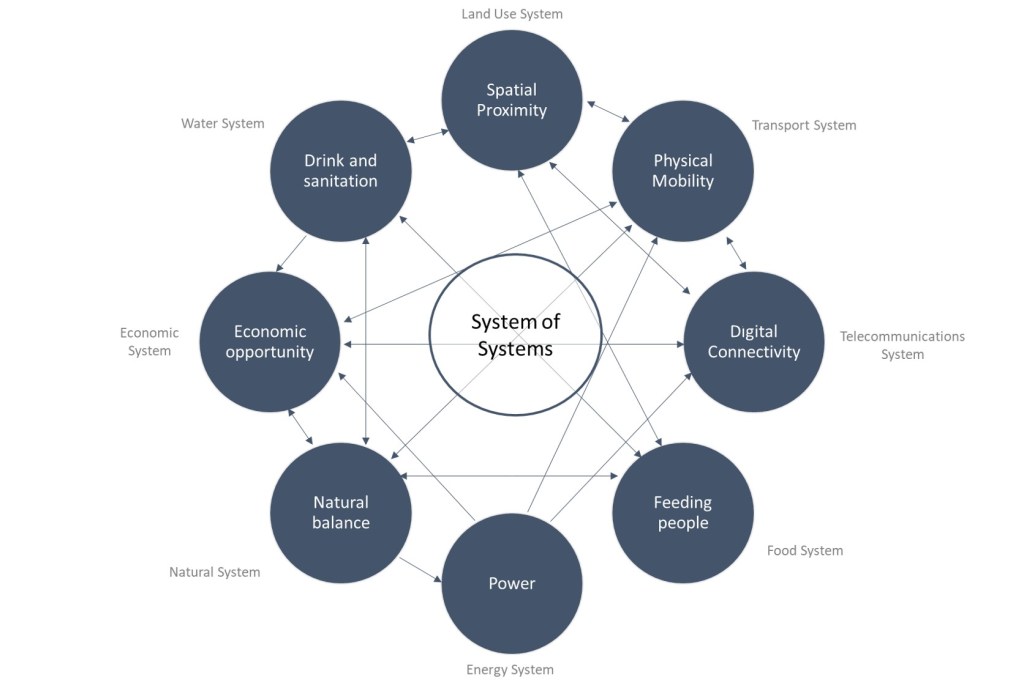
A System of Systems for Transport Decision Making
For reasons of simplicity, I have identified the most important linkages between all elements (if this were a system map, there would likely be a lot of connections). Meanwhile each system is identified by its purpose.
We can start to use this framework to start considering not just how different transport interventions will impact other systems, but in terms of how investment in other systems has an impact on transport, and could thus be considered as a transport investment.
For an example of the former, lets take the link between physical mobility and natural systems. As part of the creation of new infrastructure, balancing ponds can be installed to create new natural habitats, and to reduce the impacts of run-off on river basins and flooding. Consequently, a transport investment is in fact an investment in natural systems.
Lets go for the other way around. Lets say that energy network operators invest in new capacity both in terms of generation, and the capacity of sub-stations to handle new energy connections. Consequently increasing potential available capacity for electric vehicle charging points, and potentially stimulating demand for electric vehicles.
This makes open the possibility of something that we have not often thought of in transport. That of making non-transport investments as part of a package of interventions to achieve our own policy objectives. Lets take the last example further. One can imagine that alongside investment in energy grid capacity there is a corresponding package of measures to increase electric vehicle charging points and encourage electric vehicle take up in the affected area. Thus achieving two complimentary policy goals: renewable energy in the energy grid, and decrease carbon emissions from transport.
We can also identify potential side-effects of investment in different systems, some of which we may not have control over. For example, and this is something topical here in the UK, a failure to invest in sewerage capacity can lead to upsetting a natural balance in water courses through increased sewerage discharge. This affects transport investment within the river catchment, as transport schemes will be required to showcase how they minimise discharge into water courses.
What is also clear in this is that different elements of this system reinforce one another. The link between personal mobility, spatial proximity, and digital connectivity as indicated before is an obvious one. Another such loop is the link between water systems, food systems, and natural systems. As food and water are the primary things that humans abstract from natural systems, this is no shock. I also find it very interesting that economic opportunities relies on the inputs of a lot of different systems to function.
But why do any of this? What is the value of mapping such systems, when we could do the best with the existing transport system that we have, and assume that others within other systems should do their thing? Which is valid. I would argue that doing this bases our plans in how the world actually works, as opposed to that within our sphere of influence. Also, it allows us to identify opportunities to achieve our transport outcomes we may not think of, and increases our field of view on what uncertainties there are.
Then, it may bring us closer to delivering transport plans and schemes that are truly revolutionary.
What you can do: Go all in on systems thinking in your next plan. This article on systems thinking in Paris is a great start. The book Systems Thinking for a Turbulent World is also well worth a read.
👩🎓 From academia
The clever clogs at our universities have published the following excellent research. Where you are unable to access the research, email the author – they may give you a copy of the research paper for free.
TL:DR – In Brisbane, crimes against the person are positively correlated with changes in walking routes. Interestingly, this does not vary much by gender.
Gender equality through sustainable transport policy
TL:DR – Women seem to prefer improvements to the walking environment above everything else, and I agree with them.
TL:DR – Older people are very creative when it comes to maintaining their mobility. Also, the Dutch cycle a lot.
Inclusive climate resilient transport challenges in Africa
TL:DR – African decision makers, much like many other decision makers, lack the tools to tackle the coming changes as a result of climate change.
✊ Awesome people doing awesome things
Christiane Link writes an amazing blog on the reality of accessible transport. She wrote an amazing blog on paying disability advocates for their time – as I touched on not so long ago – and her recent blog on PRM charges at British airports is superbly geeky. You really should give her a follow.
📺 On the (You)Tube
I love taking ferries. They are such a hugely underrated way of getting around. There is something almost civilised about sailing slowly across the sea. But then the weather strikes. If you have ever wanted to see what sailing in the North Sea during a storm is like, this video is for you.
🖼 Graphic Design
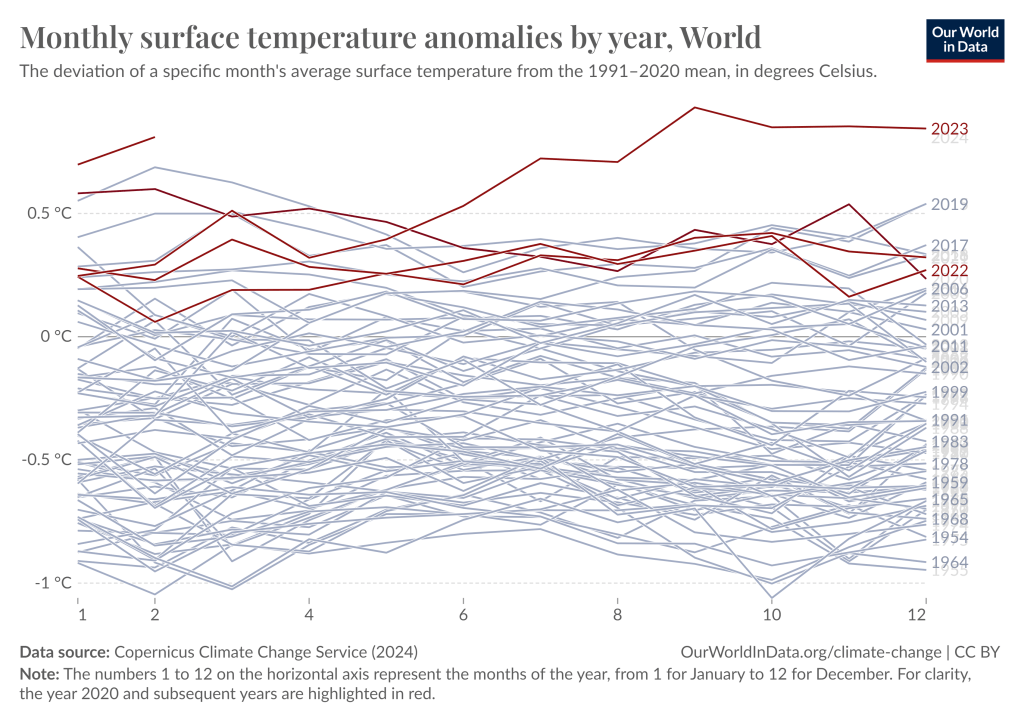
Monthly surface temperature anomalies by year, World (Source: Our World In Data)
Holy Christ that is a worrying graphic. In 2023, global temperatures were off the scale, and 2024 has started the same way. We still have time to act to avoid the very worst, but I have a feeling that this is our warning shot.
📚 Random Things
These links are meant to make you think about the things that affect our world in transport, and not just think about transport itself. I hope that you enjoy them.
- Preparing Land, Labor, and Capital For Mars (EconLife)
- AI and climate: Tackling challenges and embracing change with a people-centered approach (Development and a Changing Climate)
- Three threats to the age of energy abundance (Noahpinion)
- Quiet Disruption When The Attack on Equity is Loud (The Equity Brief)
- The Mirai Confessions: Three Young Hackers Who Built a Web-Killing Monster Finally Tell Their Story (Wired)
📰 The bottom of the news
People in Cambodia have been dancing along to the musical horns of passing trucks, who decided that the shrill blasts weren’t exactly their thing. But that is all due to stop due to Hun Manet, the Prime Minister, decreeing that this must stop. I can’t help but think he is being a bit of a spoil sport with this.
👍 Your feedback is essential
I want to make the newsletter better. To do this, I need your feedback. Just fill in the 3 question survey form by clicking on the below button to provide me with quick feedback, that I can put into action. Thank you so much.

 Mobility Matters