
Good day my good friend.
As I mentioned earlier this week, due to family commitments I will not be publishing newsletters next week. In the meantime, I have written this one on a matter that has been close to my heart for a while, and is something that we often overlook. I hope that you enjoy it, and that you have a peaceful week.
(Also, the title of this newsletter makes me instantly think of one of my favourite tracks from the 1960s 😃).
If you like this newsletter, please share it with someone else who you think will love it. The main way my audience grows is through your recommendations. I will love you forever if you do. 😍
🐰 Creature Comforts
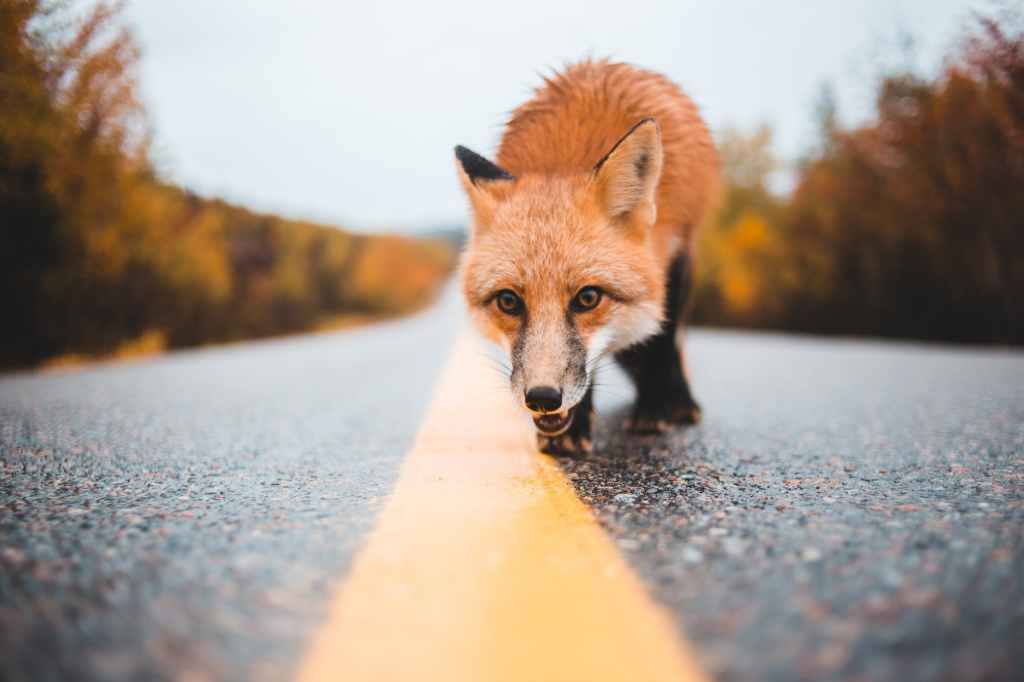
Here in the UK, National Highways have recently started an advertising campaign that tries to stop a behaviour inherent in all Brits (littering) by pulling at probably the one thing that continues to unite us all. Our desire to protect furry little animals. Their Lend a Paw campaign highlights the fact that litter attracts animals to the roadside, which then results in 3 million of them getting squished on British roads every year.
I do admire this initiative. As a massive animal lover myself, anything that can be done to stop hedgehogs, rabbits, foxes, badgers, deer, squirrels, as well as the countless millions of equally important smaller creatures like insects from getting harmed is great with me. There is some limited evidence from South Africa that shows that some behaviour change interventions can reduce the number of animals being killed on the roads. Though, as highlighted in Ben Goldfarb’s excellent book on road ecology, we know far more about the behaviour changes of animals in response to the presence of road vehicles, compared to our changes in driving behaviour in the presence of animals.
Here is hoping that this campaign does result in a corresponding drop in the number of animals killed on the UK strategic road network, though I am not hopeful that it will shift the needle that much. But this leads me to a somewhat philosophical question about how we manage our transport networks in the presence of nature. And how we account for the natural world in planning for the future of transport.
If we take the assumption that nature-based solutions are part of our future plans when it comes to tackling the climate emergency, and we accept that being in the presence of nature is good for people’s well-being, how do we square this with the fact that our road environments are actively hostile to the presence of nature? We build huge, flat, desolate infrastructure filled with apex predators (cars) that appear without notice at high speeds and seemingly without care for any animals in their path.
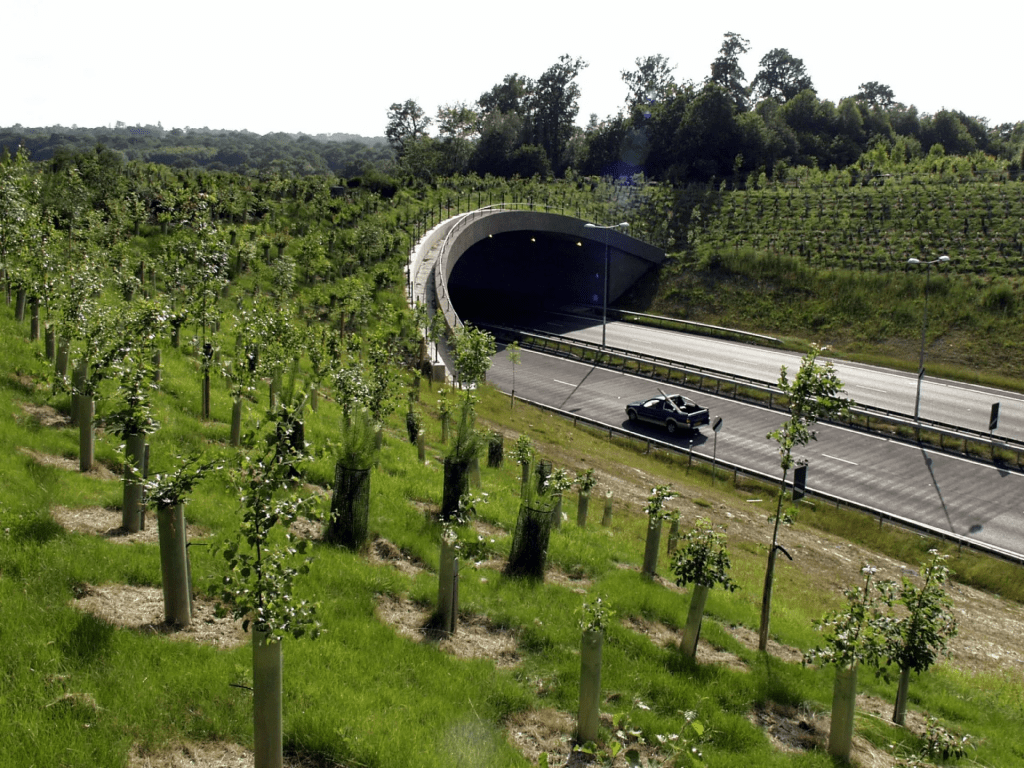
There are small things that we can do already, which we know work in terms of reducing the number of animals killed and provide safe refuge for wildlife. Wildlife crossings have been known about for years but are vanishingly rare in many parts of the world. Providing refuges away from the highway through places like balancing ponds is also well established, if only as flood prevention measures. Even then, the carnage on our roads in terms of the number of animals killed continues unabated.
Maybe, it is time to explore something more radical. And some places are doing just that. As transport planners we often consider the scheme benefits in terms of economics. Some work has been done to quantify the impact of road traffic collisions involving animals in the same way. Plug an initiative to reduce such collisions into a cost-benefit analysis and suddenly a lot of animals get saved because one fewer human loses their life.
An example is a research exercise in Sweden on scenarios for reducing collisions between moose (an especially large animal that has a habit of doing significant damage to any vehicle that hits it) and cars. It was estimated that initiatives like fences and crossings would result in a net economic benefit of 124,000 EUR per annum. So doing things to reduce animal collisions has a net economic benefit to Sweden.
Some places are going even further by giving up their road networks to nature altogether. The National Parks Service in the USA, for example, offers giving up a road altogether whenever it is too uneconomical to repair and is lightly used. So much so that its highway network has actually shrunk over the years. Giving natural areas back to nature may sound heretical. But when maintenance budgets are shrinking and maintenance backlogs are getting ever bigger, maybe this makes a lot of financial sense to do.
Thinking about how we better manage the relationship between nature and our transport infrastructure is only something that is really starting to be taken seriously, and even then its only because it is a threat to the operation of such infrastructure. But it represents an interesting and potentially exciting area of work. Maybe, in 10 years time, we won’t just be managing our infrastructure to the benefit of one species on this planet, but to all of them.
What you can do: The biggest barrier to tackling animal collisions is the lack of robust data on said collisions. So you need to collect it, and one way to do so is to get volunteers to literally count the amount of roadkill on certain roads over a certain period of time. Its crude, but its data. A lot of people love animals and want to see them free from harm, so I am very sure that you can get plenty of volunteers to do just this!
👩🎓 From academia
The clever clogs at our universities have published the following excellent research. Where you are unable to access the research, email the author – they may give you a copy of the research paper for free.
An assessment of sustainable transport infrastructure in a national healthcare system
TL:DR – Hospitals are generally well served by public transport. We just need to get more people on it.
TL:DR – We shouldn’t build metros. Invest in walking and cycling instead.
Changes in motor traffic in London’s Low Traffic Neighbourhoods and boundary roads
TL:DR – LTNs reduces traffic levels within them, but don’t change traffic levels on boundary roads much. Or “Woke WEF Globalists Force Climate Lockdowns On Innocent Londoners – Damning Evidence” if you think that way.
TL:DR – A new equity framework is developed for China
✊ Awesome people doing awesome things
Community bike initiatives are doing amazing work not only to get more people on bicycles, but also to reduce the amount of metal and plastic heading to landfill sites across the world. One such example is the Yate Community Bike Hub in Bristol, that recently recycled its 1000th bike. It has also helped refugees, including from Ukraine, to get mobile by providing them with free bicycles to use. Not bad work at all!
📷 Out and About

I was in that-there London again recently, and took a walk through St John’s Wood. Where I stumbled upon probably the most famous pedestrian crossing in the world.
📺 On the (You)Tube
RM Transit has produced an excellent deep-dive into the missing links in the transit system of Toronto. A very interesting watch, even if you are not a local.
📻 On the Wireless
The always-excellent Well There’s Your Problem podcast, along with the similarly-excellent Gareth Dennis, gloat for some considerable time about the apparent death of Hyperloop. Its very entertaining.
📚 Random Things
These links are meant to make you think about the things that affect our world in transport, and not just think about transport itself. I hope that you enjoy them.
- ‘A historic step’: G20 discusses plans for global minimum tax on billionaires (The Guardian)
- Antarctica: Are we awakening a sleeping giant? (Big Think)
- Self-pay gas station pumps break across NZ as software can’t handle Leap Day (Ars Technica)
- Humanoid robots draw millions from Bezos, OpenAI and more (Axios)
- The Rise of Batteries in Six Charts and Not Too Many Numbers (The Climate Brink)
📰 The bottom of the news
This isn’t strange news, but it is a victory for heritage and a bit of common sense to boot. The Crooked House pub in Himley was bulldozed some time ago by some characters who, as we would call it in England, tried to pull a fast one. But now they have been ordered to rebuild the wonky pub brick-by-brick. I will drink to that.
👍 Your feedback is essential
I want to make this newsletter better. To do this, I need your feedback. Just fill in the 3 question survey form by clicking on the below button to provide me with quick feedback, that I can put into action. Thank you so much.
 Mobility Matters