
Good day my good friend.
At the weekend, I committed somewhat of a sin that I feel I must repent for. I drove into Central London. My reasons for this are simple. It was my wife’s birthday. I wanted to treat her to some shopping, and she gets very travel sick on trains. Regardless, this is unforgivable, and I repent my sins.
I trust that you all can forgive me?
If you like this newsletter, please share it with someone else who you think will love it. The main way my audience grows is through your recommendations. I will love you forever if you do. 😍
🏖 The Coastal Problem
Let me start this by asking you a couple of questions. I just want you to think of the answer – the first one that instinctively comes to your head. Right? Got it? Ok then.
What is the type of area that comes to mind when you think of deprived areas?
And what is the type of area that you think of when you think of areas with poor accessibility?
You got an idea in your head of those types of areas? Got it? Right, now answer me this: what is the type of area that you think of when you think of areas that are both deprived and socially excluded?
That is a harder question to answer, isn’t it? If you are anything like me, the instinctive answer to the first question is deprived areas in cities, and the instinctive answer to the second is many rural areas. But the third question is more challenging to answer.
That has not stopped Transport for the North trying, as they have sought to map transport-related social exclusion across England, and specifically the proportion of people at risk of it. And their work has come to an interesting conclusion.
The areas most at risk of transport-related social exclusion are England’s coastal towns. Areas such as East Lindsey and Boston in Lincolnshire, Kings Lynn and Great Yarmouth in Norfolk, Tendring in Essex, Swale and Thanet in Kent, Hastings in East Sussex, Gosport in Hampshire, and Redcar and Cleveland in North Yorkshire all show over 50% of their population being at risk of transport-related social exclusion.
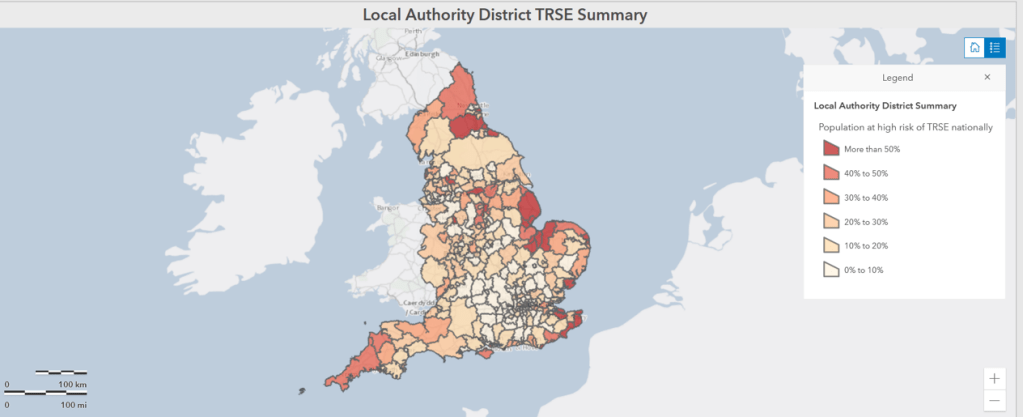
Source: Transport for the North
The way that Transport for the North calculated this is relatively simple: take the Indicies of Multiple Deprivation, and the Department for Transport’s Journey Time Statistics, combine them, and devise a metric.
A lot of the results appear to make sense. The relatively affluent and connected Home Counties around London score well, for instance. There are a lot of places in the North that perform relatively poorly, but the sheer scale of the issue in our coastal areas is quite something.
The excellent research and report by Transport for the North offers no direct observation on this. But as someone who lived and grew up close to coastal communities in Devon, I offer three observations.
The first is relatively poor strategic connectivity to coastal communities. With the notable exception of a few coastal communities (I’m looking at you, Brighton and Southend), many of these coastal towns are poorly connected by strategic public transport. To give a few examples:
- Skegness in Lincolnshire is served by the Poacher Line, which has an hourly service that takes an hour and a half to travel the 50 miles from the nearest mainline connection at Grantham;
- Margate is served by Southeastern High Speed services, but even then it is fully two hours from London, and an hour from Ashford;
- Kings Lynn in Norfolk is an hour from the nearest major population centre by train (Cambridge). And even when you get to Kings Lynn, you have to take a connecting bus to get to the nearest coastal resort of Hunstanton
A second potential explanation is the often strange nature of the local bus networks. Like most local bus networks, they are heavily concentrated on providing in-and-out direct travel into town centres (many of which are not close to the coast, by the way). In the larger towns and cities on the coast, this can result in a dense public transport network across the whole urban area. A good example of this being the bus network across Brighton.
But two other types of bus routes operate in typically smaller coastal communities. The first is the “coastal hopper” running along the coast between small towns and villages, like the imaginatively named Coasthopper in Norfolk. Then there is the straight in-and-out interurban buses that act both as the main local bus service, and providing direct connections to nearby towns. Like the Coastlink services between Norwich and the coast at Great Yarmouth and Lowestoft. The combination of these results in either transport accessibility be constrained to a specific corridor, or constrained by irregular services.
The final thing is the nature of trade in coastal communities – it is highly seasonal. Coastal communities reliant on tourism really only have from the Easter Holidays until September to make money for the entire year. This means that work is seasonal and low paying, and many shops and attractions are only open at certain times of year. They are low wage communities that have full employment and go completely nuts for about 5 months, before collapsing to almost nothing for the rest of the year.
This is a very unique transport problem, and one that is hard to solve. Providing a year-round service for inaccessible places on low incomes, whilst also being able to deal with insane levels of demand for a few months. These are places that have problems both with low demand and high demand. Its hard to make the case to improve transport connections to a coastal community due to low demand in most communities, yet everything gets clogged up for a few months.
I try and end such newsletters with suggestions of solutions. But honestly, here I am struggling. We must do what we can to help such communities, and provide them with the services that they need. But sometimes, places are victims of simple geography, and there is nothing you can do it about it.
What you can do: One thing you can do is check out Transport for the North’s Transport Related Social Exclusion Tool. It is a really good tool, and the report is brilliant too.
👩🎓 From academia
The clever clogs at our universities have published the following excellent research. Where you are unable to access the research, email the author – they may give you a copy of the research paper for free.
Banning short-haul flights and investing in high-speed railways for a sustainable future?
TL:DR – Investing in high speed rail is good.
Exploring the Factors Influencing Electric Bicycle Adoption: A Survey Among Future Adopters in India
TL:DR – Electric bike adopters value saving money, last mile connectivity, and reduced congestion.
Morphology changes and the expansion of major port cities in the Philippines from 1990 to 2020
TL:DR – Port cities expanded a lot.
Toward a smaller world. The distance puzzle and international border for tourism
TL:DR – Tough border controls affect levels of tourism.
✊ Awesome people doing awesome things
Getting even the simplest stuff built takes a long time, and campaigning requires a lot of persistence. That did not put off Hazel Foster from Torquay, who campaigned for two years to get funding for a new pedestrian crossing outside a school in Torquay. And finally won. The new crossing will be going in shortly, to make the walk to school safer for kids.
📷 Out and About
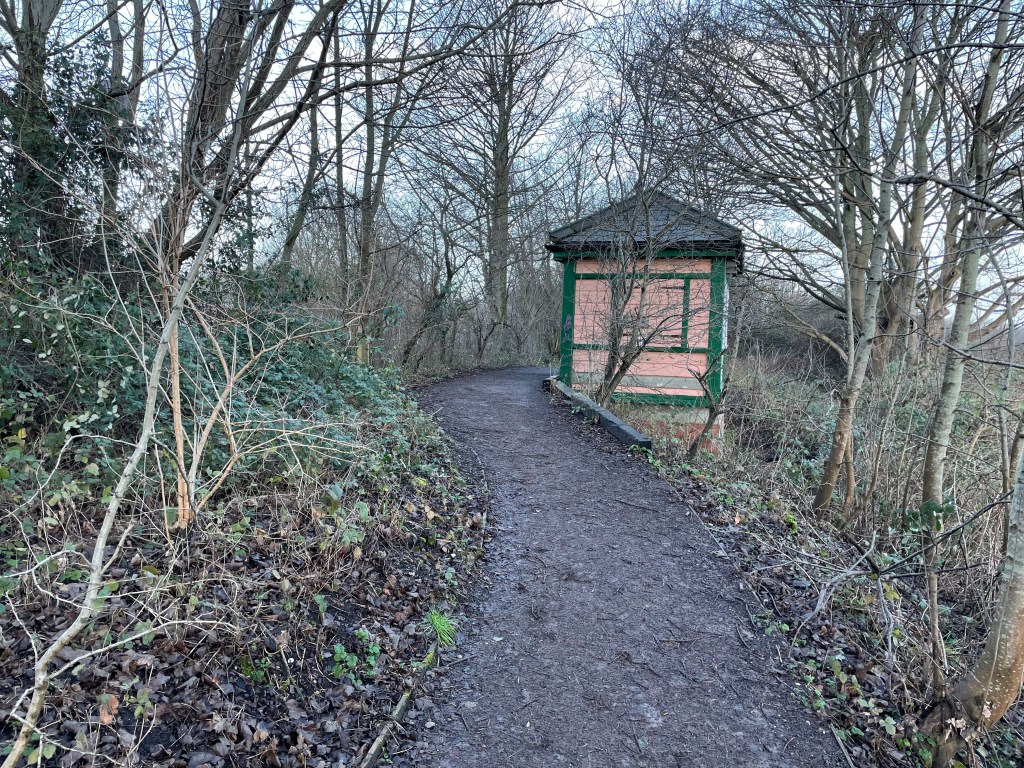
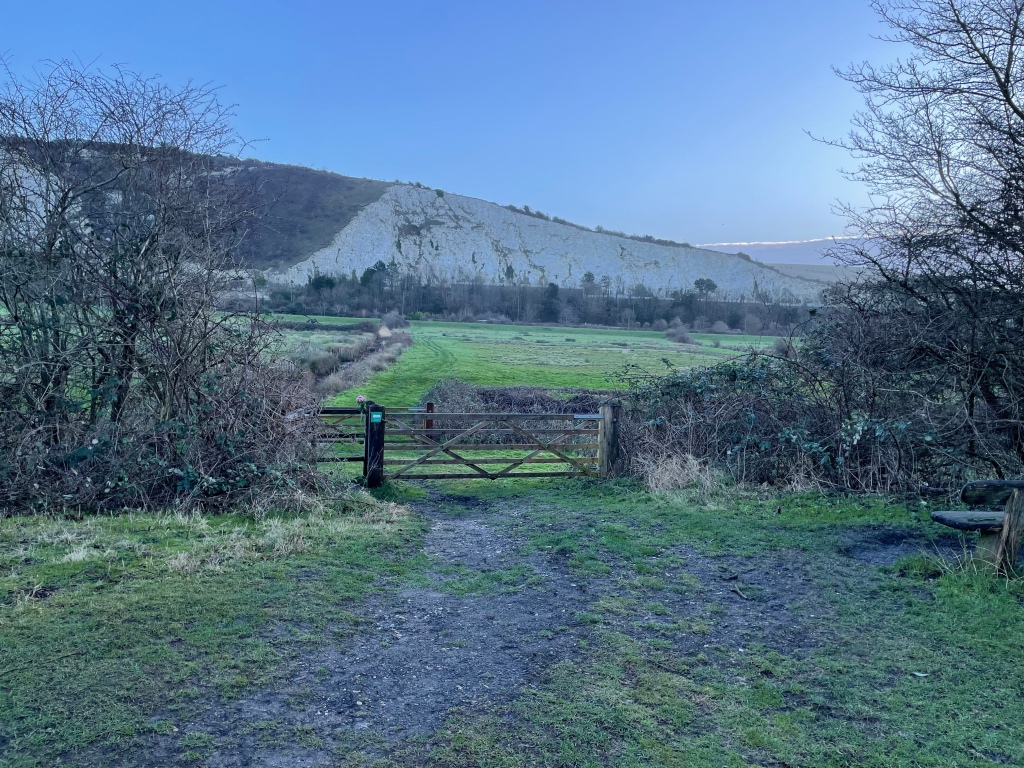


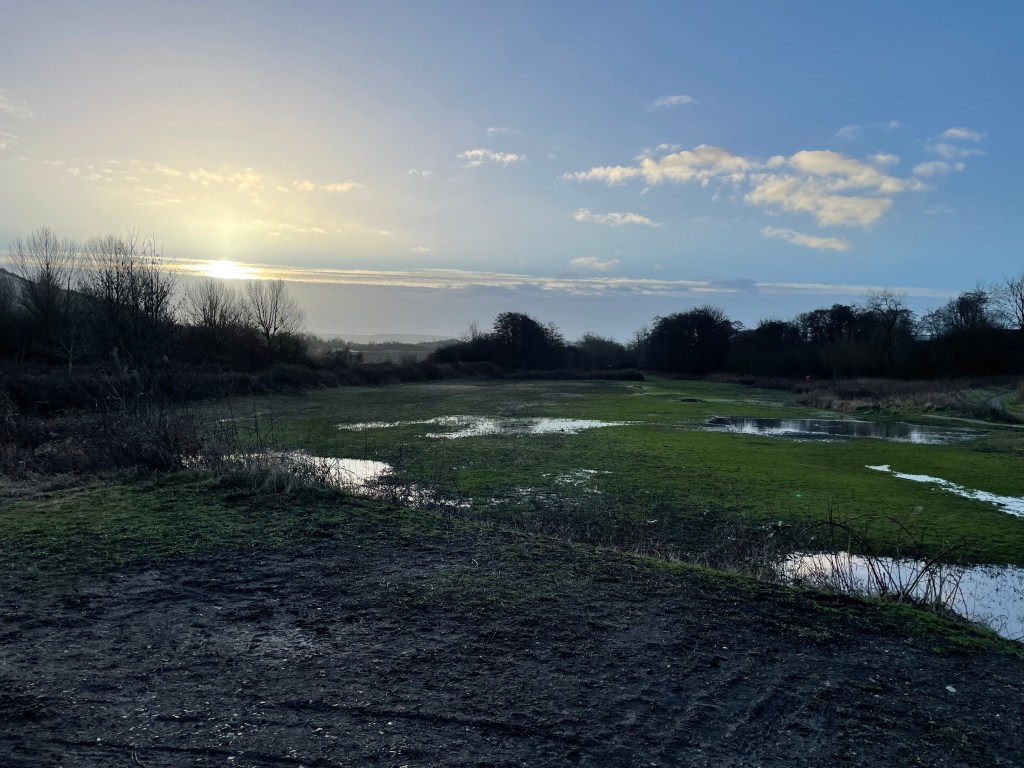

I have made it a bit of a mission this year to start going out for more walks for purely the joy of walking. And before a day working, I walked around The Railway Land in Lewes, East Sussex. A lovely chalk grassland just a short walk from Lewes Station. And it was rather nice, I have to say.
📺 On the (You)Tube
I know this from personal experience – electric vehicles struggle in the cold. But this does not mean that they are not useful. It simply means you have to adapt your driving behaviour.
🖼 Graphic Design

Source: Visual Capitalist.
This is a very useful pie chart if you have no idea how haulage companies make money. In short: charge per mile, make sure that charge covers your costs.
📚 Random things
These links are meant to make you think about the things that affect our world in transport, and not just think about transport itself. I hope that you enjoy them.
- A massive win, and what it means (The Crucial Years)
- The new climate denial: climate economics (The Climate Brink)
- A Titanic Geopolitical Struggle Is Underway (The New York Times)
- Noe Valley’s Controversial ‘$1.7 Million Toilet’ Back In the News, Mostly Because It’s Still Not Built (SFist)
- Understanding the illiberal challenge in Europe (The Loop)
📰 The bottom of the news
The Community Rail Awards is always a brilliant celebration of all that is great and good about British railways. And their annual picture competition is always a treat. You can check out the entrants and vote on them! Out of loyalty anything on the Marston Vale Line gets my vote, but a special mention goes to “No, This Isn’t The 8.20 From Manchester Piccadilly.”
👍 Your feedback is essential
I want to make the calls to actions better. To do this, I need your feedback. Just fill in the 3 question survey form by clicking on the below button to provide me with quick feedback, that I can put into action. Thank you so much.


 Mobility Matters
One response to “🌊 Beach Boys”
Hello James
I wanted to say thank you – in general, for your informative and interesting newsletter – and in particular for your reference to the Railway Land.
I live locally, in Hove, but have never heard of this place. I’ve signed up for their newsletter and will definitely be making a visit and telling my family and friends about it too.
Best wishes
Sharon
LikeLike