
Good day my good friend.
Writing this newsletter is a pleasure. But just occasionally, the backdrop makes it just that bit more so. I am currently writing this on a train speeding south along the East Coast Mainline in Northumberland. One of the great coastal railway journeys. I mean, its no Dawlish Sea Wall, but looking at across the North Sea while thinking about your next paragraph is pretty special. You don’t get this driving a car or flying at 35,000 feet.
If the recent announcement by the Prime Minister still has you hot under the collar, we are talking ‘changing the narrative’ on sustainable transport at Mobility Camp on 26th September 2023 in Birmingham. It would be great to see you there. Get your tickets now.
If you like this newsletter, please share it with someone else who you think will love it. I will love you forever if you do. ☺️
James
🚊 Light rail is back
Trams and similar forms of light rail seem to be a favourite solution of a variety of urbanists. And it was the subject of a Financial Times article recently that got a fair amount of air time. And even more recently, the Department for Transport published statistics on how well demand on the light rail systems of England is recovering since COVID-19. The conclusion? Getting there.
The all-important passenger numbers are not back to their pre-COVID highs, but at least they are going in the right direction. Which system is leading the pack in terms of demand? If you are thinking the Manchester Metrolink then you are wrong, as it is (and always has been) the Docklands Light Railway.
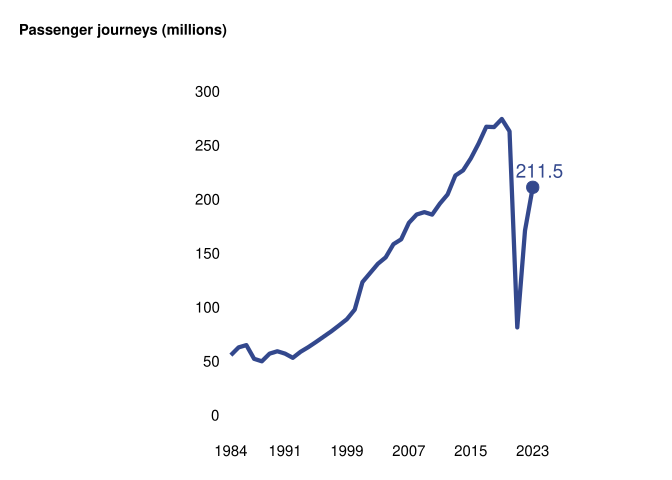
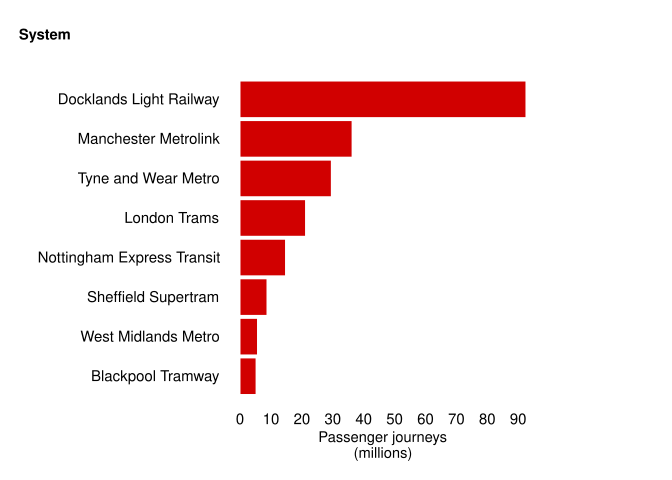
An interesting finding is how passenger numbers have increased, while the total number of vehicle miles – translation: how many vehicles were run – went down. Very slightly anyway, by about 2% compared to 2022, which the Department for Transport doesn’t really comment on, but some commentary later in the document provides some potential insight.
Unlike commercial revenue, which decreased significantly during the pandemic, most local authorities chose to maintain concessionary reimbursement at pre-pandemic levels in the year ending March 2021, with several maintaining these into the year ending March 2022. These payments, in conjunction with funding support from [the Department for Transport], worked together to help ensure the continued operation of light rail services across the country.
Several local authorities changed their concessionary funding back to normal (pre-pandemic) arrangements in the year ending March 2023, so that it was based on concessionary passenger numbers. This is likely to explain the fall in concessionary revenue for some systems, as concessionary passenger numbers are still below pre-pandemic levels.
Translation: many local authorities have had to start ploughing more money into revenue support for services now that Department for Transport grants have ended, and passengers numbers are not quite back to normal. And with local government finance being, how to say, perilous, many are starting to cut services slightly until the revenue gap is a more bearable one.
A question that often comes at this stage is the ‘what does this mean for new systems being planned?’ question. To be honest, it doesn’t really change much. Light rail is high capital cost, reasonably high operational cost, and so needs a lot of passenger to justify being built. Not helped by a huge optimism bias. The delivery of schemes is as much of a statement of what you want your place to be as opposed to it being the most value for money solution (that would be buses most of the time). And you know what? That is just fine.
What you can do: I have said it before, but the Midlands Metro Alliance website is a perfect compendium on how to make the business case for a light rail scheme very well indeed. In contrast, the Edinburgh Tram Inquiry website is a perfect compendium on how not to build a light rail project. And in line with the scheme it studied, its running late. Read both websites, and learn from them.
🏴 Thank you, Edinburgh
Today, I managed to spend a lovely day in Edinburgh. With some time to spare in the morning, I managed to get to explore the transport delights of the city. I know people say that using a city’s public transport network is the best way to get to know the city. I say rubbish, its using your own steam that gets you to experience the city.
A special thanks goes to the Transport Planning Society Board for a highly productive discussion on the future of the society (among other things), and to good friend Daisy Narayanan for a great but all-too-brief chat on the role of climate finance and new climate skills in getting transport planning ready for the future.
A side note – one of the benefits of using your own steam is the ability to be able to enjoy natures bounty, as I did climbing Arthur’s Seat. Though I highly recommend reading this before simply going out and picking blackberries off the bushes.
🎓 From academia
The clever clogs at our universities have published the following excellent research. Where you are unable to access the research, email the author – they may give you a copy of the research paper for free.
TL:DR – Da kidz think cycling is well sick. Or something (come on, the last time I was cool was around 1998).
Accessibility-based ethics-aware transit design
TL:DR – Different approaches to accessibility ethics could yield different transport results.
Trends in electric vehicles research
TL:DR – Researchers are starting to care more about the routing problem.
Feasibility of the Northern Sea route with the effect of emission control measures
TL:DR – Researchers seem to forget that Russia exists.
✊ Awesome people doing awesome things
You like the idea of School Streets and Play Streets? Thank Alice Ferguson and Amy Rose for that. In 2009, they and other parents shut their road in Bristol to traffic to allow children to play. Their final report makes for interesting reading, and it started a movement.
By the end of 2022, over 1500 streets across the UK are playing outside regularly, with streets given over to children just for the joy of it. How is that for an impact?
📼 On the (You)Tube
This Geoff Marshall video is a great addition to his ‘least used station’ series. And the station is on the Tarka Line, my local line when I was growing up. I am using this as a bit of a plug for station adoption more generally, which is a brilliant way of making stations that don’t get love from passengers that much more welcoming.
What you can do: The Community Rail Network’s Station Adoption Guide is a must read. If you are planning new stations, mobility hubs, and other similar public transport improvements, work with the local community to see if these ideas are possible.
🖼️ Graphic Design
![r/dataisbeautiful - [OC] Largest ageing population](https://mobilitymatters.io/wp-content/uploads/2023/12/2c0f9-93025474-f2f0-489f-bb49-fc7f2efcfa3c_960x960.png)
We often talk of planning for future generations. Yet we rarely plan for the future of existing generations. And the world’s population is getting much, much older and quickly. Time we started delivering age-friendly cities, I think.
📚 Random things
These links are meant to make you think about the things that affect our world in transport, and not just think about transport itself. I hope that you enjoy them.
What’s wrong with British capitalism and how to fix it (London School of Economics)
Think Globally, Act Globally: Opportunities to Mitigate Greenhouse Gas Emissions in Low- and Middle-Income Countries (Journal of Economic Perspectives)
Reducing single-use cutlery with green nudges: Evidence from China’s food-delivery industry (Science)
Rural Communities Explore New Alternatives to Closing Local Newspapers (The Daily Yonder)
✍️ Your Feedback Is Essential
I want to make the calls to actions better. To do this, I need your feedback. Just fill in the 3 question survey form by clicking on the below button to provide me with quick feedback, that I can put into action. Thank you so much.
 Mobility Matters