

Good day my good friend.
I am very much feeling this Daily Mash article right now. But regardless of what happens, the Lionesses have done us proud. And being a proud red, I eagerley await Mary Earps, Ella Toone, and Alessia Russo tearing it up against Spain on Sunday.
If the recent announcement by the Prime Minister still has you hot under the collar, we are talking ‘changing the narrative’ on sustainable transport at Mobility Camp on 26th September 2023 in Birmingham. It would be great to see you there. Get your tickets now.
If you like this newsletter, please share it with someone else who you think will love it. I will love you forever if you do. ☺️
James
⚠️ Urgent – Get Oxford Street Pedestrianised
The City of Westminster is consulting on the future of the bus garage, traffic sewer, and occasional shopping area Oxford Street in Central London. Or more specifically 5 separate projects that together could change Oxford Street for the better:
Improvements to Oxford Street itself
Improvements around Oxford Circus
Marylebone / Fitzrovia Traffic Scheme
Traffic changes off Oxford Street West
Eastcastle Street and junction improvements
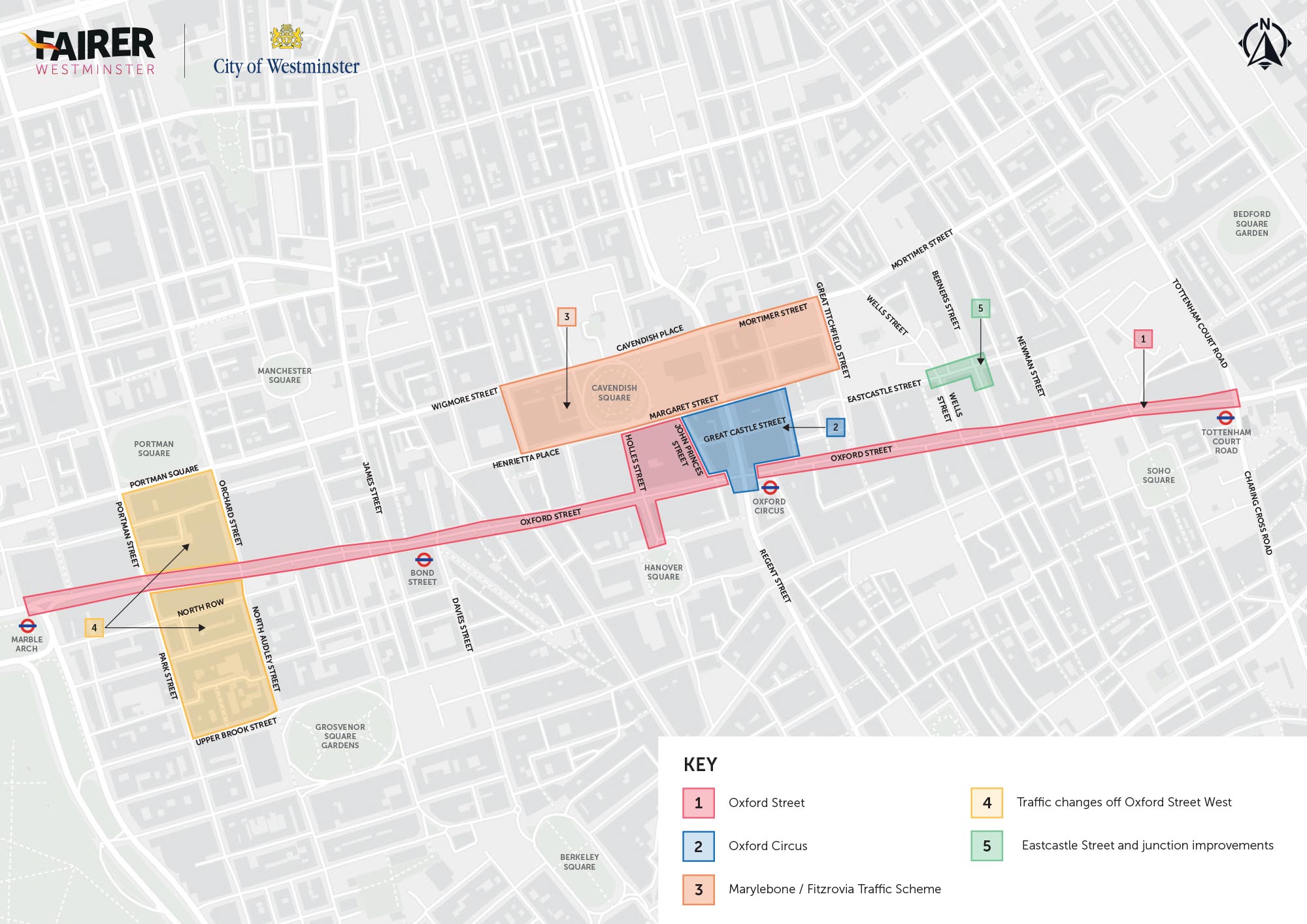
This is a real opportunity to make a significant change to a part of London where traffic still dominates what could be an amazing public space. So respond to the consultation. We know that there will be many lobbying to keep it as it is, or make it more car-dominated. So fight for it!
What you can do: Fill in the survey to start with. And get others to do so as well. Send it to 5 friends or family members, and ask them to complete it. If you are based in London, discuss with your work colleagues and friends how important this scheme is, and encourage people to respond.
Respond how you wish, but when making your response I highly recommend the following, based on years of receiving such comments:
🚘 The Cycle of Car Ownership
Something that I have seen too many times to mention is how evidence is used to refute personal experience on matters that are truly personal. A good example is this – when someone says how they “need their car to go to work” or something similar. Then well-meaning but naive people come along and say “AcKhTuAlLy ThE dAtA sEz U r JuSt 15 MiNuTeS jOuRnEy TiMe FrOm An EmPlOyMeNt SiTe.” And very occasionally it helps, but more often than not it is ignored.
We know that ownership and use of a car aligns well with lifecycle events. But an aspect of car ownership not often discussed is how owning a car locks you into car ownership. This can happen at any point in your life, though locking you in at an early stage means locking you in for much longer. Which means more miles driven, more carbon emitted and…you get the picture.
There is actually relatively little in the way of evidence as to why travel patterns change as a result of car ownership, especially as it impacts people’s individual travel patterns over the longer term. All we know is that travel patterns do change in response to life events. But what we should be interested in understanding is how the act of car ownership sets us on a path towards its continued use.
For this purpose, I propose a simple framework – the cycle of car ownership. Part of its intention, and I should stress this is based mostly on experience and talking to others as opposed to hard scientific data validating the entire thing, is to help identify the potential interventions to help break the cycle (sell the car).
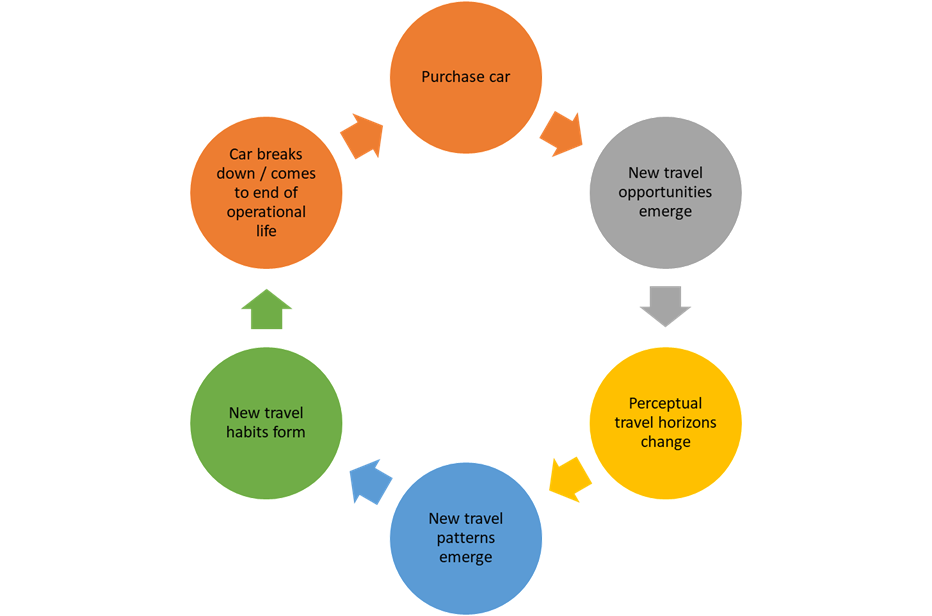
There are 6 component parts:
Purchase the car. Self-explanatory.
New travel opportunities emerge. Because those who buy cars are not confined to public transport routes and the timetable, they realise the extent of the opportunities to travel change,
Perceptual travel horizons change. As car owners explore the opportunities, their expectations and minimum standards of what can be done over and above public and active travel changes.
New travel patterns emerge. As car owners find new trip opportunities, new favourite regular and non-regular trips become a reality. And so new travel patterns start to emerge.
New travel habits form. New travel patterns start to become more regular, and a new habit is formed as a result.
Car breaks down / comes to end of operational life. Through use, vehicles break down or start to come to the end of their life. There is a choice – repair, replace, or even give up car ownership.
Lets take this for a quick spin, shall we? Lets say we want to deliver a series of Low Traffic Neighbourhoods. That changes the perceptual travel horizons, even if slightly. They get frustrated at the result of this change in minimum standard. But as a result new travel patterns emerge – they could re-route for example. But also, they could also break the cycle completely, removing themselves from it.
The name of the game here is to get people to break out of this cycle. We often talk about getting people to defer car ownership – especially the young. But with the majority of households owning cars, achieving a low carbon future means less cars being owned. No one intervention will break this cycle completely. But we can disrupt it for people. To the point where they break the cycle of their own volition.
What you can do: Plot this cycle in your next team meeting, or in conversation with fellow advocates. Have a good conversation about the kinds of people you would expect to be at what points in this cycle. Talk about the kinds of interventions needed to disrupt this cycle for key groups of people in your area, and then start to work up a plan of action.
🎓 From academia
The clever clogs at our universities have published the following excellent research. Where you are unable to access the research, email the author – they may give you a copy of the research paper for free.
A stated preference approach for measuring walking accessibility
TL:DR – An attempt is made to measure walking accessibility based on the routes people state they would prefer.
Green space exposure at subway stations, transportation mode choice and travel satisfaction
TL:DR – Providing green space at subway stations is great for passengers and surrounding communities.
Assessing the economic impact of the single African air transport market: The case of Tanzania
TL:DR – Liberalised air routes lead to lower fares.
The impact of company cars on car ownership
TL:DR – Current company car taxes increase car use.
✊ Awesome people doing awesome things
Phillippa Bannister and her amazing team at Street Space do what many of us struggle to do – help people tell their stories as part of our engagement processes. Rather than asking them what they think of something, they get people to tell their side of the story. Their Her Barking Project about making it safe for women across Barking to walk around their streets is especially amazing.
Her latest post on her daughters words got me thinking. We are natural storytellers, even from a young age. We don’t just tell people what happened – we create a narrative behind it.
📼 On the (You)Tube
Being a local from the nearby town of Barnstaple, this video of waves crashing over the wall at the Cheyne Beach Car Park in Ilfracombe shows plenty of folly in the face of nature. And idiocy.
What you can do: If you live and work in a seaside, start a conversation about the location of your car parks. Could the ones on the sea front be closed and given over as a park, places for activities or fun fairs? If needs be, you could extend other car parks to make up for the lost revenue (though bike lanes and buses are better). Think of it in the context of rising sea levels as well, and use NASA’s Sea Level Projection Tool to have an honest conversation as to whether these car parks will be viable in the future.
If you want to broaden the conversation further, run a workshop based on Wicked Questions.
🖼️ Graphic Design

Beijing is home to 9 million bicycles (according to Katie Melua) and a lot of tall buildings. But what amazed me from this graphic is the lack of tall buildings right in the centre. Most are barely over a single storey in height!
📚 Random things
These links are meant to make you think about the things that affect our world in transport, and not just think about transport itself. I hope that you enjoy them.
Tesla’s ‘ultra hardcore’ work culture — as told by its employees (The Verge)
This Bold Plan to Kick the World’s Coal Habit Might Actually Work (Wired)
Democracy and the price of a vote (The Economist)
A New Climate Frontier (God’s Spies)
Falling birth rate highlights UK’s demographic challenges (Financial Times)
✍️ Your Feedback Is Essential
I want to make the calls to actions better. To do this, I need your feedback. Just fill in the 3 question survey form by clicking on the below button to provide me with quick feedback, that I can put into action. Thank you so much.

 Mobility Matters