

Good day my good friend.
I am sure that many of you have heard of the Hollywood story of Wrexham (the team behind one of the all time greatest FA Cup shocks) and their return to the English Football League. And it is great to see. But as a football fan and Bedfordshire resident, it would be remiss of me to not point out the Hollywood story of Luton Town. 10 years ago, just like Wrexham, they were in non-League football. And now they are third in the Championship, chasing promotion to the Premier League, all while spending the same amount on players salaries as the salary of a Manchester City substitute. Up the Hatters!!
If you have any suggestions for interesting news items or bits of research to include in this newsletter, you can email me.
James
The Future of Transport according to ChatGPT
I’ve got a confession to make. I had planned to write this newsletter whilst on a train home from seeing a friend. But once on board, my “15 minute snooze because I have been up since 4am” turned into “2 hour sleep and nearly missing my station.” So, I asked ChatGPT its view on the future of transport. Here is what it said. What do you think? I think that ChatGTP has a promising future as a transport consultant, personally.
The future of transport in cities is likely to be shaped by a number of technological, social, and environmental factors. One major trend is the increasing use of electric vehicles (EVs), which are becoming more affordable and accessible to the general public. As battery technology continues to improve, EVs are expected to become more efficient and reliable, making them a viable alternative to traditional petrol and diesel cars.
Another trend is the rise of shared mobility services, such as ride-sharing and car-sharing schemes. These services enable people to access transport when they need it, without the need for individual ownership of vehicles. As these services become more popular and sophisticated, they are likely to play an increasingly important role in urban transport systems.
Smart technology is also expected to play a major role in the future of transport in cities. Intelligent transportation systems (ITS) can help to reduce congestion, improve safety, and enhance the efficiency of urban transport networks. These systems can be used to monitor traffic, manage traffic flow, and provide real-time information to drivers and passengers.
Finally, sustainable transport solutions are likely to become more important in the future. As concerns over climate change and air pollution continue to grow, cities are likely to adopt more sustainable transport options, such as cycling, walking, and public transport. This could include the development of more cycle lanes, pedestrianised areas, and low-emission public transport systems, such as electric buses and trains.
Overall, the future of transport in cities is likely to be shaped by a combination of technological, social, and environmental factors. While there are likely to be challenges and obstacles to overcome, there is also the potential for significant improvements in the efficiency, sustainability, and accessibility of urban transport systems.
Transport consultants – what value do they add?
Before I start with this, I am a transport consultant myself. But this article in Slate and this on Pedestrian Observations had a stinging criticism of us consultants. One that is, I think, well-deserved. Notably, that by outsourcing expertise and experience of transport strategy and schemes, this can be a cause of cost increases, and repeated failures on behalf of consultants who learn how to deliver things in the same failed way. The report that is the basis of these conclusions can be found here, and is worth a read.
Consultants often think of value add in terms of completing the project (and to be fair, the client usually lets us think like this). But is value-add a happy client and repeated custom? For me, its not just about writing the report but about how our knowledge and skills are transferred in a way that could potentially make us obsolete. For example, if we train and co-work with a client on developing a transport strategy so that when they do it next, they don’t need us to produce a quality outcome. That’s a good outcome, right? Something for the consultants among you to consider, and to maybe be slightly humble on.
Tech for Safety
A shout out to the GET-IT LinkedIn page for sharing this story of Emma Kay, who founded a company that created an app that helps to keep women safe while walking down the street. In a perfect world – scratch that, in a somewhat reasonable and decent world – this app wouldn’t need to exist, but we don’t live in that, do we? To me, this seems like a good application of an everyday tech. But it got me to thinking – what other apps are there to improve the safety of anyone using the transport system.
In what is no doubt a reflection of my privilege of being (a) a man, (b) white, and (c) quite tall, this was somewhat more challenging than I thought. But from my crawl, here are some that you may find somewhat useful:
WalkSafe – Emma’ Kay’s app
OneScream – Contact’s your emergency contact when it detects your scream
SafeUp – A local network of female ‘guardians’ that you can contact
StreetSafe – An app by UK Police Forces that reports unsafe areas
It needs stressing that these apps are not a substitute for creating safe spaces and changing our attitude to how we treat people in public spaces. But in the spirit of providing some help, here they are.
Graph of the Week
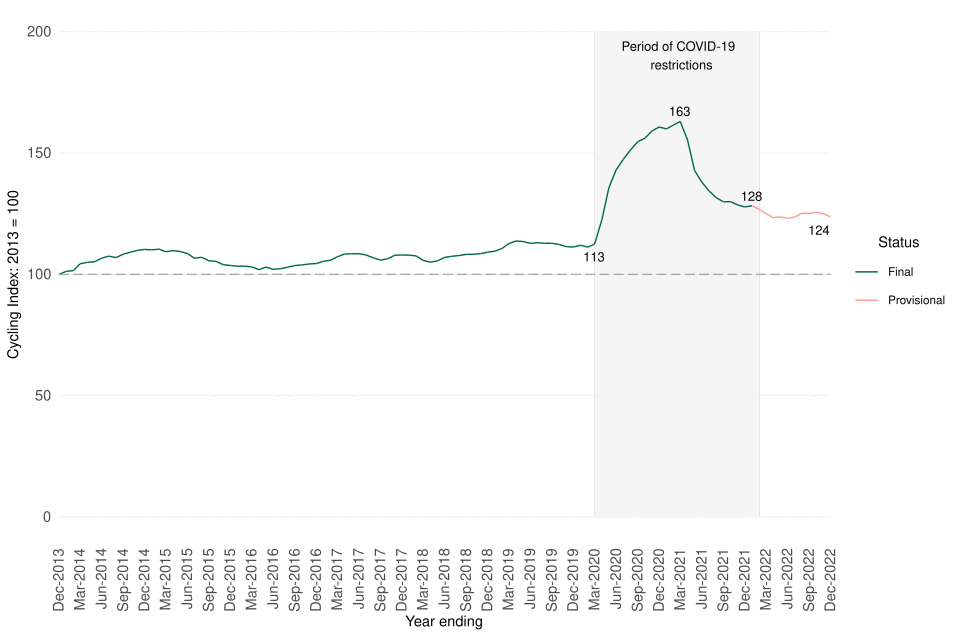
Good news. Cycling levels in England are above what they were before COVID-19. Bad news, they aren’t as high as they were during COVID-19. Lets see if we can back to it.
Random things
These links are meant to make you think about the things that affect our world in transport, and not just think about transport itself. I hope that you enjoy them.
TikTok and Critical Mass (Naked Capitalism)
Rewilding the planet (Nature)
War and subsidies have turbocharged the green transition (The Economist)
America’s Industrial Transition (Apricitas Economics)
Something interesting
This is a great video on Kai Tak airport, formerly the main airport in Hong Kong. The final approach to the airport – flying below the level of some buildings before slamming down hard on the runway and the brakes to avoid ending up in the water – was something of legend.
If you do nothing else today, then do this
The International Transport Forum have produced an excellent report on Data Architecture for Mobility as a Service. You should read it. Many of the recommendations are basic in regards to establishing data infrastructure, but its worthwhile reminding ourselves of the basics sometime.


 Mobility Matters