
Good day my good friend.
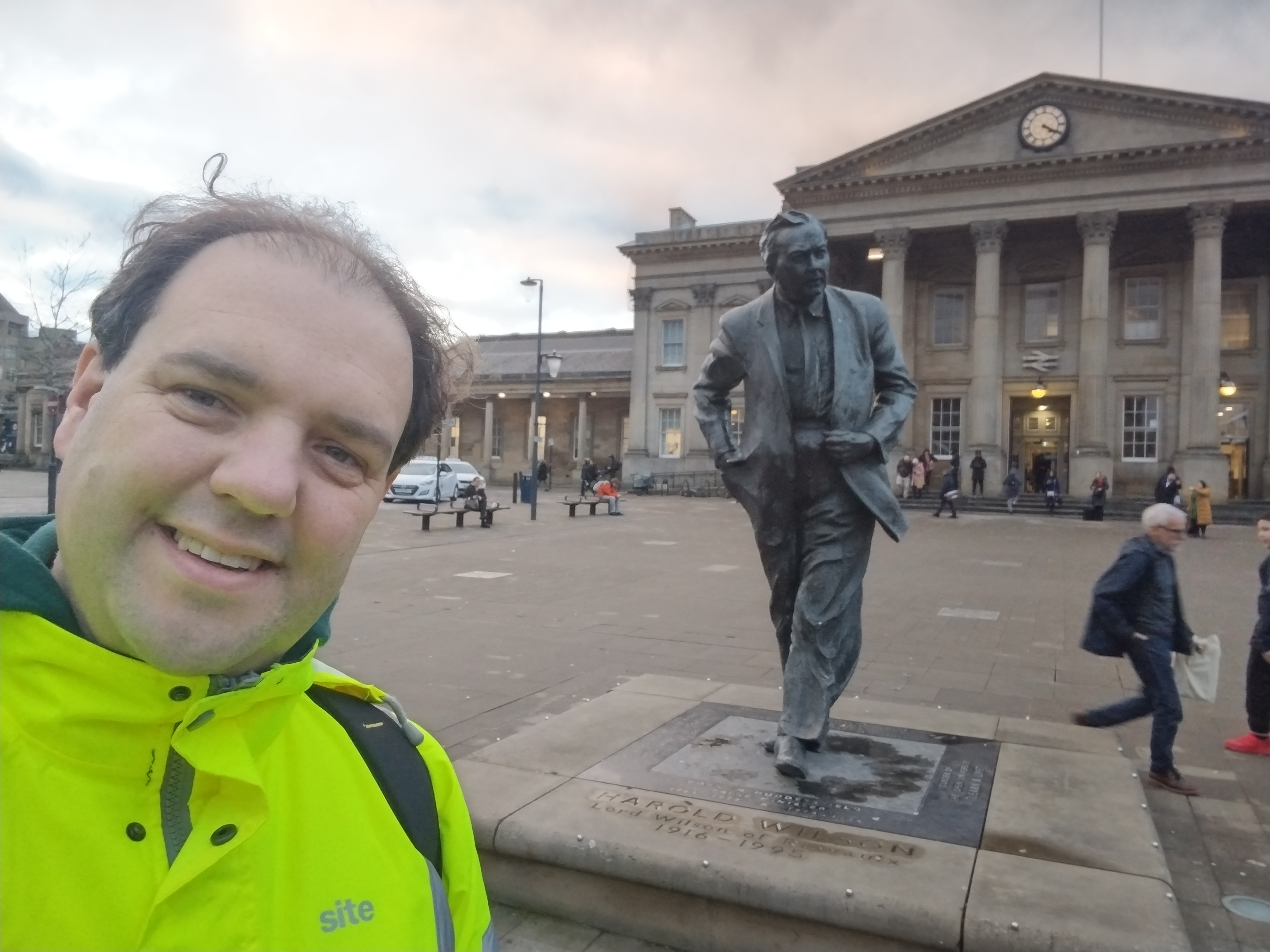
Especially good day to my good friends Rachel and Esther, who yesterday took me on an excellent ride along the Spen Valley Greenway in West Yorkshire. Its a wonderful cycle route, which is a hive of activity and community art (if you like that sort of thing) and packed with amazing examples of railway architecture (if you like that sort of thing). But the best railway architecture of the day was found just a short train ride away. As ably demonstrated by yours truly and my friend Harold.
If you have any suggestions for interesting news items or bits of research to include in this newsletter, you can email me.
James
Cars are dangerous, and their design and build needs regulating
You have probably seen the articles about this monstrosity. Words fail me. When something plays a big role in killing 1.3 million people a year, what better idea than electrifying the outside, armouring it, and fitting it with pepper spray? I know that armoured vehicles have been a thing for a while. But when you make the change from being strictly defensive to counter-attacking, and make it available to the public, it changes the game.
Vehicle design can play a huge role in reducing casualties. This has been known for over 50 years. Especially for vulnerable road users. Its a simple matter of physics. But any changes have been because of a regulatory push, not because of the actions of automotive companies (see the case of the Ford Pinto). This sort of thing needs regulation. Its that simple. I…really can’t say any more than that!

Why do people eco-drive? Its complicated
Many people don’t like to hear this, but driving will be part of our future, and eco-driving can help to reduce emissions (if only a bit). But how do you unlearn years of learned behaviour and drive in a different way. My late uncle still looked for the manual choke when starting up his car for years after automatic chokes became standard. It has been something that researchers have been exploring for years, and a new study takes that further.
It does so by exploring motivations for changing driving styles. Turns out, the environmental motivation is seen as more noble than the economic one. And if behaviour is framed in an eco-concious way, then they report more eco-driving. Which is a very good thing, and maybe it is something that we as policy makers should be doing more often.

Random things
These links are meant to make you think about the things that affect our world in transport, and not just think about transport itself. I hope that you enjoy them.
The Mystery of the World’s Oldest Billboard (Atlas Obscura)
Asia turns to tech to help watch over a growing elderly population (Context)
Extending Capital to Nature, Reducing Nature to Capital (Econospeak)
High Cost of Cheap eBikes (The Micromobility Newsletter)
Something interesting
This is a great video by LSE on the true economic effects of land use planning, and its one that is well worth a watch.
If you do nothing else today, then do this
Read this great article from Stefan Rollnick on tackling misinformation as part of consultations on schemes. Very, very useful.
What paid subscribers got extra
A bad experience of integrated bikes and trains this week made me look at how to effectively integrate the two. As always, the ideas are there, but the attitude is not.

 Mobility Matters