
This is a special version of Mobility Matters Daily shared exclusively with paid subscribers every Friday. You can also view the free version of the regular Mobility Matters Daily sent out to free subscribers.
Good day my good friend.
My UK-based readers will be well aware that a wave of strikes is currently affecting the rail network (among other public services). But it is interesting to read that Anthony Smith, the head of the public transport consumer ‘watchdog’ Transport Focus, is saying that as a way to beat the strikes then passengers should try the bike. Slightly easier to do in London compared to rural Scotland I’d wager, but its a reminder that we should encourage everyone to think, and act, multi-modally.
If you have any suggestions for interesting news items or bits of research to include in this newsletter, you can email me.
James
The results for e-scooters are in, and as expected
For the last several years, a number of public e-scooter trials have been taking place across the UK. And throughout that time, the UK Department for Transport has been collecting data on how well they are being used, their safety, and public perceptions of them. And just before Christmas, a report of the findings was published.
Its a bit hard to judge success as originally there were no objectives for the trials. We were in the ‘just do it’ phase of COVID-19 at the time, though some objectives about learning lessons were retrofitted later. So, what were the headline results? 14.5 million trips across 23,000 e—scooters. 45% of modal shift came from walking compared to 21% by car. People travelled for a mix of reasons. A casualty rate of 13 per million miles, and both users and non-users found parking to be a pain.
So, what can we learn from this? Well, not much to be entirely honest apart from the fact that in the right circumstances, e-scooters can be incredibly popular. The UK is still feeling its way through what makes an e-scooter trial work effectively, and is some way from solving the issue of parking. Whether or not there is enough evidence to show that e-scooters should be legalised is a whole other debate.
People on all sides of the e-scooter debate will take this report, and say how it shows they were right. But to me, what this shows is that if you are going to deliver an e-scooter trial in your area, you are going to have to work at it and be flexible. If you are, it could be popular. If not, you are going to have a lot of trouble ahead.
Graph of the week
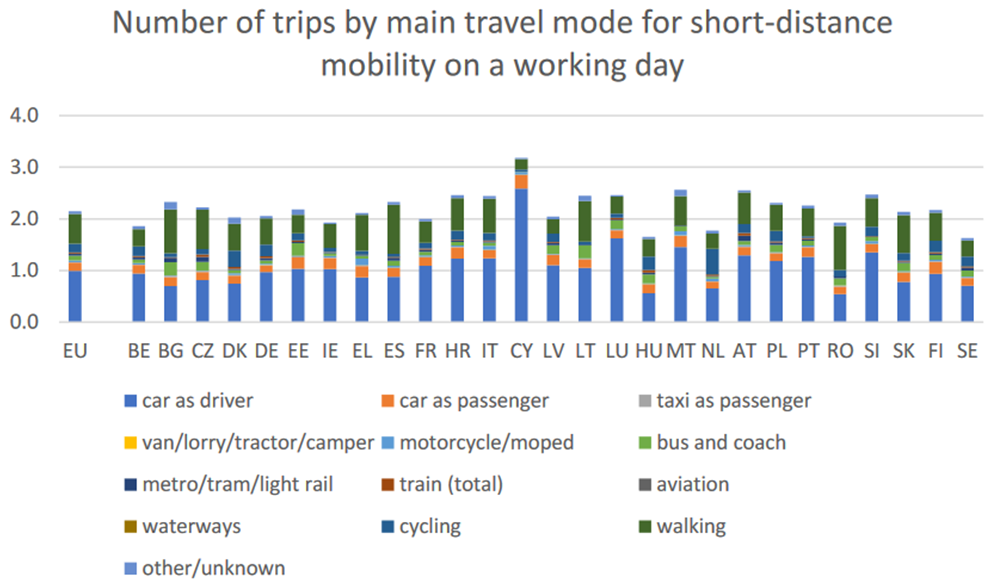
This graph, while showing interesting variations between countries in the EU on short distance trips, is one of a set of findings as part of a study by the European Commission on New Mobility Patterns post-COVID-19. Its well worth digging into the report.
Random things
These links are meant to make you think about the things that affect our world in transport, and not just think about transport itself. I hope that you enjoy them.
Why We Missed On Inflation, and Implications for Monetary Policy Going Forward (Neal Kashkari)
Why do people have to live outside? (Brutal South)
GIS Techniques Help Native Tribes Identify Land for Restoration to Its Original Custodians (Daily Yonder)
India will soon overtake China as the world’s most populous country (The Economist)
Glasgow considers legal graffiti walls amid street art renaissance (The Guardian)
Something else interesting

All of those electric vehicles and e-bikes we are building? Well, the Lithium in the batteries has to come from somewhere. And this infographic by Visual Capitalist shows that the somewhere is often Australia. Or Chile.




 Mobility Matters